
Enterprise AI conversations often start in the same place: models, algorithms, and breakthroughs. Organizations proudly showcase pilots powered by generative AI, advanced predictions, and highly skilled data science teams. Early results look impressive. Expectations rise.
Then production happens.
Or more accurately it doesn’t.
Many AI initiatives stall precisely now they are meant to scale. Not because the technology fails, but because the organization wasn’t prepared to operationalize it.
This is the paradox playing out across enterprises today: the most technically advanced AI programs often struggle the most in real-world deployment.
Innovation Without Operations Doesn’t Scale
In theory, building smarter models should lead to better outcomes. In practice, intelligence alone doesn’t create impact.
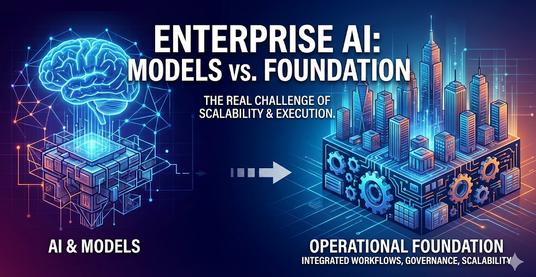
AI succeeds at enterprise scale only when it is embedded in the way work actually happens. Without that foundation, even the most advanced models become isolated experiments insightful, but disconnected from decisions, execution, and accountability.
The failure point is rarely accuracy or capability. It is timing and context.
AI is often applied before organizations have established:
- Consistent, governed workflows
- Reliable integration across systems
- Clear decision accountability
- Traceability and explainability
Without these elements, AI introduces uncertainty instead of value.
Why Successful AI Starts With Discipline, Not Demos
Organizations that move beyond pilots share a counterintuitive approach: they prioritize operational readiness before intelligence.
Instead of asking, “What can AI do?”, they ask:
- Where does work break down today?
- Which workflows are decision-heavy and time-sensitive?
- Where would intelligence meaningfully change outcomes?
They focus on building environments where AI insights naturally flow into execution not into dashboards that require humans to translate recommendations into action.
This means:
- AI insights are delivered directly within existing workflows
- Decisions are governed, traceable, and auditable
- Explainability is designed in, not retrofitted
- Change is expected, and workflows are built to evolve
This work rarely makes headlines. But it determines whether AI becomes a capability or a liability.
What AI at Scale Actually Looks Like
Across industries, organizations that have operationalized AI successfully don’t talk first about their models. They talk about their systems.
Their AI-generated insights:
- Trigger actions inside governed workflows
- Include explanations that satisfy regulators and build trust
- Respect existing controls while improving speed and accuracy
- Integrate across channels instead of fragmenting experiences
The result isn’t just faster pilots. It’s measurable impact:
- Reduced cycle times
- Improved compliance outcomes
- Lower operational costs
- Better customer experiences
Most importantly, these organizations scale from one use case to many, from experimentation to enterprise capability.
Four Questions That Expose the Real Problem
When AI initiatives stall, the root cause is often misdiagnosed. The fastest way to cut through the noise is to ask four simple questions:
- Are your workflows designed with governance, compliance, and best practices in mind?
- Are AI insights guided by those workflows or operating outside them?
- Can every AI-driven decision be explained, audited, and defended?
- Can this approach scale across multiple use cases without rework?
If the answer to any of these is “no,” the issue isn’t AI maturity. It’s operational readiness.
Why This Moment Matters
The pressure to adopt AI is only increasing. At the same time, industry analysts are signaling a correction: a significant portion of AI initiatives are expected to be abandoned over the next few years due to rising costs, unclear value, and unmanaged risk.
This creates a clear divide.
Organizations that invest now in operational foundations will compound value as AI capabilities evolve. Those that chase innovation without discipline will remain stuck in perpetual pilots investing more, delivering less, and wondering why results never materialize.
You Don’t Have to Choose Between Speed and Control
The false choice between innovation and governance has held many enterprises back. Operational discipline is what enables innovation to scale.
AI delivers value only when it:
- Integrates with how work is done
- Operates within clear guardrails
- Evolves without destabilizing operations
The most advanced AI in the world is ineffective and sometimes dangerous if it can’t be trusted, explained, or executed at scale.
The organizations that understand this aren’t slowing down innovation.
–TEAM ENIGMA
