
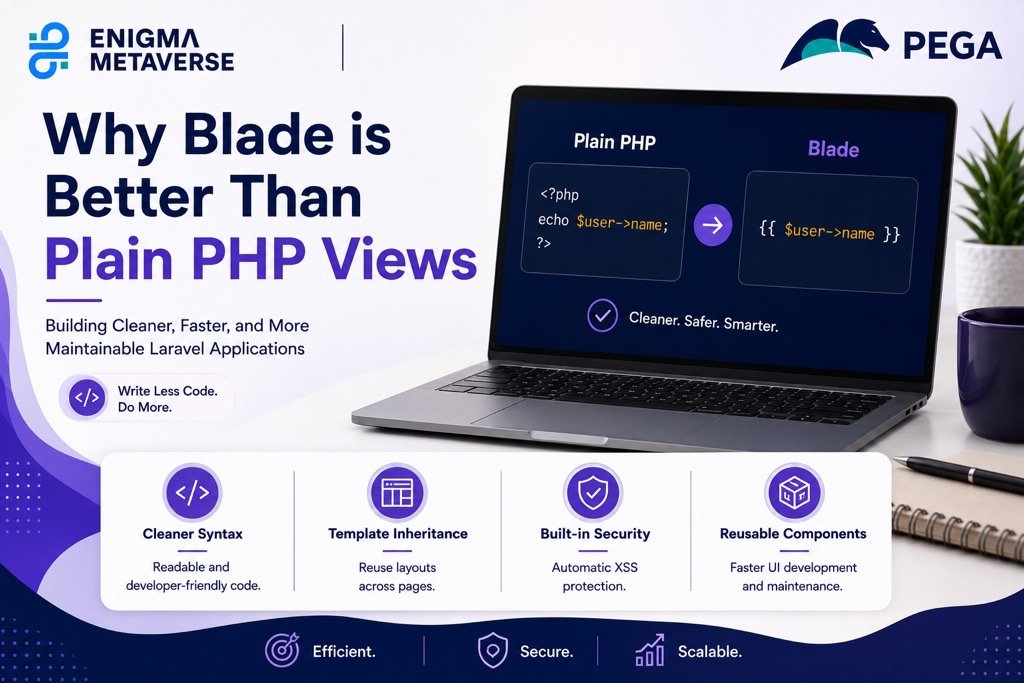
In modern web development, writing code that works is only part of the challenge. As applications grow, development teams must focus on maintainability, scalability, security, and long-term efficiency. While traditional PHP views can render dynamic content effectively, managing complex interfaces with plain PHP often becomes difficult as projects evolve.
Laravel’s Blade templating engine was designed to address these challenges by providing a clean, structured, and developer-friendly approach to building user interfaces. More than just a templating engine, Blade helps teams create applications that are easier to maintain, faster to develop, and more consistent across the entire project lifecycle.
The Challenge with Traditional PHP Views
For many developers, plain PHP views represent the foundation of dynamic web development. They offer complete flexibility and direct access to PHP logic within HTML templates. However, as applications become more sophisticated, this flexibility can introduce significant maintenance challenges.
Large-scale applications often require shared layouts, reusable UI elements, conditional rendering, and dynamic content management. In traditional PHP views, developers frequently encounter repetitive code, inconsistent structures, and difficulties in maintaining a unified design system.
Over time, these issues can lead to increased development effort, slower feature delivery, and higher maintenance costs.
Blade Brings Structure Without Sacrificing Flexibility
One of Blade’s greatest strengths is its ability to simplify view development while retaining the full power of PHP when needed.
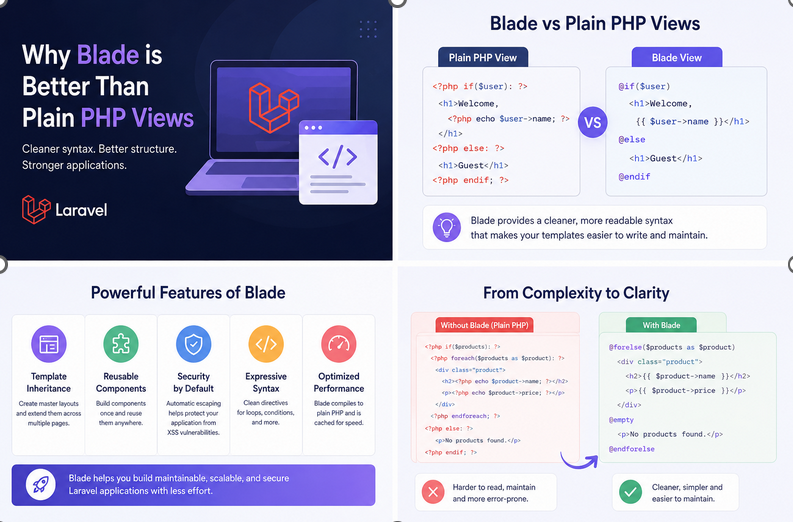
Blade introduces an elegant syntax that makes templates easier to read and understand. By reducing visual clutter and organizing presentation logic more effectively, developers can focus on building features rather than managing template complexity.
This improved readability becomes especially valuable in collaborative environments where multiple developers contribute to the same codebase. Clean templates reduce onboarding time, simplify debugging, and improve overall code quality.
Eliminating Repetition Through Template Inheritance
A common issue in traditional PHP projects is duplicated layout code. Headers, navigation menus, footers, and common page structures are often repeated across numerous files.
Blade addresses this challenge through template inheritance, allowing developers to define a master layout and extend it across multiple pages. Changes to global elements can be made in a single location, instantly affecting the entire application.
This approach not only reduces code duplication but also ensures consistency throughout the user experience.
For growing organizations and development teams, maintaining consistency across dozens or even hundreds of pages becomes significantly more manageable with Blade’s layout system.
Reusable Components Enable Scalable Development
Modern web applications rely heavily on reusable interface elements such as cards, alerts, buttons, forms, and navigation menus.
Without a component-based approach, developers often duplicate markup across multiple views, creating unnecessary maintenance overhead. Blade components provide a standardized way to create reusable UI building blocks that can be shared throughout the application.
When design requirements change, developers can update a single component rather than modifying dozens of individual pages. This significantly improves development efficiency while promoting consistency across the platform.
As organizations adopt design systems and component-driven development practices, Blade aligns naturally with these modern engineering standards.
Security by Default
Security should never be an afterthought in web development.
One of Blade’s most valuable features is its automatic output escaping mechanism. By default, Blade protects applications against common vulnerabilities such as Cross-Site Scripting (XSS) attacks by safely escaping user-generated content before rendering it in the browser.
This built-in protection reduces the likelihood of accidental security flaws and encourages safer development practices across teams.
While developers still maintain full control when rendering trusted HTML content, Blade’s secure-by-default philosophy helps establish stronger security standards throughout the application.
Enhanced Developer Productivity
Development speed is a critical factor in today’s competitive software landscape.
Blade simplifies common tasks through expressive directives for loops, conditional statements, authorization checks, and template inclusion. These features reduce boilerplate code and allow developers to express intent more clearly.
As a result, teams spend less time managing view logic and more time delivering business value.
The productivity gains become particularly noticeable in enterprise environments where applications contain hundreds of templates and continuous feature development is required.
Performance Without Compromise
A common misconception is that templating engines introduce unnecessary overhead. Blade takes a different approach.
Before serving content to users, Blade templates are compiled into optimized PHP code and cached by Laravel. This means developers benefit from a cleaner and more maintainable syntax while still achieving excellent runtime performance.
Organizations can therefore improve developer experience without sacrificing application speed or scalability.
Better Collaboration Across Development Teams
Successful software projects depend on effective collaboration.
When view files contain a mixture of HTML and extensive PHP logic, understanding and maintaining templates becomes increasingly difficult. Blade encourages a cleaner separation of concerns, resulting in templates that are easier to review, test, and maintain.
Whether working in a startup environment or a large enterprise team, structured templates contribute to improved collaboration, reduced technical debt, and more predictable development workflows.
Why Blade Matters for Modern Laravel Applications
The true value of Blade extends beyond cleaner syntax. It provides a foundation for building applications that remain maintainable as they grow in complexity.
By promoting reusable components, centralized layouts, improved security, enhanced readability, and streamlined development workflows, Blade enables teams to deliver high-quality applications more efficiently.
For developers building modern Laravel applications, adopting Blade is not simply about writing cleaner views—it’s about establishing development practices that support scalability, collaboration, and long-term success.
Final Thoughts
As software projects evolve, maintainability becomes just as important as functionality. While plain PHP views continue to serve their purpose, Blade offers a more structured and scalable approach that aligns with modern development standards.
Its combination of simplicity, flexibility, performance, and security makes it one of Laravel’s most valuable features and a key reason why Laravel remains a preferred framework for developers worldwide.
Organizations seeking faster development cycles, cleaner codebases, and sustainable growth can benefit significantly from embracing Blade as the foundation of their presentation layer.
