
As web applications and APIs continue to evolve, securing user authentication has become more important than ever. Laravel offers multiple authentication solutions, but JWT (JSON Web Tokens) and Laravel Sanctum are among the most popular choices for API authentication.
Choosing the right approach can improve security, scalability, and overall application performance.
What is JWT Authentication?
JWT is a token-based authentication method where the server generates a signed token after a user logs in successfully. The client stores this token and sends it with every API request.
Benefits of JWT
JWT provides stateless authentication, meaning the server does not need to store user session information. This makes it highly scalable and suitable for REST APIs, mobile applications, and microservice architectures. Since authentication data is stored within the token, JWT can also reduce the need for frequent database queries.
Challenges of JWT
Despite its advantages, JWT comes with certain challenges. Revoking tokens before they expire can be difficult, and developers must carefully manage token expiration and refresh mechanisms. Compared to Sanctum, JWT generally requires more configuration and maintenance.
What is Laravel Sanctum?
Laravel Sanctum is Laravel’s lightweight authentication package designed for Single Page Applications (SPAs), mobile applications, and APIs.
Unlike JWT, Sanctum stores and manages authentication tokens through Laravel, making it easier to control and revoke access when needed.
Benefits of Sanctum
Sanctum is simple to install and configure, making it a popular choice among Laravel developers. It integrates seamlessly with Laravel’s authentication system and provides straightforward token management. Sanctum also works exceptionally well with frontend frameworks such as Vue, React, and Nuxt.
Challenges of Sanctum
Because Sanctum stores tokens in the database, it is not entirely stateless. While this simplifies token management, it may not be the best fit for highly distributed systems that require completely stateless authentication.
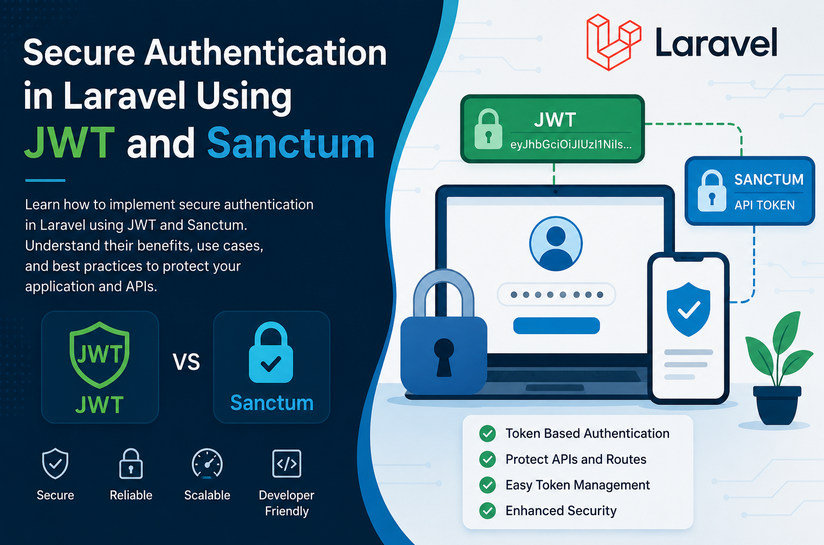
JWT vs Sanctum
JWT and Sanctum are both secure authentication solutions, but they are designed for different use cases. JWT is ideal for large-scale APIs, mobile applications, and microservice architectures where stateless authentication is important. Sanctum, on the other hand, is better suited for Laravel-based applications, particularly those using modern frontend frameworks such as Vue, React, or Nuxt.
JWT offers greater flexibility for distributed systems, while Sanctum provides easier setup, simpler token revocation, and tighter integration with Laravel.
Security Best Practices
Regardless of which authentication method you choose, following security best practices is essential. Always use HTTPS to protect data during transmission. Implement token expiration to limit the impact of compromised credentials. Validate all user input, apply rate limiting to login endpoints, and regularly revoke unused or compromised tokens. Following the principle of least privilege can also help reduce security risks.
Which One Should You Choose?
Choose JWT if your application requires a scalable and stateless authentication mechanism that can be shared across multiple services or platforms.
Choose Sanctum if you are building a Laravel application and want a simpler authentication solution with easy token management and strong support for Single Page Applications.
Conclusion
Both JWT and Laravel Sanctum provide reliable authentication solutions for modern applications. JWT excels in distributed environments that require stateless authentication, while Sanctum offers a simpler and more developer-friendly experience for Laravel projects.
For most Laravel applications, Sanctum is often the preferred choice because of its ease of use and seamless framework integration. However, applications with complex API ecosystems or microservice architectures may benefit more from JWT. Understanding the strengths of each approach will help you choose the authentication strategy that best fits your project’s requirements.
