
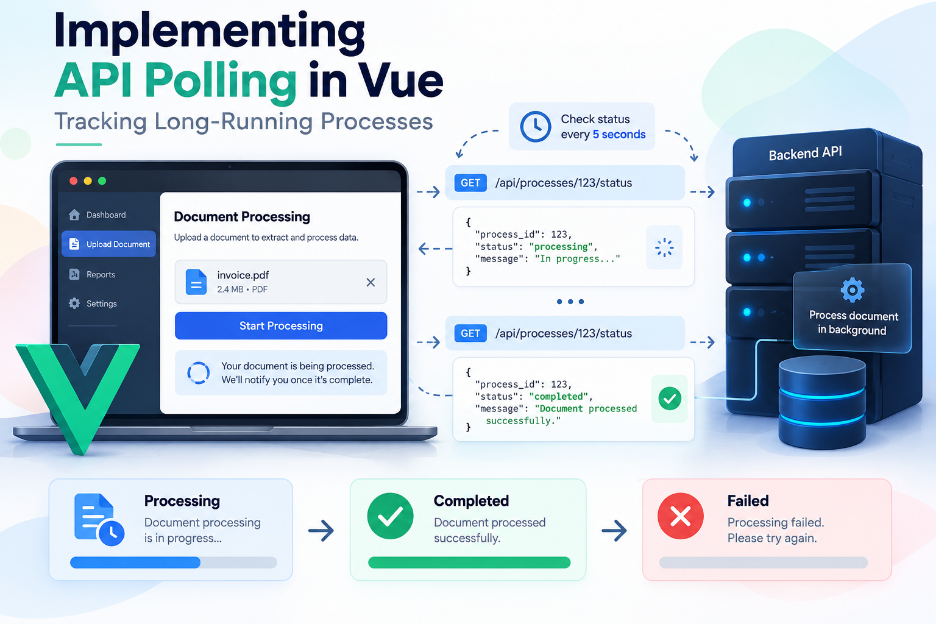
Modern web applications often perform operations that take time to complete, such as processing uploaded documents, generating reports, importing datasets, or exporting files.
During these operations, users need to know whether the process is still running, has completed successfully, or has encountered an error. API polling provides a way to monitor these operations automatically without requiring users to refresh the page.
Understanding API Polling
API polling is a technique in which a client sends requests to a server at regular intervals to retrieve updated information.
For example, when a user uploads a document, the backend may start processing it asynchronously. The frontend can periodically call a status endpoint to determine whether the operation has finished.
A typical response might look like this:
{
“process_id”: 123,
“status”: “processing”,
“message”: “Document processing is in progress.”
}
Once processing finishes, the backend returns an updated status:
{
“process_id”: 123,
“status”: “completed”,
“message”: “Document processed successfully.”
}
The frontend uses these responses to update the user interface automatically.
Why API Polling Is Important
API polling helps applications monitor long-running operations and provide timely feedback to users.
Its main benefits include:
- Automatically updating process statuses without refreshing the page.
- Displaying loading indicators and completion messages.
- Detecting processing failures.
- Monitoring background jobs and asynchronous tasks.
- Improving the user experience during time-consuming operations.
It is particularly useful when the backend exposes an API endpoint for checking the status of an ongoing operation.
Implementing API Polling in Vue
Vue 3 provides reactive state management and lifecycle hooks that simplify API polling.
Using the Composition API and Axios, developers can implement a process that periodically checks the backend for status updates.
A typical implementation involves the following steps:
- Start the operation and obtain its process ID.
- Store the process ID in the frontend.
- Send periodic requests to check the status.
- Update the interface based on the response.
- Stop polling when the operation completes or fails.
For example, an application might check the process status every five seconds.
However, developers should choose an interval based on the application’s requirements. Sending requests too frequently can increase server load, while longer intervals may delay status updates.
It is also important to prevent overlapping requests. If one request takes longer than the polling interval, another request might start before the previous one finishes. Scheduling the next request only after the current request completes helps avoid this problem.
Handling Completion and Errors
A reliable polling mechanism must distinguish between ongoing operations, successful completion, and failures.
| Status | Frontend Action |
| Processing | Continue polling. |
| Completed | Stop polling and display a success message. |
| Failed | Stop polling and display an error message. |
Network errors also require careful handling. A failed status request does not necessarily mean the backend operation has failed.
Depending on the application, developers can stop polling immediately or retry temporary failures a limited number of times.
A clear error-handling strategy prevents unnecessary requests and provides users with meaningful feedback.
Cleaning Up Polling Operations
Polling must be managed throughout the Vue component’s lifecycle.
If a user navigates away from a page while polling is active, the application should stop the recurring requests when the component is unmounted.
Vue’s onBeforeUnmount() lifecycle hook can be used to clear polling timers.
Developers should also ensure that starting a new polling operation does not create duplicate timers.
Proper cleanup helps prevent unnecessary API calls, resource consumption, and unexpected application behavior.
API Polling vs. Real-Time Communication
API polling is not the only approach to monitoring long-running processes. Other technologies, such as Server-Sent Events (SSE) and WebSockets, can provide more immediate updates.
- API Polling: Suitable for periodic status checks and background jobs.
- Server-Sent Events: Useful for continuous server-to-client updates.
- WebSockets: Appropriate for applications requiring bidirectional real-time communication.
For operations where status changes are relatively infrequent, API polling is often sufficient. For applications requiring continuous updates, SSE or WebSockets may be more appropriate.
Best Practices
A reliable API polling implementation should follow these principles:
- Choose an appropriate polling interval.
- Prevent overlapping API requests.
- Stop polling when an operation reaches a terminal state.
- Handle network errors and retries carefully.
- Clear timers when components are unmounted.
- Prevent duplicate polling instances.
- Consider backend load when many users poll simultaneously.
Following these practices helps maintain application performance and reliability.
Conclusion
API polling is a practical technique for tracking long-running operations in modern web applications. It allows frontend applications to retrieve status updates automatically and notify users when operations complete or fail.
By combining appropriate polling intervals, error handling, controlled request scheduling, and lifecycle cleanup, developers can implement reliable polling mechanisms in Vue applications.
Ultimately, effective API polling keeps users informed while minimizing unnecessary requests and maintaining reliable communication between the frontend and backend.
