
Introduction
Modernizing an enterprise application is not just about changing its user interface. It is about rethinking how the application retrieves data, communicates with external systems, processes business events, and maintains reliable workflows.
As organizations migrate from Traditional UI to Pega Constellation, one important area deserves special attention: REST integration architecture.
Many established Pega applications use REST connectors, Data Pages, activities, data transforms, and case flows to communicate with external systems. Although these integrations may work well in a Traditional UI application, some implementations can become tightly coupled to legacy UI components, property structures, or user-triggered execution patterns.
Moving to Constellation provides an opportunity to review these dependencies and build an integration architecture that is reusable, secure, maintainable, and independent of the presentation layer.
The objective is not simply to make existing REST calls work in Constellation. It is to ensure that integrations continue to support business processes regardless of how users interact with the application.
1. Understanding the Challenge: From Traditional UI to Constellation
Traditional Pega applications may contain integrations triggered through sections, harnesses, client-side scripts, or activities invoked as part of UI interactions.
Over time, these implementations can introduce dependencies between the presentation layer and the integration layer.
For example, consider a case management application that retrieves customer details from an external REST API when an operator opens a section. If the integration depends on properties populated by a particular UI interaction, the same functionality may not work as expected when the application moves to Constellation.
This creates several challenges:
- UI dependency: Integration execution relies on a particular screen, section, or interaction.
- Legacy property references: Request and response mappings depend on properties that may not exist in the new data model.
- Limited reusability: Integration logic is duplicated across multiple flows or activities.
- Difficult maintenance: Changes to the user interface can unintentionally affect integration behavior.
- Inconsistent error handling: Different service calls handle timeouts, invalid responses, and failures differently.
The key architectural principle is simple: the user interface should not determine whether essential business integrations can execute.
Integrations should be invoked through appropriate application, data, and process layers rather than being dependent on a particular presentation component.
2. Designing a Constellation-Compatible Integration Architecture
A successful modernization effort begins by separating responsibilities across the application.
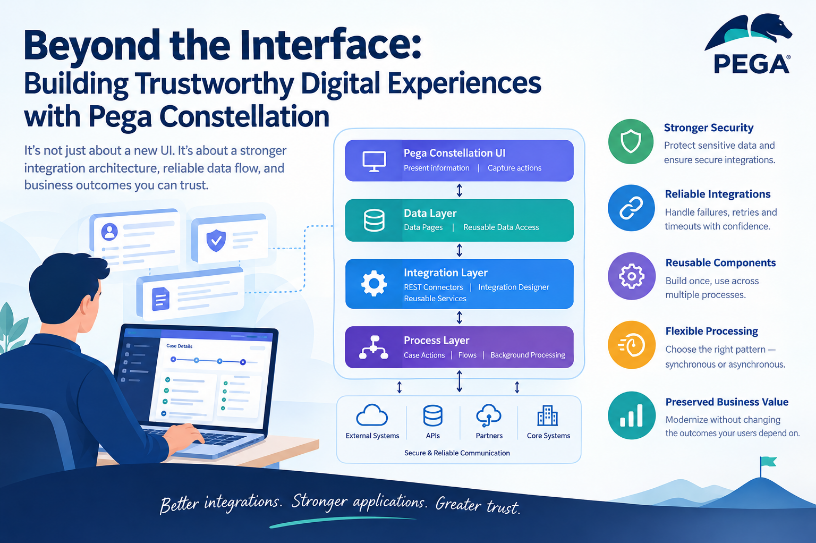
A typical architecture can be organized into four layers.
Presentation Layer
The Constellation UI provides the interface through which users view information, submit data, and perform case actions.
Its responsibility is to present data and capture user interactions—not to contain the core integration logic.
Data Layer
Data Pages provide reusable access to information from external systems or application data sources.
For example, a Data Page can retrieve customer information, agency details, financial entity records, or policy information from an external service.
The Data Page should use the appropriate source, parameters, scope, and refresh strategy for its purpose.
Integration Layer
REST connector rules, authentication profiles, request and response mappings, and reusable integration components handle communication with external services.
This layer should encapsulate the technical details of external communication wherever practical.
Process Layer
Case lifecycle actions, flows, and background processing coordinate when integrations execute as part of a business process.
For example, a case can invoke a service to validate policy information before allowing the workflow to proceed. A separate background process may handle a large bulk operation that should not block the user’s interaction.
These layers work together to create a solution in which the UI, data access, external communication, and business processing have clearly defined responsibilities.
3. The Role of Data Pages and Reusable Integration Components
Data Pages are an important part of Pega’s data access architecture, but they should not be treated as a universal replacement for every REST integration.
Their suitability depends on what the integration needs to accomplish.
When to Use Data Pages
Data Pages are appropriate for retrieving or managing data through supported data sources.
Common examples include:
- Retrieving customer or agency information.
- Looking up financial entities.
- Fetching policy and claim details.
- Loading reference data required by a case.
- Reusing external data across multiple application components.
A well-designed Data Page can reduce duplicated data retrieval logic and provide a consistent access point for consuming application components.
However, its scope and refresh strategy must be selected carefully. An incorrectly scoped or cached Data Page can return stale information or unintentionally share data between contexts.
When to Use Case Lifecycle Actions
Some integrations are part of a business decision or workflow transition rather than simple data retrieval.
For example, before a case progresses to the next stage, the application may need to validate information with an external system.
In such scenarios, the integration should be orchestrated through an appropriate case-processing mechanism so that the business outcome, error handling, and case status remain consistent.
When to Use Background Processing
Long-running tasks, bulk operations, and work that does not require an immediate response are often better suited to asynchronous processing.
Pega Queue Processors and other supported background-processing mechanisms can help separate lengthy operations from the user’s immediate interaction.
The appropriate design depends on whether the operation requires an immediate result, durable processing, retries, or coordination with other systems.
The goal is to choose the pattern based on the integration’s business purpose—not simply on the fact that it uses REST.
4. Refactoring Legacy Request and Response Mappings
One of the most important activities during Constellation migration is reviewing the existing request and response mappings.
A REST connector may continue to communicate successfully with an external endpoint while still depending on outdated property references or assumptions about the legacy case structure.
For example, a request might obtain a customer identifier from a property populated by a Traditional UI section. If that property is not populated through the new application flow, the connector could send an incomplete request.
To prevent this, each integration should be reviewed systematically.
Step 1: Identify the source data.
Determine where each request field originates and which business object owns it.
Step 2: Map the fields to the new data model.
Confirm that each field is mapped to the correct property in the appropriate class.
Step 3: Validate the request structure.
Ensure that required fields, data types, date formats, and nested objects match the external API contract.
Step 4: Review the response mapping.
Confirm that returned values are mapped correctly and that optional or missing fields are handled safely.
Step 5: Validate downstream dependencies.
Check whether case flows, decision rules, Data Transforms, reports, or other integrations consume the mapped properties.
This process helps preserve existing business behavior while removing dependencies on legacy property paths.
5. Building Reliable Error Handling
A REST integration should be designed with the expectation that failures will occur.
External systems may become unavailable, respond slowly, return unexpected payloads, or reject requests because of validation or authentication errors.
A robust implementation should distinguish between different failure scenarios.
| Failure scenario | Recommended approach |
| Authentication failure | Validate credentials, authentication profiles, and access permissions. |
| Connection timeout | Apply an appropriate timeout and determine whether a retry is safe. |
| HTTP 4xx response | Inspect request data, permissions, and endpoint-specific validation requirements. |
| HTTP 5xx response | Handle the external service failure and retry only when appropriate. |
| Invalid response payload | Validate the response structure and prevent invalid data from entering the business process. |
| Partial response | Identify required fields and handle missing optional data explicitly. |
| Duplicate request | Use idempotency controls where supported by the external service. |
Error handling should also preserve business context.
For example, if a policy lookup fails, the application should not automatically treat the policy as invalid. A technical failure and a genuine business rejection are different outcomes.
Depending on the business requirements, the case may need to remain pending, enter an exception path, or be scheduled for retry.
Retries should be bounded and designed carefully. Repeating a request that creates a financial transaction or another non-idempotent operation can produce duplicate side effects.
6. Securing REST Integrations Across Environments
Integration modernization is also an opportunity to review security.
A connector that works in a development environment may fail after deployment if authentication, endpoint configuration, or access permissions differ between environments.
A consistent approach should include:
- Using appropriate authentication profiles and supported authentication mechanisms.
- Managing credentials securely rather than hardcoding secrets in rules.
- Configuring environment-specific endpoint URLs through suitable configuration mechanisms.
- Validating authorization for both the Pega application and the external service.
- Limiting sensitive data in logs and error messages.
- Verifying access permissions and secure data propagation.
- Testing authentication and authorization after deployment.
Security should be considered part of the integration design rather than a final configuration task.
The objective is to ensure that the refactored integration behaves consistently across environments without exposing credentials or sensitive business information.
7. Synchronous and Asynchronous Processing: Choosing the Right Pattern
Not every REST operation should execute in the same way.
The distinction between synchronous and asynchronous processing is especially important in case management applications.
Synchronous Integration
A synchronous call is appropriate when the next business decision depends on the immediate result.
Examples include:
- Validating mandatory information.
- Checking a policy’s current status.
- Retrieving information needed to complete a case action.
The implementation must account for response time, timeouts, and failure behavior so that the case does not remain in an inconsistent state.
Asynchronous Integration
Asynchronous processing is useful when an operation can continue independently of the user’s current interaction.
Examples include:
- Bulk data processing.
- Large report generation.
- Sending notifications.
- Processing deferred updates.
- Synchronizing records with external systems.
A background-processing design should consider retry policies, duplicate prevention, monitoring, and recovery from failed processing.
The right choice depends on business requirements, response-time expectations, and the consequences of a failed operation.
8. Regression Testing: Preserving Business Outcomes
A technically successful REST call does not necessarily mean the migration is complete.
The refactored integration must also preserve the business behavior that depends on it.
Regression testing should cover the full path from input data to the final case outcome.
A practical test strategy includes:
- Request validation: Confirm that the correct values are sent to the external service.
- Response validation: Verify successful responses, error responses, and unexpected payloads.
- Case lifecycle testing: Confirm that stages, assignments, and status transitions behave as expected.
- Security testing: Validate authentication, authorization, and environment-specific configuration.
- Failure testing: Simulate timeouts, unavailable endpoints, and invalid data.
- Asynchronous testing: Verify retries, processing failures, duplicate prevention, and eventual completion where applicable.
- End-to-end regression testing: Compare business outcomes before and after refactoring.
For example, if an external service previously returned a valid policy result that allowed a case to proceed, the Constellation-compatible implementation should preserve that outcome under equivalent conditions.
Testing should also confirm that a failed service call does not accidentally produce a successful business outcome.
9. A Practical Migration Checklist
Before considering a REST integration refactor complete, verify the following:
- All active REST connectors and consuming rules have been inventoried.
- Obsolete integrations have been identified and assessed before removal.
- Request and response mappings use the intended data model.
- UI-dependent invocation patterns have been removed where they are not appropriate.
- Data Pages are used for suitable data-access scenarios.
- Case lifecycle actions and background processing are used according to business requirements.
- Authentication and endpoint configuration are secure and environment-appropriate.
- Error handling and retry behavior are consistent with the operation’s purpose.
- Synchronous and asynchronous processing have been tested.
- Regression tests confirm that existing business outcomes are preserved.
- Logging and monitoring support troubleshooting without exposing sensitive information.
This checklist turns migration into a controlled architectural exercise rather than a collection of isolated connector changes.
Conclusion: Build Beyond the Interface
Migrating to Pega Constellation is an opportunity to improve more than the user experience. It is an opportunity to create a cleaner separation between presentation, data access, integration, and business processing.
The most effective REST integration architecture is not the one with the most rules or the newest technology. It is the one in which each component has a clear responsibility, external communication is secure and reliable, failures are handled predictably, and business outcomes remain consistent.
By combining appropriate Data Pages, reusable integration components, case lifecycle actions, background processing, and systematic regression testing, development teams can reduce legacy dependencies and make their applications easier to maintain and extend.
The key takeaway: Modernizing for Constellation is not simply a UI migration. It is an architectural opportunity to make integrations independent of the interface, resilient to failure, and aligned with the business processes they support.
