
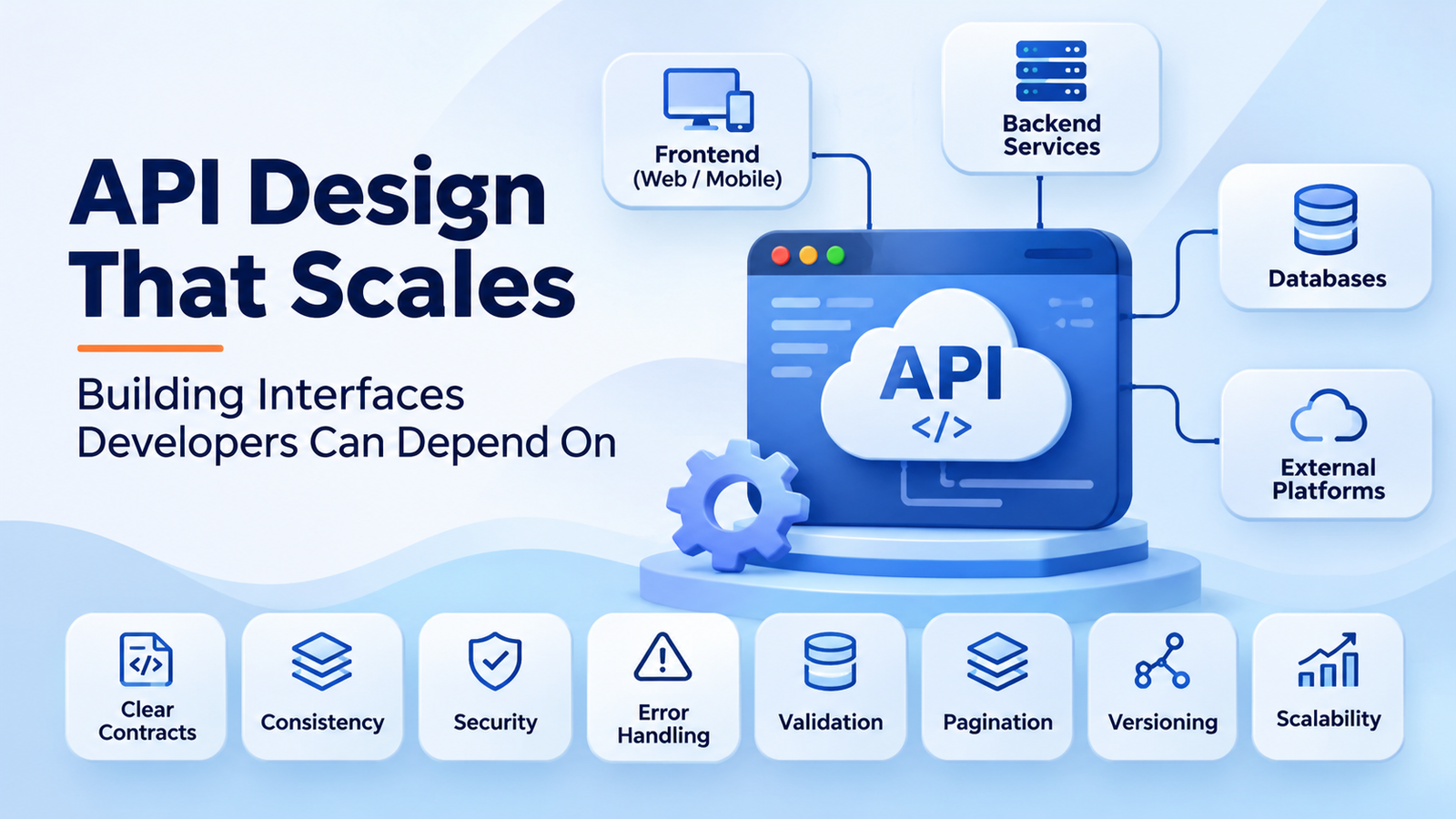
Modern applications rely on APIs to connect frontend interfaces, backend services, databases, mobile applications, and external platforms. But building an API that works today is only part of the challenge.
A well-designed API must remain understandable, secure, maintainable, and reliable as an application grows.
The real measure of good API design is not simply whether an endpoint returns the correct response. It is whether other systems can depend on that API without constantly adapting to unexpected changes.
1. An API Is a Contract, Not Just an Endpoint
An API defines how two systems communicate. Its contract includes request formats, response structures, validation rules, error responses, authentication requirements, and expected behavior.
Consider an endpoint that returns user information.
Initially, it might return a simple response containing a user’s ID and name. Later, the application may need to include a profile image, subscription status, or account preferences.
If these changes are introduced without considering existing consumers, frontend components or third-party integrations may break.
Engineering principle: Design API contracts around clear expectations and evolve them deliberately.
2. Consistency Makes APIs Easier to Use
Imagine an application where one endpoint returns userId, another returns user_id, and another returns id for the same concept.
Each endpoint might work independently, but the inconsistency creates unnecessary complexity for developers.
Consistent API design includes:
- Predictable naming conventions.
- Standard request and response structures.
- Consistent pagination behavior.
- Clear date, time, and currency formats.
- Reusable validation and error-handling patterns.
Consistency reduces the amount of special-case logic required in frontend applications and makes integrations easier to maintain.
3. Good Error Responses Are Part of Good API Design
A successful response is only one part of the API experience.
When something fails, clients need enough information to understand what happened and how to respond.
For example, an API should distinguish between an unauthenticated request, insufficient permissions, invalid input, a missing resource, and an unexpected server failure.
A structured error response might look like this:
{
“error”: {
“code”: “VALIDATION_FAILED”,
“message”: “The submitted data is invalid.”,
“details”: {
“email”: [“A valid email address is required.”]
}
}
}
The exact structure can vary between applications. What matters is that the format remains predictable and does not expose internal stack traces, database details, or sensitive information.
4. Validation Must Exist Beyond the Frontend
Frontend validation improves the user experience, but it cannot guarantee that incoming data is valid.
Requests can come from mobile applications, scripts, external integrations, or malicious clients that bypass the interface entirely.
The backend must independently validate incoming data, enforce business rules, and verify that the user has permission to perform the requested action.
For example, hiding an administrative button in the frontend does not prevent someone from calling the administrative API directly.
The rule is simple: The frontend guides the user; the backend enforces the rules.
5. Design for Pagination and Growing Data
Returning every record from a database might work when an application has only a few hundred records. As the dataset grows, the same endpoint can become slow, consume excessive memory, and create a poor user experience.
Pagination allows clients to request manageable portions of data.
For example:
GET /api/orders?page=2&limit=20
A response can include the records along with useful metadata, such as the current page, page size, and total number of records.
For large or frequently changing datasets, cursor-based pagination may provide more predictable performance than offset-based pagination.
The important lesson is to consider expected data growth before an endpoint becomes a bottleneck.
6. Versioning and Backward Compatibility Matter
APIs rarely remain unchanged throughout an application’s lifetime.
Requirements evolve, response structures improve, and business logic becomes more sophisticated. However, existing clients may depend on the current behavior.
A breaking change, such as removing a response field or changing its data type, can affect several applications simultaneously.
Before introducing changes, determine whether they are backward-compatible. Additive changes are generally easier to introduce than changes that remove or reinterpret existing fields.
When breaking changes are unavoidable, use an appropriate versioning or migration strategy and provide consumers with a clear transition path.
7. Reliability Requires Timeouts, Retries, and Idempotency
An API request may fail because of a network interruption, temporary service outage, or overloaded dependency.
Retries can help with temporary failures, but uncontrolled retries can increase traffic and make an already struggling service less stable.
Reliable API integrations should consider:
- Timeouts: Prevent requests from waiting indefinitely.
- Controlled retries: Retry only appropriate failures, with backoff and jitter.
- Idempotency: Prevent repeated requests from producing unintended duplicate effects.
- Rate limiting: Protect services from excessive traffic.
- Clear failure responses: Help clients decide whether to retry or ask the user to take action.
For example, if a payment request times out, the client may not know whether the payment was processed. Retrying with an appropriate idempotency key can help prevent duplicate charges.
Reliability is not achieved by assuming failures will never happen. It is achieved by designing for them.
8. Security Must Be Built Into the API Contract
Security cannot be added effectively as a final step.
Every sensitive endpoint should consider authentication, authorization, input validation, rate limits, and the information included in responses.
An authenticated user should not automatically gain access to every resource. The API must verify whether that specific user is permitted to access the requested record or perform the requested action.
For example, changing an order ID in a URL should not allow a user to view another customer’s order.
Secure API design also includes protecting credentials, avoiding sensitive information in logs, using appropriate transport security, and limiting unnecessary data exposure.
9. Observability Helps Teams Understand API Behavior
When an API becomes slow or begins failing, developers need more than a report that something is wrong.
Useful observability includes:
- Logs to investigate individual failures.
- Metrics to track latency, traffic, and error rates.
- Distributed traces to follow requests across multiple services.
Correlation IDs or trace IDs can help connect related events across frontend requests, backend services, and downstream dependencies.
These signals help teams identify whether a problem originates in the API itself, a database query, an external service, or another part of the system.
10. API Performance Is More Than Response Time
An endpoint may return quickly under light traffic but struggle when concurrent requests increase.
Performance depends on several factors, including database query efficiency, indexing, caching, payload size, network overhead, and downstream service dependencies.
Before optimizing an API, measure its behavior under realistic conditions.
Avoid adding caching or complex infrastructure without understanding the actual bottleneck. Caching can improve performance, but it also introduces invalidation and consistency challenges.
The objective is not to make every endpoint as complicated as possible. It is to meet the application’s performance requirements with the simplest reliable design.
11. Documentation and Testing Are Part of the Product
An API that works but is difficult to understand creates friction for every developer who integrates with it.
Documentation should explain endpoints, parameters, authentication, response structures, error codes, and examples of common requests.
Automated tests should verify successful requests, invalid inputs, permission checks, expected errors, and important business rules.
Contract testing can also help detect incompatible changes between API providers and consumers before deployment.
These practices reduce integration surprises and make future modifications safer.
12. A Practical Framework for Designing an API
Before implementing a new endpoint, ask:
- What business problem does this endpoint solve?
- Who or what will consume it?
- What request and response contracts are required?
- Which validation and authorization rules apply?
- How should failures be represented?
- How will the endpoint behave as data and traffic grow?
- Could retries create duplicate side effects?
- How will it be tested, monitored, and documented?
- How can the API evolve without unnecessarily breaking consumers?
Answering these questions early can prevent avoidable complexity later.
Final Thoughts
Good API design is not about following a particular naming convention or choosing a specific architectural style. It is about creating dependable boundaries between systems.
Consistency makes APIs easier to understand. Validation and authorization protect business rules. Versioning supports change. Timeouts, retries, and idempotency improve reliability. Observability helps teams diagnose problems, while testing and documentation make integrations more predictable.
A well-designed API does more than connect applications. It creates a stable foundation on which applications can evolve.
The best API is not necessarily the one with the most features. It is the one that solves the right problem clearly and remains dependable as the system grows.
Discussion Question
What is the most challenging part of API design in real-world projects: maintaining backward compatibility, handling failures, securing endpoints, or keeping performance predictable as traffic grows?
#APIDesign #SoftwareEngineering #BackendDevelopment #FullStackDevelopment #SystemDesign #WebDevelopment #CleanArchitecture #DeveloperExperience
