
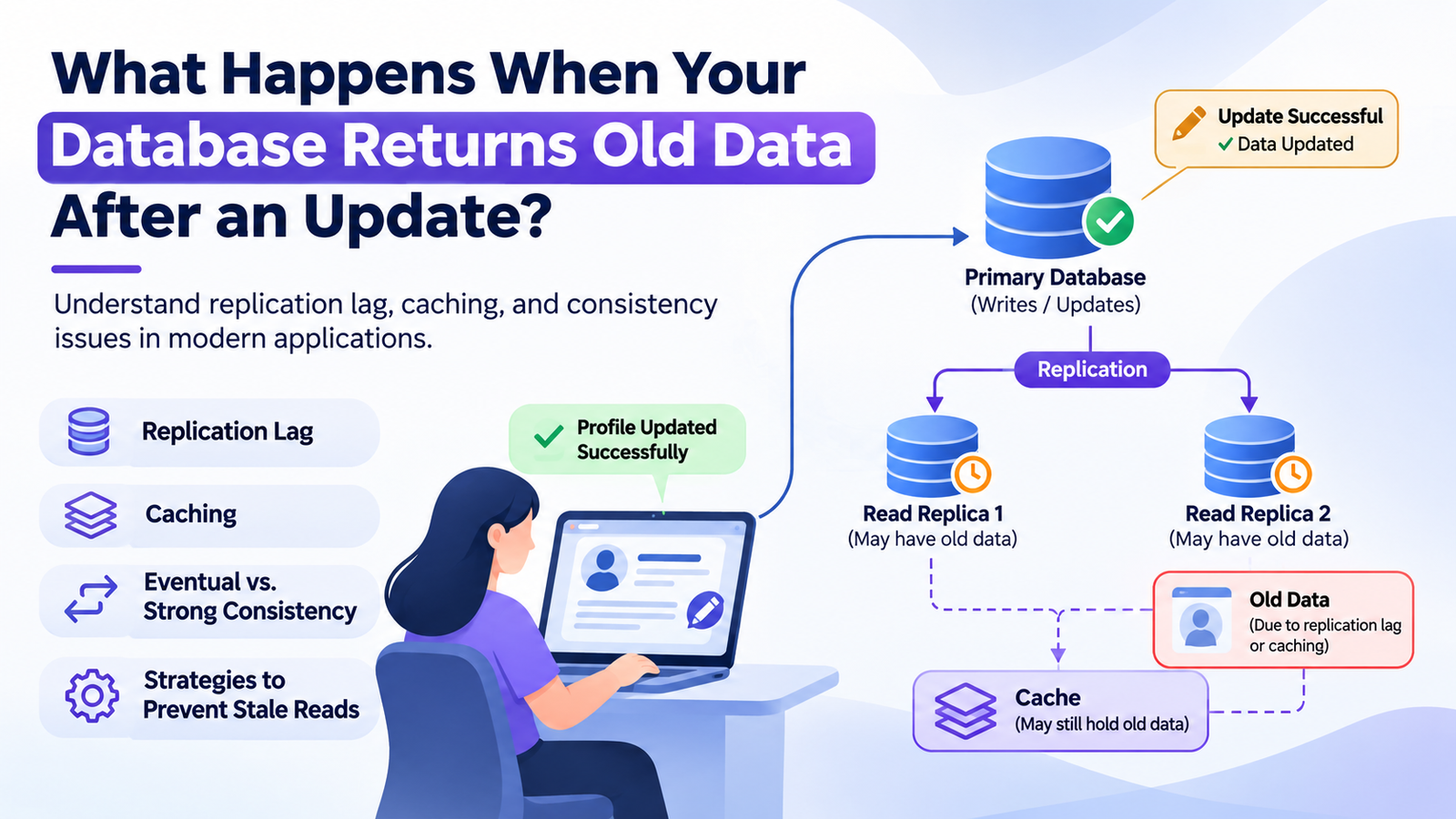
Imagine updating your profile, receiving a success message, and then refreshing the page only to see your previous information.
The update succeeded, so why is the application displaying outdated data?
This is a common challenge in modern application architecture. The cause may be database replication lag, caching, transaction timing, or inconsistent reads across different services.
Understanding these mechanisms is essential for building reliable applications.
1. When a Successful Update Does Not Mean Every Read Is Fresh
In a simple application, writes and reads may use the same database instance. Once a transaction commits, subsequent reads can generally observe the committed change, subject to transaction isolation and caching behavior.
However, larger applications often distribute database workloads across multiple systems.
The primary database handles writes, while read replicas serve queries to reduce load.
When an update occurs, the change must propagate from the primary database to its replicas. This process may take some time.
During that interval, a query sent to a replica can return the previous value.
This delay is known as replication lag.
2. Understanding Database Replication
Database replication maintains copies of data across multiple database instances.
A typical architecture looks like this:
Application → Primary Database → Replication → Read Replicas
The application sends updates to the primary database. Replication mechanisms then propagate those changes to other database instances.
Read replicas can improve scalability by distributing read traffic. However, they may temporarily contain older data than the primary database.
Replication is therefore a trade-off between performance, availability, and the consistency guarantees an application requires.
3. The Role of Caching
Database replication is not the only reason users see outdated information.
Applications frequently cache data to reduce repeated database queries and improve response times.
Caching may exist at several levels:
- Application memory or distributed caches.
- API response caches.
- Browser and client-side state.
- Content delivery networks.
Suppose a user updates a product’s price. The database stores the new value, but a cache still contains the previous price.
The next API request may return the cached response instead of querying the database.
A successful database update does not automatically invalidate every cache containing that data.
Applications need an explicit cache invalidation or refresh strategy.
4. Eventual Consistency vs. Strong Consistency
Not every application requires every read to reflect the latest write immediately.
Eventual consistency means that, provided updates stop and replication continues successfully, replicas are expected to converge toward the same data.
This model works well for many analytics dashboards, activity feeds, and reporting systems.
Strong consistency provides stronger guarantees about which values reads can observe, depending on the system’s consistency model.
Applications handling financial balances, inventory reservations, or other critical operations may require stricter guarantees for particular workflows.
The right approach depends on the business requirements. Stronger consistency can introduce additional latency, coordination, or reduced availability in some architectures.
5. Strategies to Prevent Stale Reads
Reliable systems use different techniques depending on the source of the problem.
Read critical data from the primary database
After an important update, route subsequent reads to the primary when immediate visibility is required.
Implement cache invalidation
Invalidate or refresh affected cache entries after successful updates. Consider race conditions that could allow an older value to be cached again.
Use versioning or timestamps
Version numbers or update timestamps can help detect outdated representations and prevent older data from overwriting newer state.
Design read-after-write behavior
Keep related reads consistent with recent writes where the user experience requires it. This may involve temporarily routing reads to the primary or using database-specific consistency mechanisms.
Monitor replication lag
Track replica delays and adjust routing or alerting when replicas fall behind acceptable thresholds.
No single strategy solves every consistency problem. The system must identify whether the stale value originates from the database, cache, or application layer.
6. Why Testing Matters
Consistency issues can be difficult to reproduce locally because development environments often use a single database instance with minimal traffic.
Production environments introduce replication delays, concurrent updates, cache races, and network interruptions.
Testing should therefore cover scenarios such as:
- Reading immediately after a successful update.
- Updating a record while another request reads it.
- Serving requests when a replica falls behind.
- Invalidating caches during concurrent access.
- Recovering when replication or cache infrastructure becomes unavailable.
These tests help reveal assumptions that may not hold under production conditions.
Final Thoughts
Outdated data is not always evidence of a failed database update. It can be the result of a system designed to distribute reads, cache responses, and scale across multiple components.
The challenge is to choose the appropriate consistency guarantees for each operation and ensure that every layer follows them.
Performance optimization should never rely on consistency assumptions that the architecture cannot guarantee.
Reliable applications balance speed with correctness, ensuring users receive data that is appropriate for the operation they are performing.
#SoftwareEngineering #DatabaseArchitecture #SystemDesign #BackendDevelopment #DistributedSystems #DatabaseOptimization #FullStackDevelopment
