
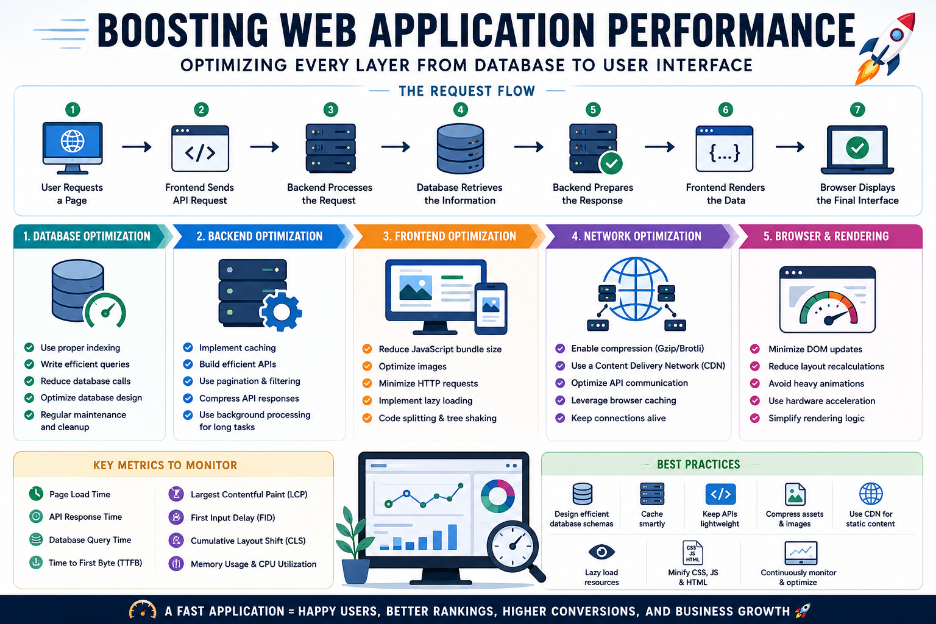
In today’s fast-paced digital world, application performance plays a crucial role in user satisfaction and business success. Users expect websites and web applications to load quickly and respond instantly. Even small delays can lead to higher bounce rates, lower engagement, and reduced conversions.
Optimizing performance requires improving every layer of a full-stack application, including the database, backend, frontend, and network. A well-optimized application delivers a faster, smoother, and more reliable user experience.
Why Application Performance Matters
A high-performing application offers several advantages:
- Faster page load times
- Better user experience
- Improved SEO rankings
- Higher conversion rates
- Easier scalability
Performance optimization also reduces server load and infrastructure costs while supporting business growth.
Optimize Your Database
The database is often the biggest source of performance issues.
Improve database performance by:
- Creating indexes for frequently searched columns
- Writing efficient SQL queries
- Retrieving only required data
- Reducing unnecessary database calls
- Maintaining a well-structured database schema
Efficient databases reduce response times and improve overall application speed.
Improve Backend Performance
The backend processes requests and communicates with the database.
Key optimization techniques include:
- Implement caching to reduce repeated database queries.
- Build lightweight APIs that return only necessary data.
- Use pagination for large datasets.
- Move long-running tasks such as email sending and report generation to background jobs.
These practices improve response times and server efficiency.
Optimize the Frontend
Users experience application performance through the frontend.
To improve loading speed:
- Minimize JavaScript and CSS files.
- Compress and optimize images.
- Reduce HTTP requests.
- Implement lazy loading for images and components.
A lightweight frontend provides faster rendering and smoother interactions.
Optimize Network Performance
Efficient data transfer helps reduce loading times.
Best practices include:
- Enable Gzip or Brotli compression.
- Use a Content Delivery Network (CDN) for static assets.
- Compress API responses.
- Cache frequently accessed resources.
These techniques reduce latency and improve global performance.
Monitor Performance Regularly
Performance optimization is an ongoing process.
Monitor important metrics such as:
- Page Load Time
- API Response Time
- Database Query Time
- Time to First Byte (TTFB)
- Largest Contentful Paint (LCP)
Regular monitoring helps identify bottlenecks before they impact users.
Best Practices
Follow these simple guidelines to maintain high performance:
- Optimize database queries.
- Use caching whenever possible.
- Keep APIs lightweight.
- Compress images and static files.
- Implement lazy loading.
- Minify CSS and JavaScript.
- Continuously monitor application performance.
Conclusion
Improving web application performance requires optimizing every layer of the technology stack. From efficient database queries and backend processing to optimized frontend assets and network communication, every improvement contributes to a faster and more responsive application.
By following these best practices, developers can build scalable, high-performance applications that deliver an excellent user experience while supporting future growth.
