
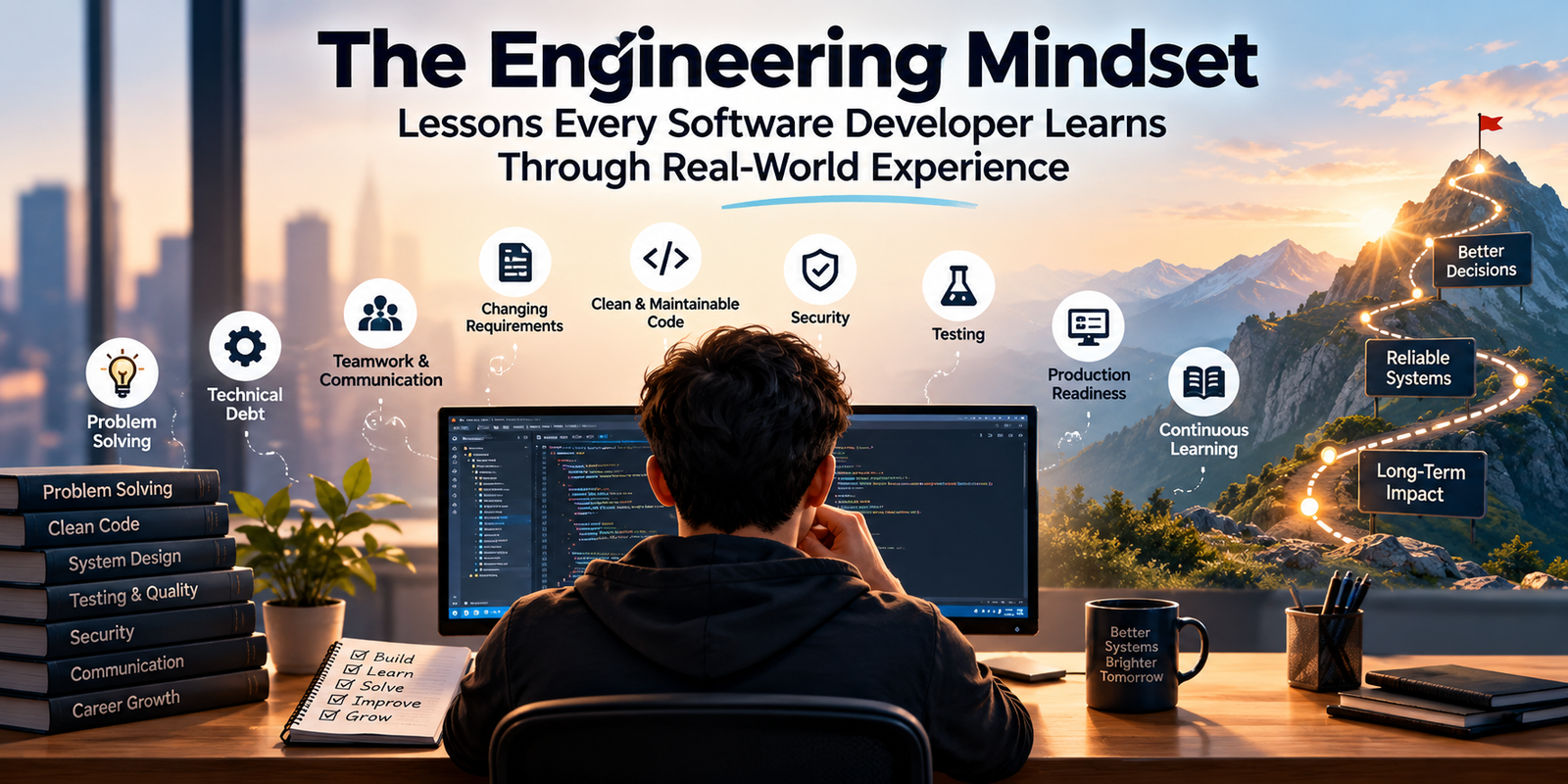
Introduction
When developers begin their careers, success can seem straightforward:
Learn a programming language. Build features. Fix bugs. Complete tasks.
However, real-world software development gradually teaches a different lesson.
Writing code is only one part of being a software engineer. As projects grow and responsibilities increase, developers encounter changing requirements, production issues, legacy code, technical debt, deadlines, unexpected bugs, team decisions, customer expectations, and systems that behave differently from their original design.
Over time, the focus shifts from:
“How do I write this code?”
to:
“How do I solve this problem in a way that works today and remains sustainable tomorrow?”
That shift represents the engineering mindset.
It is not tied to one programming language, framework, or technology. Instead, it is a way of thinking about problems, decisions, systems, people, and long-term impact.
1. Software Development Is About Solving Problems
One of the first lessons developers learn through experience is that coding is not the ultimate goal.
The real goal is to solve a problem.
For example, a business requirement might simply say:
“Add a new filter to the dashboard.”
However, several engineering questions need to be considered:
- What problem is the filter solving?
- How should it behave?
- Where should filtering happen?
- Can the existing API support it?
- Will the database query remain efficient?
- What happens when there are no results?
- Could it affect existing functionality?
- How should the feature be tested?
The code is the implementation.
The problem is the real work.
Therefore, experienced developers spend time understanding the requirement before immediately starting implementation.
2. Requirements Are Not Always Final
In real projects, requirements change.
A feature may be completely developed before new business rules are introduced. Similarly, an API may need additional fields after another system begins consuming it. A workflow can also change once users start interacting with it.
This can become frustrating when developers assume the original requirement will remain unchanged.
With experience, however, developers learn to expect change.
Instead of asking:
“Will this requirement ever change?”
they begin asking:
“If this changes later, how difficult will it be to modify?”
This does not mean overengineering every feature. Rather, it means recognizing that change is a normal part of software development.
3. Simple Solutions Are Often More Valuable Than Clever Solutions
Developers naturally want to create elegant and technically impressive solutions.
However, real projects teach an important lesson:
Clever code is not always good engineering.
A simple solution that the entire team understands can be more valuable than a highly abstract implementation that only its author can maintain.
Good engineering often means choosing:
- Clear code over clever code
- Simple architecture over unnecessary complexity
- Practical solutions over theoretical perfection
- Readability over unnecessary abstraction
Ultimately, the best solution is usually the one that solves the problem effectively without introducing unnecessary complexity.
4. Technical Debt Is Sometimes Unavoidable
In an ideal world, every feature would be implemented perfectly.
Real projects, however, operate under deadlines, changing requirements, and technical limitations. Teams may need to release functionality quickly. Existing systems can also restrict the available options.
As a result, technical debt can appear.
The important lesson is that technical debt itself is not always a failure. The real problem is unmanaged technical debt.
Experienced developers learn to identify:
- Where shortcuts were taken
- Why those shortcuts were necessary
- What risks they create
- When they should be addressed
Therefore, technical debt should be treated as something to manage rather than something to ignore.
5. Production Changes Everything
Code can behave perfectly in a development environment and still fail in production.
Real users introduce conditions that developers may not encounter during local testing. For example, production can expose:
- Unexpected input
- Large datasets
- Slow networks
- Configuration differences
- Authentication problems
- Database issues
- External service failures
- Performance bottlenecks
For this reason, the statement “It works on my machine” cannot define software quality.
Production readiness requires developers to think beyond the happy path.
6. Debugging Is a Core Engineering Skill
Developers sometimes assume their primary responsibility is writing new code.
In reality, a significant part of software engineering involves understanding existing behavior.
You may encounter a familiar problem:
“This worked yesterday, but it doesn’t work today.”
The solution is not always obvious.
A structured debugging process can help:
Observe → Reproduce → Isolate → Investigate → Identify → Fix → Verify
Instead of changing code randomly, experienced developers gradually narrow down the problem.
As a result, debugging becomes an evidence-based process rather than a guessing exercise.
7. Reading Code Is as Important as Writing Code
A developer may spend hours writing a feature but spend even more time understanding an existing system.
Real projects often involve:
- Existing codebases
- Legacy modules
- Previous implementations
- Framework conventions
- Shared services
- External integrations
You will not always be the person who originally wrote the code.
Therefore, the ability to understand existing implementations becomes extremely valuable.
A strong developer should be comfortable asking:
- Why was this designed this way?
- What depends on this code?
- What assumptions does it make?
- What could happen if I change it?
Software engineering is often about understanding before changing.
8. Every Change Has a Ripple Effect
A small modification can affect multiple parts of an application.
For example:
Database change
↓
Backend model
↓
API response
↓
Frontend DTO
↓
UI component
↓
Validation
↓
Tests
Because these components are connected, experienced developers think about impact before making changes.
Before modifying existing functionality, ask:
“Who or what depends on this?”
This simple question can prevent many unexpected regressions.
9. Testing Is About Confidence
Testing is not only about proving that code works.
More importantly, it provides confidence when the code changes.
Imagine modifying an important business service used by several features. Without appropriate tests, every change becomes risky.
With automated tests, developers can make changes with greater confidence.
Testing also encourages developers to consider:
- Edge cases
- Invalid input
- Failure scenarios
- Business rules
- Unexpected behavior
A mature engineering mindset does not ask only:
“Does it work?”
Instead, it also asks:
“How do we know it will still work after the next change?”
10. Communication Is Part of Engineering
Software development is a team activity.
A technically correct solution can still fail if the team does not understand it.
Developers communicate through:
- Code
- Documentation
- Pull requests
- Technical discussions
- Requirement clarification
- Status updates
- Design decisions
Good communication reduces misunderstandings.
For example, asking one clear question before development can sometimes save hours of unnecessary work.
Therefore, communication is not separate from engineering. It is part of engineering.
11. Ownership Goes Beyond Completing a Task
There is an important difference between:
“I completed my task.”
and:
“I made sure the problem was actually solved.”
Ownership means thinking beyond the immediate assignment.
For example, when implementing an API, ownership may include considering:
- Validation
- Error handling
- Security
- Testing
- Logging
- Documentation
- Frontend integration
You do not need to own every part of the system. Nevertheless, you should understand how your work affects the larger application.
12. Deadlines Matter, But So Does Engineering Quality
Software teams operate under business constraints.
There will be deadlines. There will also be urgent requests and situations where a perfect solution cannot be delivered immediately.
An engineering mindset does not ignore business reality.
Instead, it asks:
“What is the safest and most reasonable solution we can deliver within the constraint?”
Sometimes a simpler implementation is appropriate. In other situations, technical risks may require the team to push back.
Good engineering therefore balances:
Business Value + Technical Quality + Risk + Time
13. Not Every Problem Needs a New Technology
One common trap for developers is assuming that every problem requires a new tool.
A new framework, library, architecture, or service can certainly be attractive. However, technology should solve a problem rather than create another one.
Before introducing something new, ask:
- What problem does it solve?
- Do we actually have that problem?
- What complexity does it introduce?
- Can the existing stack solve it?
- What will maintenance look like?
As developers gain experience, they often become more comfortable saying:
“We don’t need another tool for this.”
Sometimes, the best engineering decision is to use what already works.
14. Performance Should Be Based on Evidence
Performance optimization is another area where experience changes perspective.
Developers may assume something is slow because it looks inefficient. However, assumptions can be misleading.
A better approach is:
Measure → Identify the bottleneck → Optimize → Measure again
This approach can be applied to:
- Database queries
- API response times
- Frontend rendering
- Network requests
- Memory usage
- Background jobs
Therefore, optimization should be based on evidence whenever possible.
Otherwise, developers may introduce additional complexity without solving the actual performance problem.
15. Security Cannot Be an Afterthought
Security becomes increasingly important as developers take on more responsibility.
A feature is not complete simply because it works.
Developers also need to consider:
- Authentication
- Authorization
- Input validation
- Sensitive data
- Access control
- File uploads
- API protection
- Rate limiting
Importantly, a frontend restriction is not a security boundary.
The backend must independently enforce permissions.
This mindset becomes especially important when applications handle real user and business data.
16. Documentation Is Part of the Product
Documentation may feel less exciting than coding.
Nevertheless, real projects demonstrate how expensive undocumented systems can become.
Without documentation, teams may struggle to understand:
- Why a decision was made
- How an API works
- How an environment is configured
- How a deployment works
- What a business rule means
Good documentation reduces dependency on individual developers.
As a result, knowledge about the system becomes part of the team rather than remaining inside one person’s memory.
Building Better Engineering Habits
The lessons above are not isolated practices. Together, they shape how developers approach software development.
The engineering mindset becomes stronger when developers consistently consider system impact, maintainability, security, testing, communication, and long-term consequences.
17. Mistakes Are Part of Engineering
Every developer eventually makes mistakes.
A deployment may fail. A query may be inefficient. A requirement may be misunderstood. A change may introduce a regression.
The important question is not:
“Did I make a mistake?”
Instead, ask:
“What can I learn from it so the same problem becomes less likely?”
A strong engineering culture focuses on learning and improving processes rather than simply assigning blame.
18. Experience Changes the Questions You Ask
One of the clearest signs of professional growth is that the questions become better.
A beginner might ask:
“How do I implement this?”
With experience, the question may become:
“What is the simplest reliable way to implement this?”
Later, a developer may ask:
“What are the consequences of this decision six months from now?”
The technical skill remains important. However, the quality of the questions increasingly influences the quality of the solutions.
19. Think Beyond Your Own Code
A Full Stack application is a connected system.
Your code interacts with:
- Other developers’ code
- APIs
- Databases
- Infrastructure
- External services
- Deployment pipelines
- Users
Consequently, a local improvement can sometimes create a system-wide problem.
An engineering mindset therefore considers the impact beyond the immediate code being changed.
The question becomes:
“How does this decision affect the system as a whole?”
20. Software Is a Long-Term Responsibility
A feature may take only a few days to build.
However, that feature may remain in production for years.
During that time:
- Developers will change
- Requirements will evolve
- Dependencies will be upgraded
- Traffic may increase
- Business rules may change
- Infrastructure may evolve
The code you write today may eventually be maintained by someone you have never met.
For this reason, maintainability matters.
Write code that another developer can understand, modify, test, and safely extend.
21. The Engineering Mindset Is About Trade-Offs
There is rarely a perfect solution.
Depending on the situation, developers may need to balance:
Speed vs. Quality
Simplicity vs. Flexibility
Cost vs. Scalability
Delivery vs. Refactoring
Performance vs. Complexity
The goal is not to eliminate trade-offs.
Instead, the goal is to make them consciously.
A strong engineer understands the consequences of a decision and chooses an approach based on the context.
22. Keep Learning, But Learn With Purpose
Technology changes constantly.
Frameworks change. Libraries change. Architectural patterns evolve.
Nevertheless, several fundamentals remain valuable:
- Problem solving
- System thinking
- Communication
- Debugging
- Testing
- Security
- Maintainability
- Decision-making
Learning a new technology is useful.
Understanding why and when to use it is even more valuable.
Therefore, continuous learning should focus not only on what technology can do but also on where it makes sense.
From Code to Responsibility
23. The Biggest Shift: From Code to Responsibility
Perhaps the most important lesson developers learn is that software engineering is ultimately about responsibility.
That responsibility includes:
- Code quality
- System reliability
- The impact of changes
- Application security
- User experience
- Project maintainability
- Technical decisions
This does not mean one developer is responsible for everything.
Instead, it means developers understand that their technical decisions can have consequences beyond the code editor.
A Practical Engineering Mindset
Before starting a task, developers can use a simple checklist.
Understand
What problem are we actually solving?
Question
Are the requirements clear?
Consider
What could go wrong?
Design
What is the simplest maintainable solution?
Implement
Can another developer understand this code?
Test
What happens beyond the happy path?
Review
What could this change affect?
Monitor
How will we know if something fails?
Learn
What can we improve next time?
This approach gradually changes how developers approach their work.
Final Thoughts
Becoming a better software developer is not only about learning more programming languages, frameworks, or tools.
Instead, real growth comes from developing better judgment.
Real-world experience teaches developers that requirements will change, production will surprise them, legacy code will exist, and deadlines will happen. Bugs and technical debt will also appear along the way.
Good engineering means being prepared for these realities.
The engineering mindset is the ability to look beyond the immediate task and think about problems, people, systems, risks, trade-offs, and long-term impact.
You may start your career by learning how to write code.
With experience, you learn how to build software.
Over time, however, you learn that the deeper skill is knowing why, when, and how to make thoughtful engineering decisions.
The goal of software engineering is not simply to write more code. It is to solve the right problems, make thoughtful decisions, and build systems that continue to create value over time.
Final Takeaway
Write code that works.
Design systems that can evolve.
Make decisions consciously.
Learn from failures.
Communicate clearly.
Think beyond the immediate task.
Always consider the long-term impact of what you build.
What is one lesson that real-world software development taught you that no tutorial could?
