
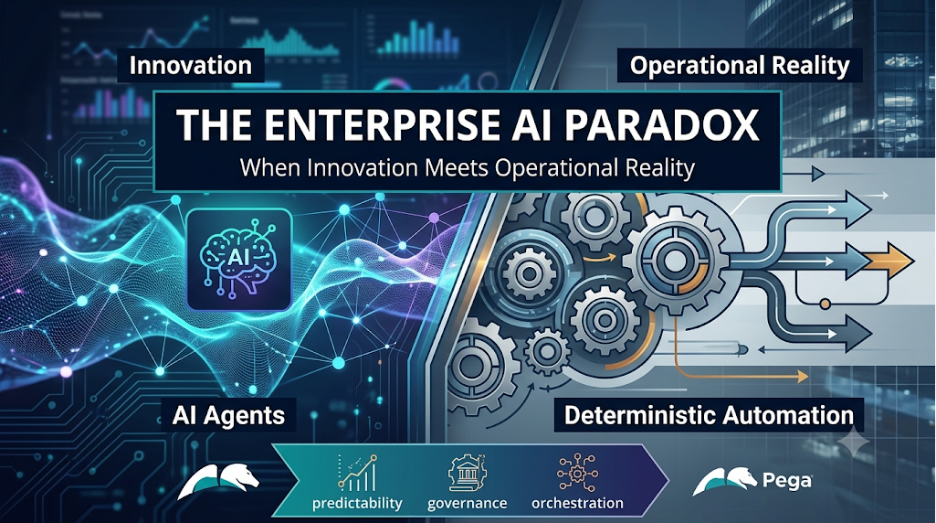
Enterprise AI adoption often begins with impressive demonstrations: AI that understands customer intent, automates complex processes, summarizes information, and makes intelligent recommendations.
The challenge begins when those demonstrations meet real world enterprise operations.
A controlled demo may work perfectly. Production environments are different. Customers use unexpected language, accents vary, data can be incomplete, systems can behave unpredictably, and critical business processes often operate under strict compliance requirements.
A simple request can expose the difference between AI that is impressive and AI that is dependable.
For example, an AI system may correctly understand most customer requests but produce an unexpected interpretation when the input is ambiguous. In a consumer application, that may be inconvenient. In an enterprise workflow involving financial transactions, healthcare decisions, or regulatory processes, unpredictability can become a significant operational risk.
The issue is not that AI is incapable.
The issue is where and how AI should be used.
Predictability Is a Business Requirement
Consumer AI can prioritize creativity and flexibility. Enterprise systems often require something different:
Consistency, transparency, and governance.
Predictable AI should provide three fundamental capabilities:
1. Consistency
Similar inputs should generate consistent outcomes.
For example, if the same business conditions are presented to an automated claims process, the resulting decision should follow the same defined logic rather than changing unpredictably.
2. Transparency
Organizations need to understand why a decision was made.
If an AI assisted process recommends rejecting a high value claim, approving a transaction, or escalating a customer case, the organization should be able to trace the reasoning and supporting business conditions.
3. Governance
Enterprise AI must operate within established:
- Business rules
- Compliance requirements
- Security policies
- Risk controls
- Approval processes
- Audit requirements
This means governance cannot be something added after deployment. It needs to be part of the architecture.
AI Agents and Deterministic Automation Should Work Together
One of the most important concepts in enterprise AI is that not every task should be delegated to an AI agent.
AI agents are particularly useful for tasks involving interpretation, reasoning, and unstructured information.
For example:
AI driven tasks
- Understanding an incoming customer email
- Extracting information from unstructured documents
- Summarizing a case
- Determining customer intent
- Recommending the next best action
But some activities require deterministic execution:
Deterministic tasks
- Applying regulatory rules
- Performing eligibility calculations
- Validating required fields
- Executing predefined approval rules
- Calculating risk scores
- Recording audit information
The strongest enterprise architecture combines both.
Use AI where judgment and interpretation are valuable. Use deterministic automation where precision and repeatability are mandatory.
This creates a controlled workflow where AI contributes intelligence without becoming an uncontrolled decision maker.
How Pega Approaches Enterprise AI
Pega takes this approach by combining agentic AI with enterprise workflow orchestration.
Structured orchestration
Workflows can combine AI powered activities with deterministic business rules.
An AI agent might interpret a customer request, while a rules based component performs the critical validation or calculation.
This separation allows organizations to introduce intelligence without sacrificing operational control.
Auditable execution
Enterprise processes need traceability.
Actions performed by AI, automation, or employees should be recorded so organizations can understand what happened during a case lifecycle and support compliance and investigation requirements.
Center out architecture
A center out approach places core business processes, rules, and intelligence at the center of the architecture rather than recreating business logic independently across every channel.
This allows AI powered experiences to operate using established organizational knowledge and business rules.
From AI Concept to Production Workflow
A practical enterprise AI implementation can follow a structured lifecycle:
1. Define the business outcome
Start with the process rather than the AI technology.
For example:
Automate customer address change requests.
2. Break the process into individual steps
Identify which activities require intelligence and which require deterministic execution.
For example:
Customer Request
↓
Understand Request → AI
↓
Verify Identity → Deterministic
↓
Validate Address → Rules/Automation
↓
Update Customer Data → Deterministic
↓
Notify Customer → Automation
3. Assign the appropriate technology to each step
AI should handle ambiguity and interpretation.
Rules and automation should handle precision critical operations.
4. Add governance
Define authorization, compliance controls, auditability, and escalation paths before production deployment.
5. Monitor continuously
Enterprise AI is not a “deploy once and forget” technology. Production behavior needs continuous monitoring, evaluation, and improvement.
Why This Matters for Business
The value of enterprise AI is not simply measured by how intelligent an AI model appears.
The more important questions are:
- Can the organization trust its decisions?
- Can those decisions be explained?
- Can the process be audited?
- Can business rules be enforced?
- Can exceptions be handled safely?
- Can the organization scale the solution without increasing operational risk?
This changes the definition of successful AI adoption.
The goal is not maximum autonomy. The goal is appropriate autonomy.
AI should be given enough freedom to solve problems where adaptive intelligence creates value, while deterministic controls should remain responsible for processes where errors are unacceptable.
The Future of Enterprise AI Is Controlled Intelligence
The next stage of enterprise AI will not be about choosing between innovation and control.
It will be about combining them.
AI agents can provide reasoning, interpretation, and adaptability. Enterprise workflows can provide structure, governance, auditability, and deterministic execution.
Together, they create a more practical model for AI adoption:
AI for intelligence.
Automation for precision.
Workflows for orchestration.
Governance for trust.
The organizations that successfully scale AI will not necessarily be those that automate everything with AI.
They will be the organizations that understand where AI belongs, where deterministic automation belongs, and how both can work together inside governed business processes.
#ArtificialIntelligence #EnterpriseAI #AgenticAI #Pega #PredictableAI #Automation #DigitalTransformation #AI #WorkflowAutomation #EnterpriseArchitecture
