
Introduction
In today’s digital world, customers connect with businesses through multiple channels—email, chat, social media, and messaging apps. To handle this on a large scale, businesses need more than simple keyword searches. This is where Natural Language Processing (NLP) in Pega comes into play.
NLP helps to understand customer intent, sentiment, and entities in real time, enabling faster resolution, personalized service, and reduced CSR effort.
What is NLP?
NLP is the ability of Pega to interpret unstructured customer text or speech and convert it into meaningful actions.
Pega leverages NLP to:
- Detect intents (e.g., “I want to reset my password”).
- Extract entities (e.g., account number, date, email ID).
- Identify sentiment (positive, neutral, or negative tone).
- Route interactions to the right queue or service case.
Key NLP Features
- Intent Detection
- Identifies the purpose of the customer message.
- Example: A message like “I lost my card, please block it immediately” triggers the Block Lost Card service case.
- Entity Extraction
- Pulls out critical information from text.
- Example: In “My order #45678 hasn’t arrived”, NLP extracts order #45678.
- Sentiment Analysis
- Detects customer mood (positive/negative).
- Helps in escalation if a customer is frustrated.
- Auto Case Creation
- Creates or suggests a Service Case automatically based on the intent.
- Example: Email subject line “Need billing details” opens the Billing Inquiry case.
- Smart Routing
- Routes interactions to the most appropriate CSR or automated bot, based on detected intent and sentiment.
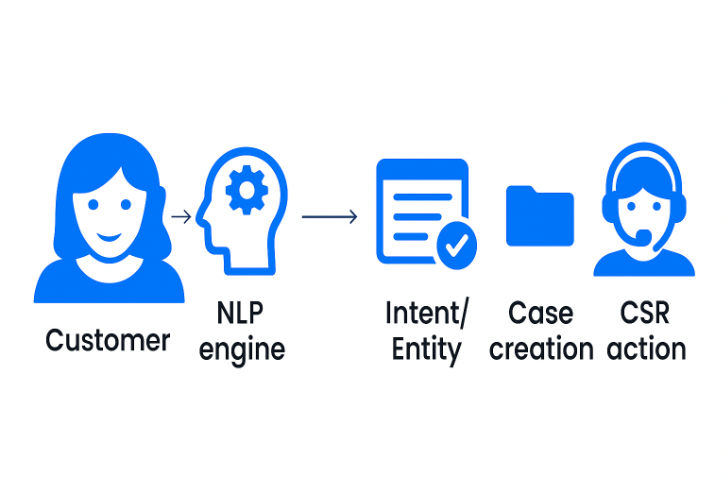
How NLP Works
- Message arrives → via Email, Chat, WhatsApp, or other channels.
- NLP model analyzes the text:
- Runs intent and entity detection rules.
- Applies sentiment analysis.
- Case suggestion → Service case or reply template is suggested to CSR.
- Automation → Pega either auto-creates a case or guides CSR with the next best step.
Business Benefits of NLP
- Faster resolution – reduces CSR handling time.
- Consistent experience – ensures customers get the right response every time.
- Proactive service – sentiment-based escalation prevents churn.
- Reduced manual effort – automates case creation and routing.
- Scalability – handles thousands of unstructured messages daily.
Real-World Examples
- Banking – NLP detects “block card” requests and automatically launches the Block Lost Card case.
- Telecom – Customer complaint “My internet is slow” triggers troubleshooting workflow.
- Retail – “Where is my order #78910?” → NLP extracts order ID and starts a tracking case.
Best Practices for Using NLP
- Train NLP models with real customer data for accuracy.
- Regularly update intents and entities as business evolves.
- Use sentiment analysis for proactive escalation.
- Leverage Knowledge Articles for CSR-guided responses.
- Integrate with Next-Best-Action (NBA) for personalized service.
Conclusion
NLP in Pega Customer Service transforms raw customer conversations into actionable insights. By automating intent detection, entity extraction, and sentiment analysis, businesses can deliver faster, smarter, and more personalized services while reducing CSR workload. In a world where customer expectations are higher than ever, NLP is not just an add-on—it’s a core enabler of intelligent customer engagement.
