
Introduction
When most people think about software development, they often imagine writing code, building applications, and creating new features. While those are certainly important parts of the job, the reality of being a developer goes far beyond simply writing code.
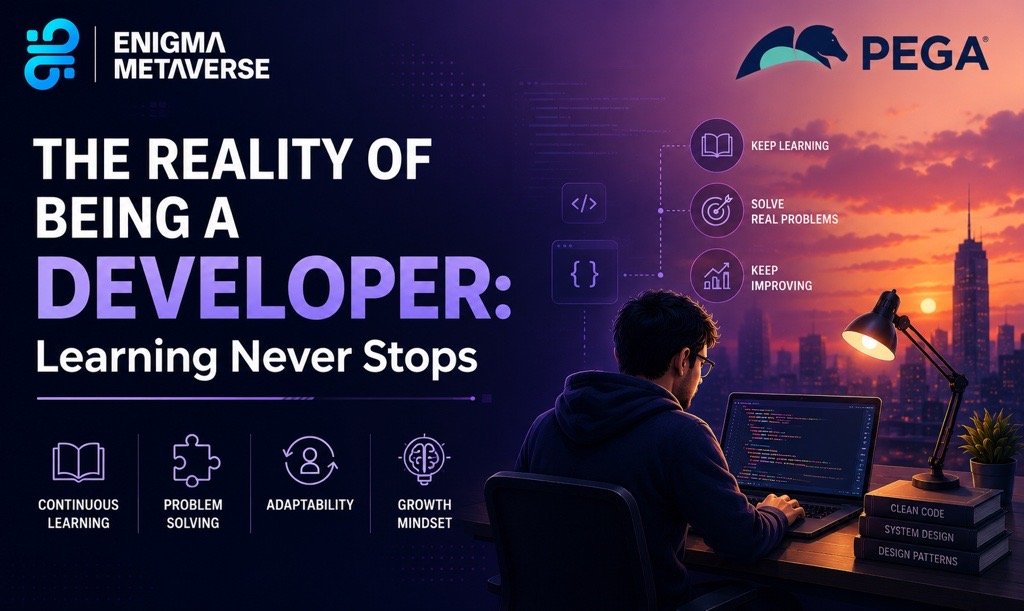
One of the most important lessons I’ve learned is that software development is a field where learning never truly stops.
Unlike many professions where knowledge can remain relevant for years, technology evolves at an incredible pace. New frameworks emerge, existing technologies receive major updates, industry best practices change, and businesses continuously introduce new requirements. As developers, we must adapt to these changes while continuing to deliver quality solutions.
This constant evolution is both the greatest challenge and the greatest opportunity in a developer’s career.

The Myth of “Knowing Everything”
Many aspiring developers believe that experienced engineers know everything about programming. When starting a career in technology, it’s easy to assume that senior developers have all the answers and rarely encounter difficulties.
However, the reality is very different.
The more experience developers gain, the more they realize how vast the technology landscape truly is. Every framework has its own ecosystem. Every programming language has unique concepts. Every project introduces new business logic, requirements, and challenges.
Even the most experienced professionals regularly encounter situations where they need to research, experiment, and learn something new.
The difference is not that experienced developers know everything. The difference is that they have developed the ability to learn efficiently, troubleshoot effectively, and adapt quickly.
Learning how to learn is often more valuable than memorizing technical concepts.
Every Challenge Becomes a Lesson
One aspect of software development that makes it unique is the number of challenges developers face on a daily basis.
Sometimes a feature works perfectly in development but fails in production.
Sometimes an API returns unexpected results.
Sometimes a deployment introduces issues that were never visible during testing.
Sometimes a bug appears in a completely unrelated part of the application after making a small change.
While these situations can be frustrating, they often become the most valuable learning experiences.
Every debugging session teaches patience.
Every production issue teaches responsibility.
Every failed deployment teaches preparation.
Every code review teaches improvement.
Over time, developers begin to understand that challenges are not obstacles to growth—they are growth itself.
The lessons learned while solving difficult problems often remain valuable long after the specific problem has been forgotten.
Technology Never Stands Still
One of the defining characteristics of the technology industry is its rapid pace of innovation.
A few years ago, certain frameworks dominated the industry. Today, new tools and approaches have emerged.
Cloud computing transformed how applications are deployed.
Artificial Intelligence is transforming how software is developed.
Modern frontend frameworks continue to evolve.
Backend architectures are becoming increasingly sophisticated.
Development practices such as DevOps, CI/CD, containerization, and microservices have become mainstream.
For developers, this means continuous adaptation.
Learning cannot be treated as a one-time activity completed after graduation or after securing a job. It becomes a lifelong commitment.
The most successful developers are often those who remain curious regardless of their experience level.
They read documentation.
They explore new technologies.
They study best practices.
They learn from colleagues.
They continuously improve their skills.
This commitment to growth helps them remain valuable in an ever-changing industry.
Learning Beyond Code
When people discuss software development, they often focus exclusively on technical skills.
While technical expertise is essential, many important lessons occur outside the code itself.
Developers learn communication skills while discussing requirements with stakeholders.
They learn collaboration while working with teammates.
They learn time management while balancing multiple priorities.
They learn problem-solving through complex technical challenges.
They learn accountability when managing production systems.
These professional skills become increasingly important as careers progress.
In many situations, the ability to communicate effectively and collaborate with others can be just as important as technical knowledge.
Great developers do not simply write good code.
They understand business goals.
They communicate clearly.
They support their teammates.
They contribute to a positive development culture.
The Importance of Curiosity
Curiosity is one of the most powerful qualities a developer can possess.
Curious developers ask questions.
They seek to understand how systems work.
They investigate root causes instead of accepting surface-level explanations.
They explore alternatives and continuously search for better solutions.
Curiosity drives innovation.
It transforms ordinary tasks into opportunities for learning.
It encourages experimentation and improvement.
Many of the most significant breakthroughs in technology began because someone was curious enough to ask, “Can this be done differently?”
For developers, maintaining curiosity helps prevent stagnation and keeps learning enjoyable.
Growth Happens Gradually
One of the biggest mistakes developers make is underestimating the value of small improvements.
Growth rarely happens overnight.
Instead, it occurs through hundreds of small learning experiences accumulated over time.
Reading a technical article.
Fixing a difficult bug.
Learning a new framework feature.
Participating in a code review.
Understanding a database optimization technique.
Improving application performance.
Each individual lesson may seem small.
However, over months and years, these lessons combine to create significant professional growth.
Consistency often matters more than intensity.
Developers who commit to learning a little every day frequently achieve greater long-term success than those who learn only occasionally.
Embracing the Journey
Perhaps the most important realization in software development is that there is no final destination.
There will always be new technologies to explore.
There will always be better practices to learn.
There will always be new challenges to solve.
Instead of viewing this as overwhelming, developers can view it as an opportunity.
The endless learning journey is what keeps technology exciting.
Every project introduces something new.
Every challenge develops new skills.
Every experience contributes to growth.
The goal is not to know everything.
The goal is to become better than you were yesterday.
Conclusion
The reality of being a developer is simple: learning never stops.
Technology changes.
Projects evolve.
Challenges emerge.
New opportunities appear.
The developers who thrive are not necessarily those with the most knowledge today. They are the ones who remain curious, adaptable, and committed to continuous improvement.
Every bug fixed, every feature delivered, every mistake corrected, and every lesson learned contributes to becoming a stronger developer.
In a world where technology constantly evolves, continuous learning is not just an advantage—it is a necessity.
And perhaps that is what makes software development such a rewarding career.
The journey never ends, and that’s exactly what makes it worth pursuing.
