
Introduction
Modern web applications often manage thousands or even millions of records. As data grows, applications can become slower if they are not optimized properly. Efficient data handling improves performance, scalability, and user experience by ensuring that information is processed and displayed quickly.
Why Efficient Data Handling Matters
Managing large datasets effectively helps:
- Improve application speed
- Reduce server load
- Lower memory usage
- Enhance user experience
- Support application scalability
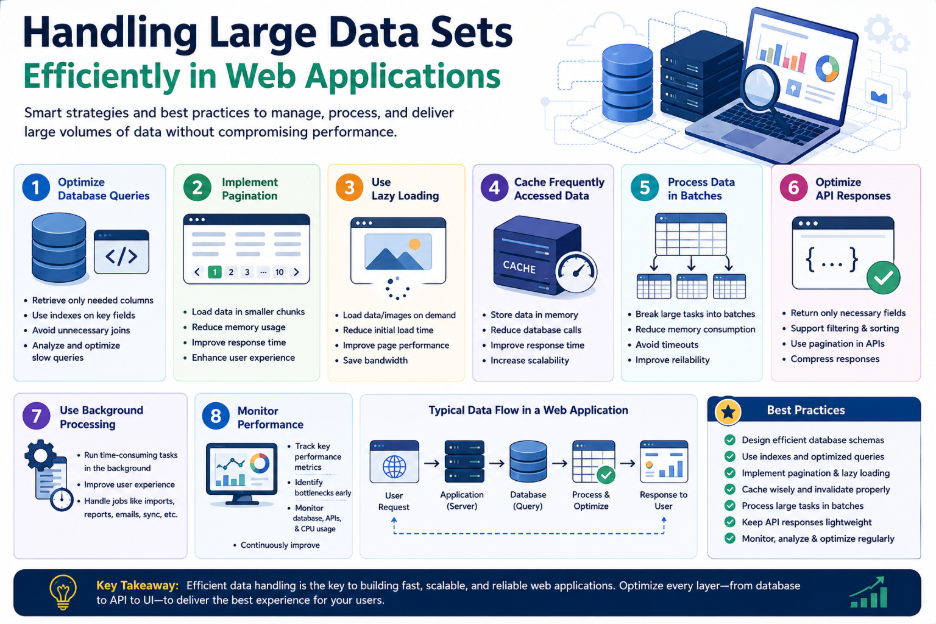
Optimize Database Queries
Database performance is the foundation of a fast application.
Best practices include:
- Use indexes on frequently searched columns.
- Retrieve only the required data.
- Avoid unnecessary queries.
- Optimize slow SQL statements.
Use Pagination and Lazy Loading
Instead of loading all records at once:
- Implement pagination to display data in smaller chunks.
- Use lazy loading to load data or images only when needed.
These techniques reduce load times and improve responsiveness.
Cache Frequently Used Data
Caching stores commonly accessed data in memory, reducing repeated database requests and improving response times. It also helps applications handle more users efficiently.
Optimize API Responses
Keep API responses lightweight by:
- Returning only required fields
- Supporting filtering and pagination
- Compressing response data
Smaller responses improve communication between the server and client.
Process Large Tasks in the Background
Operations like file imports, report generation, and email notifications should run as background jobs. This keeps the application responsive while heavy tasks are processed.
Best Practices
- Optimize database queries.
- Use pagination and lazy loading.
- Cache frequently accessed data.
- Keep API responses lightweight.
- Process large operations in batches or background jobs.
- Monitor application performance regularly.
Conclusion
Efficiently handling large datasets is essential for building fast and scalable web applications. By optimizing database queries, using pagination, implementing caching, and processing large tasks in the background, developers can ensure smooth performance even as data continues to grow. These practices improve both system efficiency and the overall user experience.
