
Introduction
Artificial Intelligence (AI) is one of the most impactful technologies of the modern era. It enables computers and machines to perform tasks that typically require human intelligence, such as learning, problem-solving, decision-making, and understanding language. From virtual assistants to self-driving cars, AI is transforming the way we live and work.
What is Artificial Intelligence?
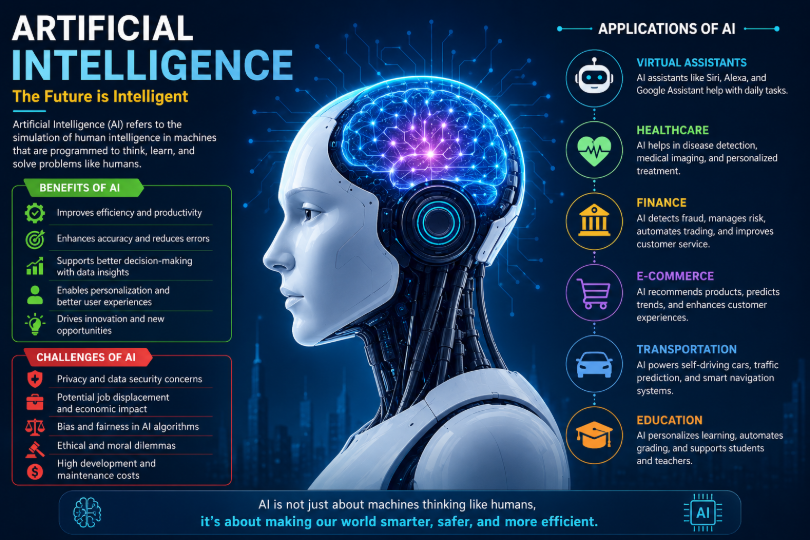
Artificial Intelligence is the simulation of human intelligence in machines. AI systems analyze data, recognize patterns, and make decisions with minimal human intervention. By learning from experience, these systems continue to improve their performance over time.
Common Applications of AI
AI has become a part of our daily lives in many ways:
- Virtual Assistants: Siri, Google Assistant, and Alexa help users perform tasks using voice commands.
- Healthcare: AI assists doctors in diagnosing diseases, analyzing medical images, and recommending treatments.
- Finance: Banks use AI to detect fraud, assess credit risk, and automate customer support.
- E-commerce: Online shopping platforms recommend products based on customer preferences.
- Transportation: AI powers navigation systems, traffic prediction, and autonomous vehicles.
- Education: Personalized learning platforms adapt lessons based on student performance.
Benefits of AI
Artificial Intelligence offers numerous advantages:
- Improves efficiency by automating repetitive tasks.
- Reduces human errors and increases accuracy.
- Enhances decision-making through data analysis.
- Provides personalized experiences for users.
- Supports innovation across industries.
- Saves time and operational costs.
Challenges of AI
Despite its benefits, AI also presents several challenges:
- Privacy and data security concerns.
- Potential job displacement due to automation.
- Bias in AI models caused by poor-quality training data.
- Ethical issues surrounding decision-making.
- High development and maintenance costs.
Addressing these challenges requires responsible AI development, transparency, and proper regulations.
The Future of AI
The future of AI is promising. As technology advances, AI will become even more capable in areas such as healthcare, robotics, cybersecurity, and scientific research. Businesses will increasingly use AI to improve productivity, while individuals will benefit from smarter and more personalized digital experiences.
However, the future success of AI depends on balancing innovation with ethical responsibility, ensuring that AI systems remain fair, secure, and beneficial for society.
Conclusion
Artificial Intelligence is reshaping industries and changing the way people interact with technology. Its ability to learn, analyze, and automate complex tasks makes it a powerful tool for solving real-world problems. While challenges remain, responsible development and ethical practices can help unlock AI’s full potential, making it a valuable force for innovation and progress in the years ahead.
