
Introduction
Enterprise applications are becoming increasingly data-driven, requiring information from multiple systems, services, and databases. Traditional REST-based integrations have served organizations well for years, but as application ecosystems grow more complex, challenges such as over-fetching, under-fetching, and excessive API calls become more apparent.
GraphQL has emerged as a powerful alternative that allows clients to request exactly the data they need through a single endpoint. While Pega natively supports REST and SOAP integrations, many organizations are exploring GraphQL to build more flexible, efficient, and scalable integration architectures.
This article explores GraphQL fundamentals, integration patterns, architectural considerations, and best practices for implementing GraphQL in enterprise Pega environments.
Understanding GraphQL
GraphQL is a query language and runtime for APIs that enables clients to specify precisely what data they need.
Unlike REST APIs where multiple endpoints often exist for different resources, GraphQL typically exposes a single endpoint.
For example, instead of calling:
- /customer
- /orders
- /payments
A GraphQL client can retrieve all required information through one query.
Key Characteristics
- Single API endpoint
- Client-driven data retrieval
- Strongly typed schema
- Reduced network traffic
- Flexible data aggregation
These capabilities make GraphQL particularly attractive for modern digital experiences.
Why Organizations Are Adopting GraphQL
Modern applications frequently consume information from multiple systems simultaneously.
Examples include:
- Customer portals
- Mobile applications
- Partner platforms
- Constellation-based applications
- Headless architectures
Common REST challenges include:
Over-Fetching
Receiving more information than needed.
Example:
A customer profile API returns 100 fields when only 10 are required.
Under-Fetching
Needing multiple API calls to gather related information.
Example:
Customer details, order history, and payment records require separate requests.
API Proliferation
Managing hundreds of endpoints becomes increasingly complex.
GraphQL addresses these limitations through flexible query structures.
GraphQL Architecture Patterns
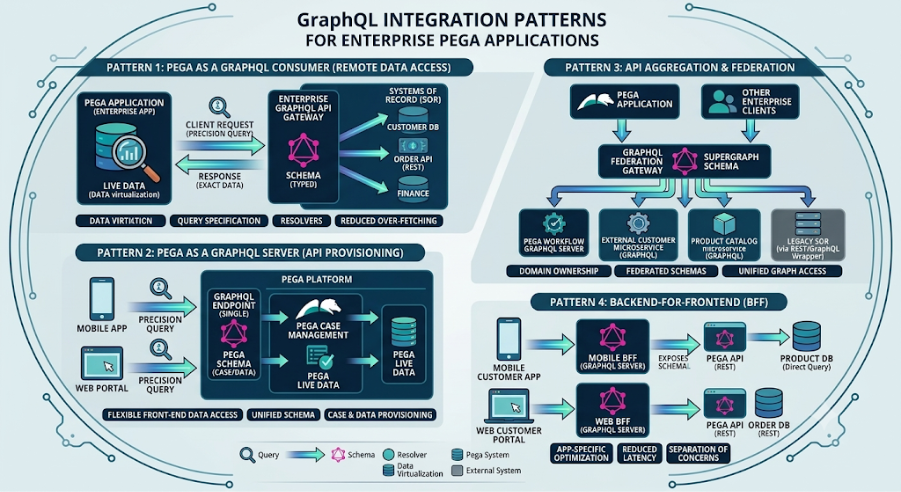
Several GraphQL integration patterns are commonly used within enterprise environments.
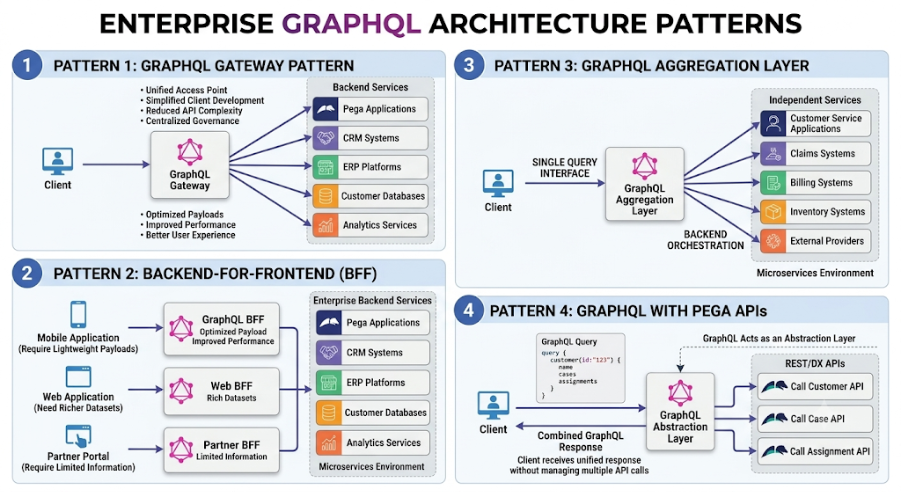
Pattern 1: GraphQL Gateway Pattern
The GraphQL Gateway acts as a centralized access layer.
Architecture
Client → GraphQL Gateway → Multiple Backend Services
Backend services may include:
- Pega applications
- CRM systems
- ERP platforms
- Customer databases
- Analytics services
Benefits
- Unified access point
- Simplified client development
- Reduced API complexity
- Centralized governance
This is one of the most common enterprise GraphQL architectures.
Pattern 2: Backend-for-Frontend (BFF)
Different channels often require different data structures.
Examples include:
Mobile Applications
Require lightweight payloads.
Web Applications
Need richer datasets.
Partner Portals
Require limited information.
A GraphQL BFF layer can tailor responses to specific channel requirements.
Benefits include:
- Optimized payloads
- Improved performance
- Better user experience
Pattern 3: GraphQL Aggregation Layer
Many enterprises operate dozens of independent services.
GraphQL can aggregate information from:
- Customer service applications
- Claims systems
- Billing systems
- Inventory systems
- External providers
Clients interact with a single query interface while the aggregation layer orchestrates backend requests.
This pattern is especially valuable in microservices environments.
Pattern 4: GraphQL with Pega APIs
Pega exposes extensive functionality through REST APIs and DX APIs.
GraphQL can act as an abstraction layer above these services.
Example
GraphQL Query:
query {
customer(id:”123″) {
name
cases
assignments
}
}
GraphQL Resolver Actions:
- Call Customer API
- Call Case API
- Call Assignment API
- Combine responses
The client receives a unified response without managing multiple API calls.
GraphQL for Constellation Applications
Constellation applications are highly API-driven.
GraphQL can complement Constellation by:
- Aggregating backend data
- Simplifying external integrations
- Supporting custom digital channels
- Enabling headless architectures
Potential use cases include:
- Customer dashboards
- Self-service portals
- Mobile applications
- Partner ecosystems
This approach can significantly reduce frontend integration complexity.
Schema Design Best Practices
A GraphQL schema serves as the contract between clients and services.
Good Schema Characteristics
- Consistent naming conventions
- Clear object relationships
- Strong typing
- Logical organization
Example entities:
- Customer
- Case
- Assignment
- Product
- Payment
Well-designed schemas improve maintainability and developer productivity.
Security Considerations
GraphQL introduces unique security challenges.
Query Complexity Attacks
Clients may submit highly complex queries that consume excessive resources.
Mitigation:
- Query depth limits
- Query complexity scoring
- Execution time limits
Authorization Controls
Access must be enforced at:
- Object level
- Field level
- Operation level
Rate Limiting
Protect APIs against abuse by limiting request frequency.
Input Validation
Validate all incoming parameters before processing.
Security should be considered from the beginning of implementation.
Performance Optimization Strategies
GraphQL flexibility can introduce performance concerns if not managed carefully.
Data Loader Pattern
Prevents repeated database queries.
Benefits:
- Reduced database load
- Faster response times
Response Caching
Cache frequently requested data.
Examples:
- Product catalogs
- Reference data
- Configuration settings
Pagination
Avoid returning large datasets.
Use:
- Cursor-based pagination
- Offset-based pagination
Query Monitoring
Track:
- Execution times
- Query complexity
- Resource utilization
Continuous monitoring prevents performance degradation.
Error Handling Patterns
Enterprise integrations require robust error management.
Recommended approaches:
Partial Success Responses
Allow successful data retrieval even when some backend systems fail.
Standardized Error Objects
Provide consistent error structures across services.
Retry Strategies
Implement controlled retry mechanisms for transient failures.
Circuit Breakers
Prevent cascading failures during service outages.
These patterns improve resilience and user experience.
GraphQL in Microservices Environments
GraphQL aligns naturally with microservices architectures.
Benefits include:
- Service abstraction
- Reduced client complexity
- Centralized data orchestration
- Independent service evolution
Organizations frequently use GraphQL as the presentation layer while microservices remain independently managed behind the scenes.
Governance and Operational Considerations
Successful GraphQL implementations require governance.
Key areas include:
Schema Management
Control schema evolution through versioning strategies.
Monitoring
Track:
- Query execution
- Latency
- Error rates
- Usage patterns
Documentation
Maintain clear schema documentation for developers.
Change Management
Ensure backward compatibility whenever possible.
Governance becomes increasingly important as adoption grows.
Future Trends
Several emerging trends are shaping GraphQL adoption:
- AI-driven API composition
- Federated GraphQL architectures
- Real-time GraphQL subscriptions
- Event-driven GraphQL integrations
- Hybrid GraphQL and REST ecosystems
These innovations will continue expanding GraphQL’s role in enterprise architectures.
Conclusion
GraphQL provides a flexible and efficient integration approach for modern enterprise applications. By allowing clients to request exactly the data they need, GraphQL reduces network traffic, simplifies frontend development, and improves integration flexibility.
For organizations using Pega, GraphQL can serve as a powerful abstraction layer that aggregates information from multiple APIs, supports headless architectures, and enhances digital experiences. When implemented with proper governance, security, and performance controls, GraphQL becomes a valuable component of an enterprise integration strategy capable of supporting future growth and innovation.
