
Introduction
Enterprise applications communicate with customers every day—sending emails when a case is created, generating printable mail after an approval, notifying users through SMS, or producing documents for business processes. In Pega, all these outbound communications are handled through the Correspondence framework.
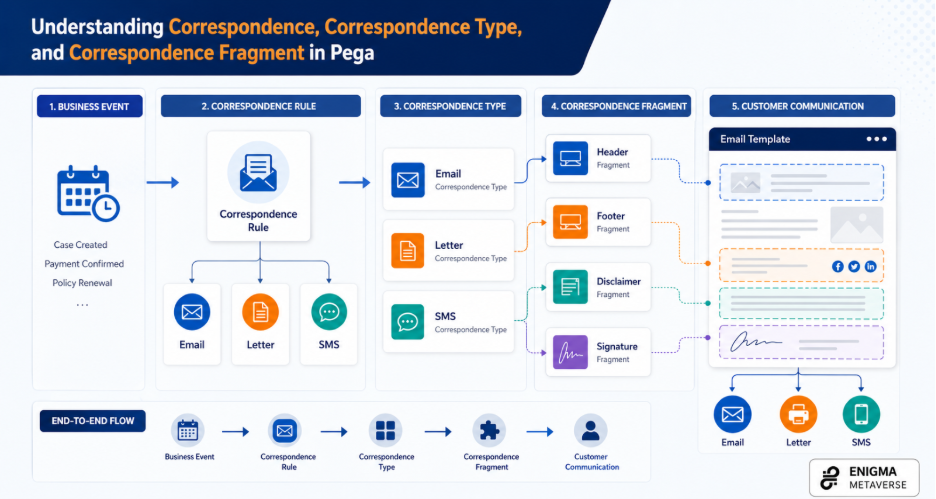
Rather than creating separate templates for every communication channel, Pega divides the functionality into three rule types that work together:
- Correspondence Rule – Defines the content of the message.
- Correspondence Type – Specifies how the message will be delivered.
- Correspondence Fragment – Stores reusable content that can be shared across multiple correspondence rules.
This modular approach makes correspondence easier to maintain, promotes reuse, and ensures consistent communication across the application.
What is Correspondence in Pega?
A Correspondence Rule is responsible for creating the actual communication that is sent to customers, work parties, or external users.
Correspondence can be generated in different formats such as:
- Fax
- Phone (SMS)
A correspondence rule contains the complete message template, including:
- Subject
- Message body
- HTML formatting
- Dynamic property references
- Images
- Attachments
- Correspondence fragments
Whenever a business event occurs—such as case creation, assignment completion, approval, rejection, or resolution—Pega can automatically generate correspondence using the configured rule.
Unlike traditional email templates, correspondence rules are dynamic. They retrieve information directly from the clipboard so every message is personalized using live case data.
Typical examples include:
- Welcome Emails
- Payment Confirmation
- Order Updates
- Approval Notifications
- Policy Renewal Messages
- Case Resolution Emails
How a Correspondence Rule Works
A correspondence rule follows a straightforward process:
- A business event triggers communication.
- Pega executes the Correspondence Rule.
- Dynamic case information is inserted.
- Correspondence Fragments are included.
- The selected Correspondence Type determines the delivery channel.
- The final communication is sent to the customer.
Because the content and delivery mechanism are separated, developers can update templates without changing how the communication is delivered.
What is a Correspondence Type?
A Correspondence Type defines how a correspondence is delivered to the recipient. Instead of embedding the delivery method inside every correspondence rule, Pega separates this responsibility into a dedicated Correspondence Type rule.
This design allows developers to reuse the same correspondence content while delivering it through different communication channels.
Pega provides four standard Correspondence Types out of the box:
| Correspondence Type | Purpose |
| Sends HTML email messages through the configured email system. | |
| Generates printable correspondence for physical mail delivery. | |
| Fax | Generates correspondence for fax transmission using supported integrations. |
| Phone (SMS) | Sends short text-based notifications to mobile devices. |
Each Correspondence Type is associated with specific data classes that determine how the communication is generated and where recipient information is stored.
For example:
- Correspondence Class: Data-Corr-Email
- Address Class: Data-Address-Email
- Correspondence Class: Data-Corr-Mail
- Address Class: Data-Address-Postal
Fax
- Correspondence Class: Data-Corr-Fax
- Address Class: Data-Address-Fax
Phone (SMS)
- Correspondence Class: Data-Corr-Phone
- Address Class: Data-Address-Phone
When correspondence is generated, Pega automatically checks the selected Correspondence Type and retrieves the appropriate recipient information.
For example:
- If the type is Email, Pega uses the customer’s email address.
- If the type is Mail, Pega retrieves the postal address.
- If the type is Fax, Pega looks for the fax number.
- If the type is Phone (SMS), Pega retrieves the registered mobile number.
This separation makes correspondence rules reusable while allowing the same business event to communicate through different channels.
What is a Correspondence Fragment?
A Correspondence Fragment is a reusable rule that stores common content shared across multiple correspondence rules.
Instead of copying the same HTML into every email template, developers create the content once and include it wherever needed.
Common examples include:
- Company Header
- Company Footer
- Signature Block
- Legal Disclaimer
- Privacy Policy
- Contact Information
- Dynamic Case Links
Fragments are included inside correspondence rules during stream processing, allowing the final communication to be assembled dynamically.
If a fragment is updated, every correspondence rule that references it automatically uses the latest version. This greatly simplifies maintenance and ensures consistency across customer communications.
Benefits of Correspondence Fragments
Using Correspondence Fragments offers several advantages:
- Eliminates duplicate content
- Promotes rule reuse
- Simplifies maintenance
- Maintains consistent branding
- Reduces development effort
- Makes updates easier
- Improves application maintainability
For enterprise applications with many communication templates, fragments significantly reduce maintenance overhead.
How Correspondence, Correspondence Type, and Correspondence Fragment Work Together
Dynamic Content in Correspondence
One of the biggest advantages of Pega Correspondence is its ability to personalize every message.
Developers can insert dynamic values such as:
- Customer Name
- Case ID
- Assignment ID
- Approval Status
- Due Date
- Account Number
- Policy Number
- Payment Details
During execution, Pega retrieves these values from the clipboard and merges them into the final communication, ensuring that each customer receives information specific to their case.
Best Practices
To build maintainable correspondence in Pega, follow these best practices:
- Use Correspondence Rules only for business-specific message content.
- Store reusable sections such as headers, footers, and signatures in Correspondence Fragments.
- Avoid duplicating HTML across multiple templates.
- Use meaningful rule names for easier maintenance.
- Verify recipient information before generating correspondence.
- Keep styling consistent across all templates.
- Reuse fragments whenever possible.
- Test correspondence using different case scenarios before deployment.
Comparison of the Three Rule Types
| Rule Type | Purpose |
| Correspondence Rule | Defines the complete communication message and its dynamic content. |
| Correspondence Type | Specifies the delivery channel such as Email, Mail, Fax, or Phone (SMS). |
| Correspondence Fragment | Stores reusable content like headers, footers, signatures, and disclaimers that can be shared across multiple correspondence rules. |
Conclusion
The Correspondence framework is a core feature of the Pega Platform that enables applications to communicate efficiently with customers and external users. By separating the message content, delivery channel, and reusable content, Pega provides a flexible and maintainable approach to outbound communication.
A Correspondence Rule defines what the customer receives, a Correspondence Type determines how it is delivered, and a Correspondence Fragment allows commonly used content to be reused across multiple templates. Together, these rule types reduce duplication, simplify maintenance, and ensure a consistent communication experience.
Whether you’re building approval emails, printable mail, SMS notifications, or customer updates, understanding how these three rule types work together is essential for designing scalable and professional communication solutions in Pega.
