
Introduction
Notifications play an important role in modern applications. They keep users informed about account verification, password resets, payment confirmations, and order updates.
However, users sometimes receive the same notification twice.
Duplicate notifications may seem like a minor issue. Yet, they can reduce user trust, increase delivery costs, and create confusion. In some cases, they can even trigger unintended business operations.
The problem becomes more challenging when an application relies on background workers, message queues, databases, and external delivery providers.
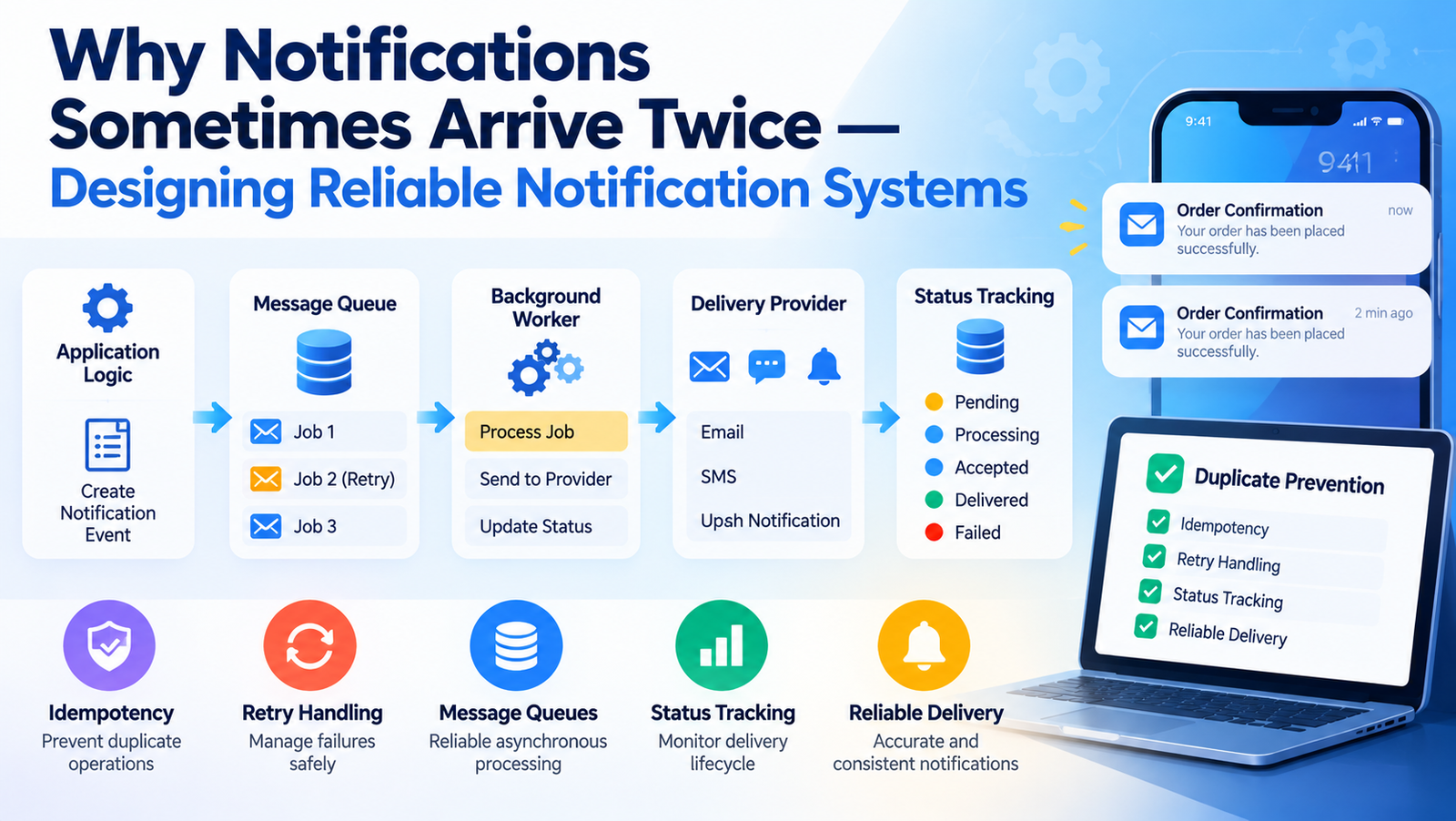
Preventing duplicate notifications requires more than sending a message once. It requires a reliable system that can handle retries, track delivery status, and manage failures across multiple components.
In this article, we’ll explore why duplicate notifications occur and how developers can design more reliable notification systems.
1. Why Do Duplicate Notifications Happen?
Most notification systems depend on several components working together. These may include application logic, job queues, background workers, databases, and external delivery providers.
A failure in any part of this workflow can result in duplicate notifications.
Common causes include:
- Queue retries: A queue retries a job after a timeout or temporary failure.
- Worker crashes: A worker sends a notification but crashes before recording success.
- Repeated application events: The application creates the same notification more than once.
- Provider timeouts: A delivery provider processes a request, but its response never reaches the application.
- Concurrent processing: Multiple workers process the same logical notification at the same time.
The biggest challenge is determining whether an operation actually failed.
For example, a timeout does not necessarily mean the notification was never sent. The provider may have processed the request successfully, even though the application received no confirmation.
Therefore, reliable systems must distinguish between a confirmed failure and an unknown outcome.
2. Why Retries Can Create Duplicate Notifications
Retries help applications recover from temporary failures. They are especially useful when network connections are interrupted or external services become temporarily unavailable.
However, retries can also introduce duplicate notifications.
Consider an email notification sent through an external provider.
- The application submits an email request.
- The provider accepts the request.
- The application times out before receiving confirmation.
- The application retries the request.
- The provider processes the second request.
If the first email was already sent, the recipient may receive the same email twice.
This problem occurs because the application cannot always determine whether the original operation succeeded.
Retries improve reliability, but they do not automatically prevent duplicate side effects.
To handle this situation, developers need additional safeguards that identify repeated operations and prevent unnecessary processing.
3. Idempotency: A Key Reliability Principle
Idempotency is an important concept in reliable notification systems.
An operation is idempotent when repeating the same logical request does not produce additional unintended effects.
For example, an application may need to send an order confirmation to a customer. If the same order event is processed multiple times, the system should recognize that it represents the same logical notification.
One approach is to assign a unique identifier to each notification.
This identifier might combine the order ID, recipient ID, and notification type. The exact design depends on the application’s requirements.
Before creating or processing a notification, the system can use this identifier to detect duplicate operations.
Techniques for Preventing Duplicate Notifications
Several techniques can help:
- Unique notification IDs: Give each logical notification a stable identifier.
- Database unique constraints: Prevent duplicate notification records with the same logical identity.
- Provider idempotency keys: Use an external provider’s idempotency feature when supported.
- Deduplication records: Store information about previously registered or processed notifications.
- Atomic state transitions: Prevent multiple workers from claiming the same notification simultaneously.
However, a simple database check is not always sufficient.
Suppose two workers check for a notification at the same time. Both may find that no record exists and then attempt to create it.
This can still produce duplicates.
Database constraints, transactions, and atomic operations help prevent such race conditions.
4. Managing Notification Status
Reliable notification systems need clear visibility into the notification lifecycle.
Without accurate status tracking, an application may retry successful operations or fail to retry notifications that were never sent.
A notification might move through the following states:
Pending → Processing → Accepted → Delivered
Alternatively, it may enter a failure or recovery state when an error occurs.
These states should reflect what the system actually knows.
For example, a provider accepting an email request does not necessarily mean the email has reached the recipient’s mailbox.
Similarly, a delivery failure reported by a provider may require a different response from a temporary network timeout.
Why Status Tracking Matters
A well-designed status system helps developers:
- Identify notifications that are still waiting to be processed.
- Detect failed delivery attempts.
- Avoid unnecessary retries.
- Investigate notifications with unknown outcomes.
- Monitor delivery progress.
- Reconcile application records with provider events.
It’s also important to distinguish between accepted, delivered, and failed notifications.
These statuses represent different outcomes and should not be treated as interchangeable.
5. Designing a Reliable Notification Workflow
A reliable notification architecture separates business events from notification delivery.
This separation allows the application to record what needs to happen while background workers handle delivery independently.
A typical workflow looks like this:
Business Event → Notification Record → Queue → Background Worker → Delivery Provider → Status Update
Each component has a specific responsibility.
Business Event
A business event identifies when a notification is required.
For example, an order confirmation may be triggered when an order is successfully created.
Notification Record
The application creates a durable record containing the notification’s identity, recipient, type, and current status.
This record helps the system track the notification throughout its lifecycle.
Message Queue
The queue allows notifications to be processed asynchronously.
It also supports controlled retries when temporary failures occur.
Background Worker
The worker retrieves queued jobs and executes the delivery logic.
It should use appropriate deduplication and concurrency controls to avoid processing the same logical notification incorrectly.
Delivery Provider
The external provider handles the delivery request.
Depending on the provider, the application may receive acceptance responses, delivery events, failure notifications, or other status information.
Status Update
The application records the outcomes it can confirm.
If the result is unknown, the system should follow a defined recovery or reconciliation process rather than automatically assuming the notification failed.
Using the Transactional Outbox Pattern
The transactional outbox pattern can help prevent events from being lost between a database transaction and message publication.
For example, an application may need to save an order and schedule an order confirmation.
If the order is saved but the event is never published, the notification may not be processed.
With a transactional outbox, the application stores the business change and an associated event in the same database transaction. A separate process then publishes the event to the message queue.
However, the transactional outbox pattern does not eliminate duplicate delivery by itself.
The publisher or consumer may process an event more than once. Therefore, idempotency and deduplication remain important.
6. Can Exactly-Once Delivery Be Guaranteed?
Exactly-once delivery is difficult to guarantee when multiple systems are involved.
The challenge becomes greater when the external delivery provider does not support idempotency or provide enough information to reconcile uncertain outcomes.
For example, an application may send an email successfully but lose the provider’s confirmation. Without a reliable way to identify the original operation, retrying may produce a duplicate.
For this reason, developers often focus on reducing duplicate side effects rather than assuming that every notification can be delivered exactly once.
Recommended Reliability Techniques
A practical notification system combines several safeguards:
- Durable notification records.
- At-least-once job processing where appropriate.
- Idempotent application logic.
- Controlled retries with backoff.
- Provider status reconciliation.
- Deduplication mechanisms.
- Monitoring and alerting.
Together, these techniques help the system recover from failures while reducing duplicate notifications.
It’s important to understand the difference between processing a notification exactly once and delivering it exactly once.
Exactly-once processing does not automatically guarantee exactly-once delivery. The final result depends on the guarantees provided by every component in the workflow.
7. Monitoring Notification Systems in Production
Even a carefully designed notification system can experience failures.
Therefore, monitoring is essential for identifying problems before they affect large numbers of users.
Monitoring should cover more than whether background jobs complete successfully.
A job may finish without an error even when the overall notification workflow produces an unwanted duplicate.
Important Metrics to Monitor
Track the following metrics to understand system reliability:
- Duplicate notification rate: Measures how often users receive unintended duplicate notifications.
- Delivery success rate: Shows how many delivery attempts succeed according to the available status information.
- Failure rate: Identifies unsuccessful notification attempts.
- Retry frequency: Reveals whether jobs are repeatedly failing or encountering timeouts.
- Queue waiting time: Measures how long notifications remain waiting for processing.
- Provider response time: Helps identify slow external services.
- Stuck processing jobs: Highlights notifications that remain in processing longer than expected.
- Delivery costs: Helps identify unnecessary spending caused by repeated requests.
- Provider throttling: Reveals when delivery limits affect notification processing.
Use Logs to Investigate Problems
Structured logs can make duplicate notifications easier to investigate.
Include relevant identifiers, such as the notification ID, business event ID, queue job ID, and provider request ID when available.
These identifiers help developers trace a notification across different components.
As a result, teams can determine whether a duplicate originated in application logic, queue processing, concurrent workers, or an external delivery provider.
Monitoring should also trigger alerts when important thresholds are exceeded.
For example, a sudden increase in retries or duplicate notifications may indicate a problem that requires immediate attention.
8. Best Practices for Building Reliable Notification Systems
Preventing duplicate notifications requires coordinated safeguards across the application, queue, database, and delivery provider.
The following practices provide a useful starting point.
1. Assign Stable Notification Identifiers
Give each logical notification a unique, repeatable identifier.
Use it to recognize repeated processing attempts for the same business event.
2. Enforce Deduplication at the Database Level
Use appropriate unique constraints and transactions to prevent duplicate notification records.
Do not rely solely on checking whether a record exists before inserting it.
3. Make Processing Idempotent
Design workers so that processing the same logical notification repeatedly does not create additional unintended effects.
Where supported, use provider idempotency keys to protect external delivery operations.
4. Handle Retries Carefully
Use bounded retries, exponential backoff, and appropriate error classification.
A confirmed temporary failure may justify a retry. An unknown outcome may require reconciliation before another delivery attempt.
5. Track Notification States Accurately
Distinguish between pending, processing, accepted, delivered, failed, and unknown outcomes where appropriate.
Update statuses according to confirmed information rather than assumptions.
6. Protect Against Concurrent Workers
Use atomic claims, conditional updates, or suitable database locking mechanisms to prevent multiple workers from processing the same notification simultaneously.
7. Test Failure Scenarios
Test what happens when workers crash, providers time out, messages are redelivered, or database operations fail.
These scenarios often reveal reliability problems that normal testing does not catch.
8. Monitor Production Behavior
Track retries, delivery failures, queue delays, and duplicate rates.
Use structured logs and alerts to identify problems quickly.
By applying these practices together, development teams can build notification systems that recover from failures without creating unnecessary duplicate messages.
Conclusion
Duplicate notifications are more than a minor inconvenience. They can reduce user trust, increase operational costs, and create unintended business effects.
The problem often occurs when applications cannot determine whether an operation succeeded, especially during network timeouts, queue retries, and concurrent processing.
Fortunately, developers can reduce these risks through idempotency, durable notification records, database constraints, controlled retries, and accurate status tracking.
The transactional outbox pattern can also help prevent events from being lost between database changes and message publication. However, it must be combined with deduplication and other safeguards.
Finally, production monitoring helps teams detect duplicate deliveries and investigate their causes.
The key takeaway is simple: Reliable notification systems must be designed for retries, failures, and duplicate processing from the beginning. Sending a notification is only one part of the process. Ensuring that the system handles the outcome correctly is what makes it reliable.
