
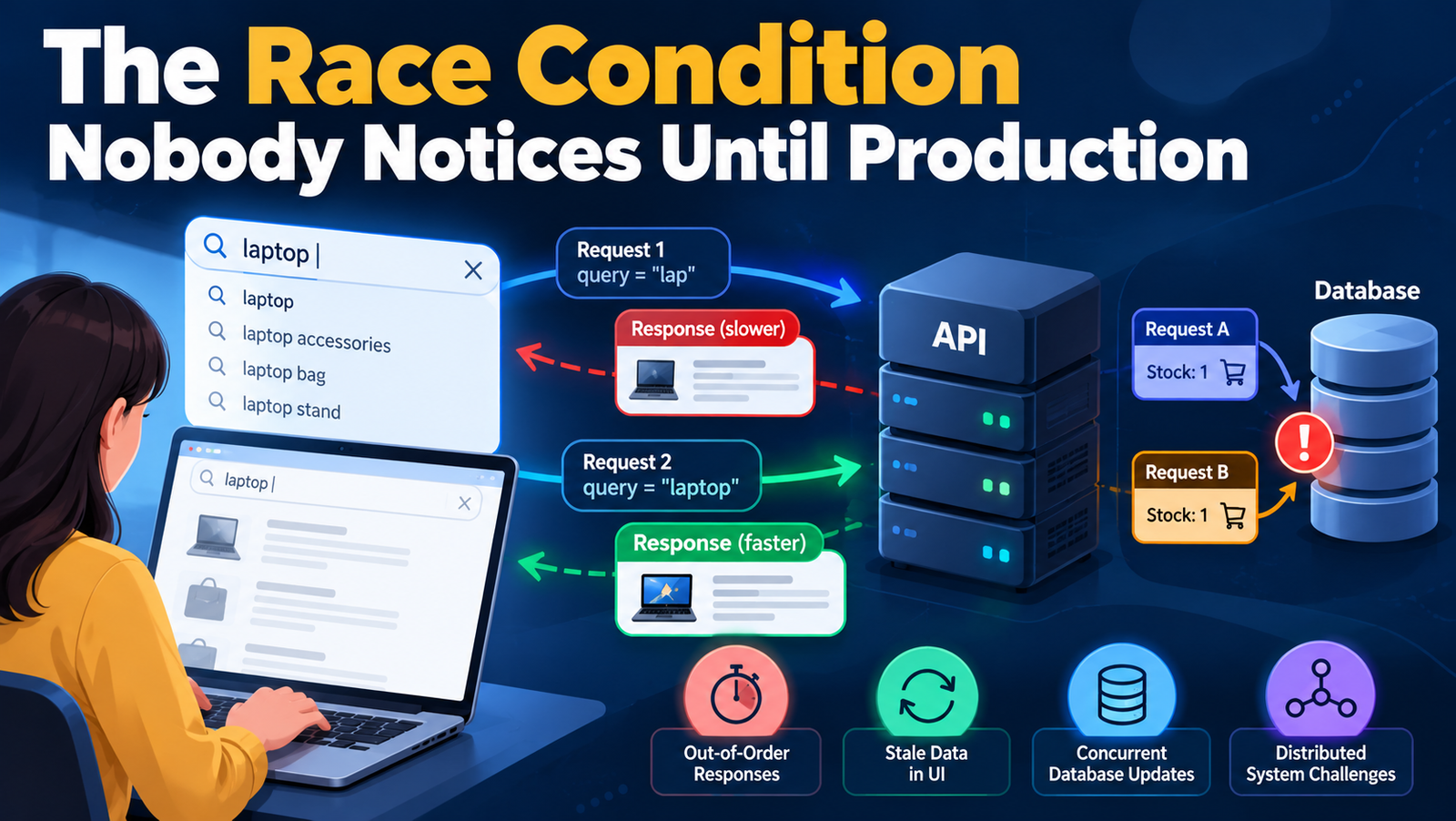
Imagine typing a search query into an application. Before the first API request completes, you continue typing, triggering another request. The second request returns first, displaying the correct results, but the earlier request later overwrites them with outdated information.
This is a race condition. It occurs when an application’s behavior depends on the timing or order of concurrent operations. These bugs can be difficult to identify because they often appear only under specific network conditions or during high production traffic.
1. What Is a Race Condition?
A race condition occurs when multiple operations execute concurrently and their timing affects the final result.
In full-stack applications, requests may finish in a different order from the order in which they were initiated. If the application does not handle this properly, older responses can overwrite newer data, or concurrent operations can produce inconsistent database records.
2. The Search Autocomplete Problem
Search autocomplete is a common example of a frontend race condition.
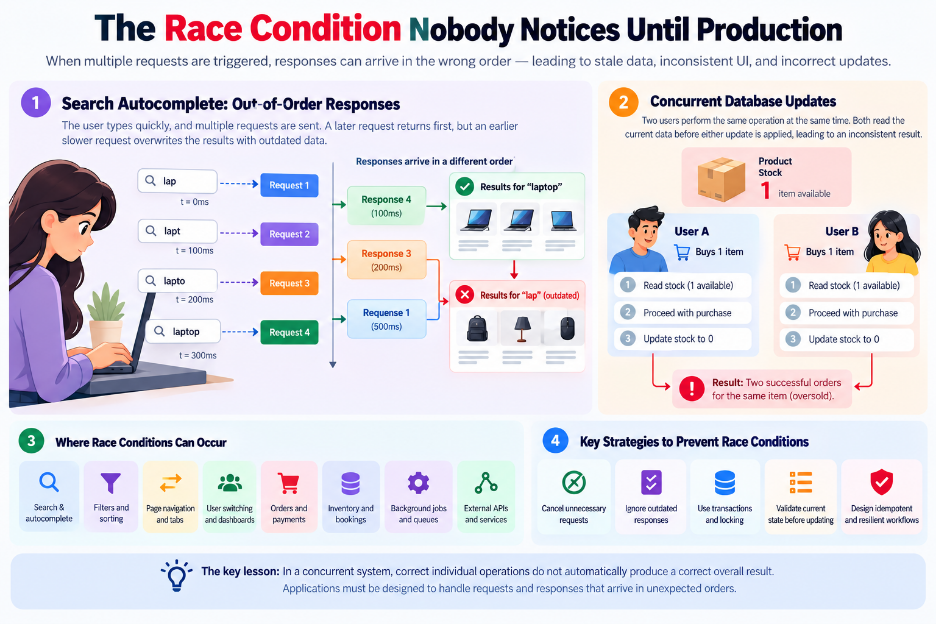
When a user types “lap” and quickly changes it to “laptop”, the application sends two requests. If the response for “laptop” arrives first, the correct results appear. However, the earlier response may subsequently replace them with results for “lap”.
This happens because the application updates its state without checking whether the response still matches the user’s latest input.
Similar issues can affect filters, dashboards, dropdowns, and pagination.
3. Why Race Conditions Often Go Unnoticed During Development
Race conditions depend heavily on timing. During development, requests may complete quickly, making these bugs difficult to reproduce.
In production, network delays, server load, and concurrent users create unpredictable execution orders. Since requests may succeed without generating errors, outdated information can appear without any obvious warning.
Traditional testing may miss these problems if it assumes requests always complete in the order they were sent.
4. Stale Responses: When Old Data Replaces New Data
A stale response contains information that is no longer relevant to the application’s current state.
For example, when a user switches from Project A to Project B, the application sends requests for both projects. If the response for Project A arrives last, it may overwrite Project B’s information.
This can affect search results, product filters, dashboards, and dynamically loaded forms.
Applications should verify that responses remain relevant before allowing them to update the interface.
5. Request Cancellation: Stopping Work That Is No Longer Needed
Request cancellation allows applications to stop waiting for requests that are no longer useful.
For example, when a user changes a search query, the application can attempt to cancel the previous request and send a new one.
This reduces unnecessary processing and improves responsiveness. However, cancellation does not guarantee that the backend stops processing a request that has already reached the server.
Therefore, cancellation should be combined with stale-response handling.
6. Preventing Outdated Responses From Updating the UI
Applications need a way to identify which responses are still valid.
One approach is to assign each request an identifier and allow only the latest request to update the interface. Another is to compare the response with the current search query or selected item.
These techniques prevent older responses from overwriting newer results, keeping the interface consistent with the user’s latest actions.
7. Race Conditions in Backend Database Updates
Race conditions can also occur when multiple requests modify the same database records simultaneously.
Consider an online store with one item remaining. Two customers attempt to purchase it, and both requests read the available stock before either updates the database.
Both may proceed with the purchase, potentially creating two orders for one available item.
Similar problems occur in booking systems, payment processing, and account-balance updates when concurrent operations are not properly controlled.
8. Preventing Concurrent Database Updates
Backend race conditions require mechanisms that protect shared data and enforce business rules.
- Database transactions: Keep related database operations consistent.
- Pessimistic locking: Prevent conflicting operations from modifying locked records.
- Optimistic concurrency control: Detect whether data has changed before applying an update.
- Atomic operations: Combine checks and updates into a single database operation where possible.
- Database constraints: Enforce rules such as unique bookings or valid inventory limits.
The appropriate approach depends on the application’s requirements and the type of data being protected.
9. The Relationship Between Race Conditions and Distributed Systems
In distributed applications, a single operation may involve multiple services, such as order processing, inventory management, payments, and notifications.
Network delays, retries, and partial failures can cause these services to process events in unexpected orders.
Developers can reduce these risks through idempotent operations, unique request identifiers, concurrency controls, and reliable workflow management.
Because separate services cannot always share a single database transaction, distributed workflows must also account for partial success and recovery.
10. How to Detect and Test Race Conditions
Race conditions should be tested under different timing and concurrency conditions.
Useful testing scenarios include:
- Delaying API responses to simulate slow networks.
- Sending multiple requests simultaneously.
- Changing search terms rapidly.
- Updating the same database record concurrently.
- Testing repeated operations and network retries.
For example, a search test should confirm that results for the latest query remain visible even when an earlier request finishes later.
Application logs, request identifiers, and timing information can also help identify race conditions in production.
11. A Practical Strategy for Reliable Full-Stack Applications
Preventing race conditions requires different safeguards at different layers.
Frontend: Cancel unnecessary requests and ignore outdated responses.
Backend: Validate operations and protect shared state from conflicting updates.
Database: Use transactions, locking, atomic operations, and constraints where appropriate.
Distributed systems: Handle retries, duplicate events, partial failures, and inconsistent execution orders.
Combining these approaches helps ensure that concurrent operations do not produce incorrect application states.
Conclusion
Race conditions are challenging because individual requests can succeed while the overall application produces incorrect results.
Whether the issue involves outdated search results, incorrect dashboard information, or multiple customers purchasing the same item, the underlying problem is how concurrent operations interact.
By managing frontend responses, protecting database updates, and designing systems for unpredictable execution orders, developers can build more reliable full-stack applications.
The key lesson: Correct individual operations do not automatically guarantee a correct overall result. Reliable applications must account for concurrency at every layer.
