
Introduction
Full stack development plays an important role in building modern websites and applications. It combines frontend and backend technologies to create complete digital experiences.
Today, people use websites to shop, learn, communicate, and make payments. However, many users do not know how these applications work behind the scenes.
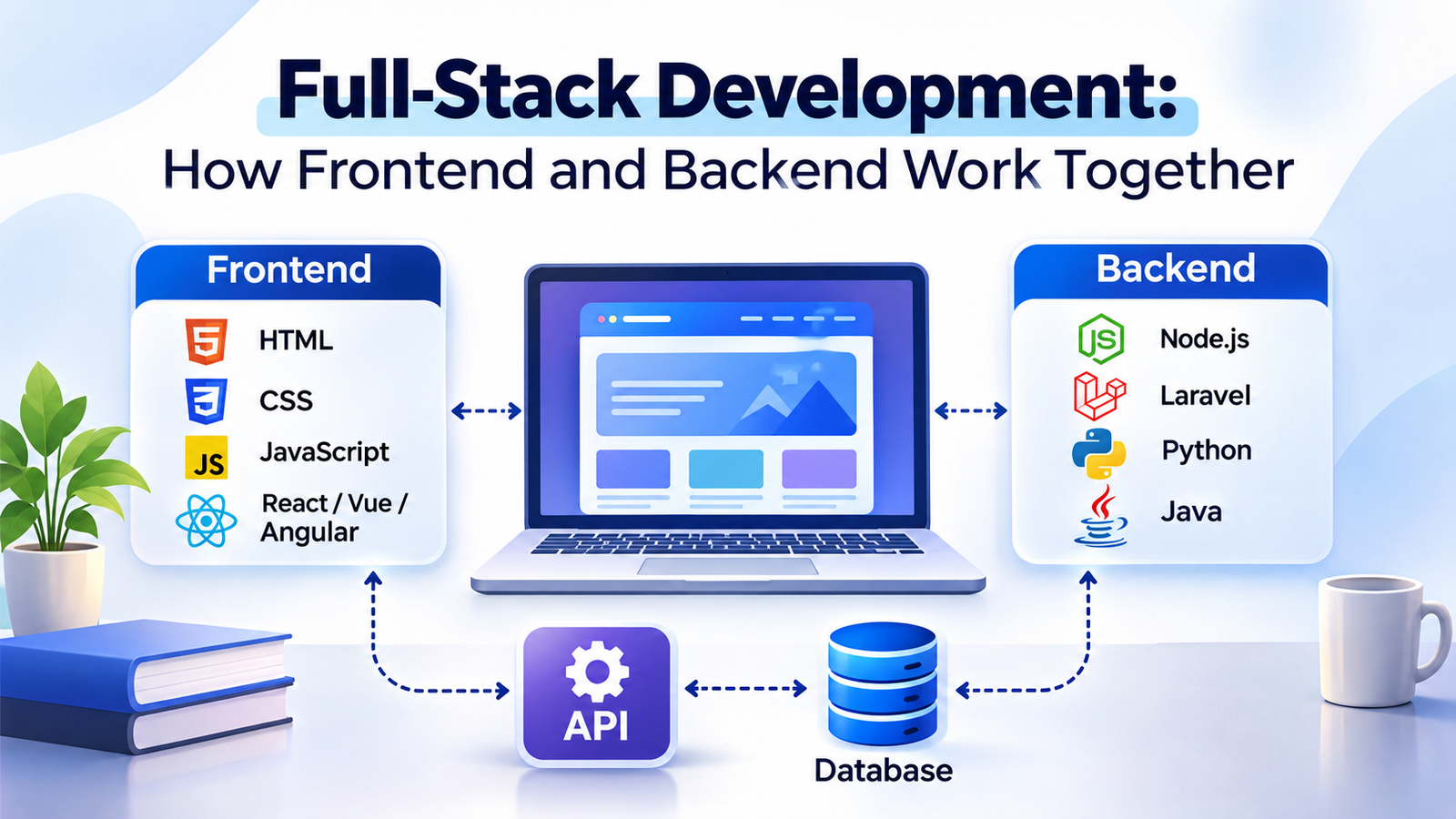
The frontend manages everything users see and interact with. Meanwhile, the backend handles requests, processes information, and manages application logic. Databases store important records, while APIs connect different parts of an application.
For example, when someone logs into a shopping website, several components work together. First, the frontend collects the login details. Next, the backend checks the information. Finally, the application displays the user’s account.
Therefore, understanding full stack development is useful for students, beginners, and aspiring software developers.
In this article, we will explore frontend development, backend development, databases, APIs, authentication, popular technologies, and essential developer skills.
1. What Is Full-Stack Development?
Full stack development involves building both the frontend and backend of a web application. Together, these components create a complete system.
The frontend focuses on the user interface. In contrast, the backend manages application logic, processes requests, and communicates with databases.
A full-stack developer understands how these different components work together. Additionally, they can build features that connect the user interface with server-side operations.
Main Components of a Full-Stack Application
A typical application includes three important layers.
Frontend
The frontend displays everything users see, including buttons, forms, menus, and pages. Moreover, it manages how users interact with the application.
Backend
The backend processes requests, manages authentication, and applies business rules. It also communicates with databases and other services.
Database
A database stores information such as user accounts, products, orders, and payment records. As a result, applications can access saved information whenever needed.
Example of Full-Stack Development
Consider a student registration application.
First, a student enters their name, email address, and password into a registration form.
Next, the frontend sends this information to the backend through an API. After receiving the request, the backend checks the submitted details.
Once validation is complete, the database stores the new student record.
Finally, the backend sends a response, and the frontend displays a success message.
Therefore, all three layers work together to complete the registration process.
2. Understanding Frontend Development
Frontend development focuses on the visual and interactive parts of a website.
It determines how users view information, navigate pages, and interact with different features. Additionally, frontend development helps create responsive and user-friendly designs.
Frontend developers work on layouts, forms, navigation menus, dashboards, buttons, and interactive elements.
Three core technologies form the foundation of frontend development.
HTML
HTML stands for HyperText Markup Language. It provides the basic structure of a webpage.
Developers use HTML to create headings, paragraphs, images, links, buttons, and forms.
For example, HTML creates the email and password fields on a login page.
However, HTML mainly defines the structure of a webpage. Other technologies control its appearance and behavior.
CSS
CSS stands for Cascading Style Sheets. It controls the visual appearance of webpage elements.
For instance, developers use CSS to manage:
- Colors and fonts.
- Spacing and alignment.
- Page layouts.
- Animations and visual effects.
- Responsive designs.
Additionally, CSS helps websites adjust to different screen sizes.
As a result, users can access websites more comfortably on desktops, tablets, and mobile devices.
JavaScript
JavaScript adds functionality and interactivity to websites.
For example, it allows developers to:
- Validate forms.
- Handle button clicks.
- Update webpage content.
- Display interactive elements.
- Communicate with backend APIs.
JavaScript can also check whether users have entered valid information before submitting a form.
Therefore, HTML, CSS, and JavaScript work together to create interactive web experiences.
Frontend Frameworks and Libraries
Modern applications often require complex user interfaces. Therefore, developers use frameworks and libraries to simplify development.
Some popular examples include:
- Vue.js
- React
- Angular
- Nuxt
- Next.js
These technologies help developers organize components and manage application data. Moreover, they support reusable interface elements and easier application maintenance.
As a result, developers can build modern applications more efficiently.
3. Understanding Backend Development
Backend development focuses on the server-side operations of an application.
Users cannot usually see the backend directly. However, it performs important tasks that keep applications working.
For example, when someone submits a login form, the backend checks the provided credentials. If the details are correct, the application allows the user to access their account.
Additionally, backend systems manage information, apply business rules, and communicate with databases.
Important Backend Responsibilities
Backend development includes several important tasks.
Request Handling
The backend receives requests from the frontend. Next, it processes them and returns suitable responses.
Business Logic
Business logic controls how an application performs specific operations. For example, an online store may calculate discounts based on shopping cart values.
Authentication
Authentication verifies the identity of users. As a result, applications can protect user accounts.
Authorization
Authorization determines which actions users can perform after logging in.
Data Management
Backend systems create, read, update, and delete database records. Additionally, they help maintain accurate application information.
API Development
APIs allow different software components to communicate. Therefore, they play an important role in connecting frontend and backend systems.
Popular Backend Technologies
Developers use different programming languages and frameworks to build backend applications.
Some common technologies include:
- PHP with Laravel.
- JavaScript or TypeScript with Node.js.
- Python with Django or FastAPI.
- Java with Spring Boot.
- C# with ASP.NET Core.
For example, Laravel provides tools for routing, authentication, validation, and database operations.
However, the best technology depends on application requirements, performance needs, and team experience.
4. What Is a Database and Why Is It Important?
A database stores, organizes, and manages application information.
Most web applications need databases because they must remember information even after users leave a website.
For example, an online learning platform may store:
- Student profiles.
- Course information.
- Enrollments.
- Quiz results.
- Assignments.
- Payment records.
When a student logs into the platform, the backend requests the required information. Next, the database provides the relevant records.
Finally, the frontend displays the information to the student.
Therefore, databases play an important role in storing and managing application data.
Types of Databases
Databases come in different types. However, relational and NoSQL databases are two common categories.
Relational Databases
Relational databases organize information into tables containing rows and columns.
Additionally, they use relationships to connect related records.
Popular examples include:
- MySQL
- PostgreSQL
- Microsoft SQL Server
- SQLite
For example, an online shopping application may use separate tables for customers, products, and orders.
These tables can connect through relationships. As a result, developers can manage structured information efficiently.
NoSQL Databases
NoSQL databases support different ways of storing information.
For example, some NoSQL databases use documents, while others use key-value structures.
Popular examples include:
- MongoDB
- Redis
- Apache Cassandra
These databases can support applications with flexible data structures or specific performance requirements.
However, developers should select a database based on application needs rather than popularity.
5. How Frontend and Backend Communicate Through APIs
An API stands for Application Programming Interface.
It allows different software components to communicate with one another.
In full stack development, APIs commonly connect the frontend with the backend. Therefore, they help different application layers exchange information.
For example, consider a student dashboard that displays enrolled courses.
First, the frontend sends a request to the backend API. Next, the backend gets the student’s course information from the database.
After processing the request, the backend returns the information. Finally, the frontend displays the course list.
How Does an API Work?
A typical API interaction involves five steps.
Step 1: Frontend Request
The frontend sends a request to a backend endpoint.
Step 2: Backend Processing
Next, the backend receives the request and checks the submitted information.
Step 3: Database Communication
After validation, the backend reads or updates the required database records.
Step 4: API Response
The backend sends a response, commonly in JSON format.
Step 5: Frontend Update
Finally, the frontend processes the response and updates the user interface.
Example of a Simple API Endpoint
Consider the following API endpoint:
GET /api/courses
A successful response might look like this:
{
  "success": true,
  "data": [
    {
      "id": 1,
      "name": "Web Development"
    },
    {
      "id": 2,
      "name": "Database Fundamentals"
    }
  ]
}
The frontend uses this information to display available courses.
As a result, APIs allow frontend and backend components to work independently while communicating effectively.
6. Understanding the Complete Request and Response Flow
Understanding how requests and responses work is important for full-stack developers.
For example, consider an online shopping application.
Imagine a user adding a product to their shopping cart.
Several steps take place before the application completes this action.
Step 1: User Interaction
First, the user opens the shopping page and clicks the Add to Cart button.
Step 2: Frontend Processing
Next, the frontend collects the product ID and quantity. It then prepares an API request.
Step 3: Backend Receives the Request
After receiving the request, the backend checks whether the product exists. It also verifies the user’s login status when required.
Step 4: Business Logic Execution
The backend checks product availability and applies the application’s cart rules.
Step 5: Database Operation
Next, the backend creates a cart record or updates an existing cart item.
Step 6: Backend Response
Once the operation is complete, the backend sends a response indicating whether the action succeeded.
Step 7: Frontend Update
Finally, the frontend displays a success message and updates the shopping cart count.
Therefore, a simple user action may involve several connected application components.
Understanding this process also helps developers identify errors and solve integration problems.
7. Popular Technologies Used in Full-Stack Development
Developers can combine different technologies to build complete web applications.
However, the right technology stack depends on project requirements, team experience, and application complexity.
Here are some popular combinations.
MERN Stack
MERN is a popular technology stack that includes four technologies.
- MongoDB: Stores and manages application data.
- Express.js: Supports backend application development.
- React: Builds interactive frontend interfaces.
- Node.js: Runs JavaScript on the server.
Together, these technologies support full-stack web application development.
Additionally, MERN allows developers to use JavaScript across multiple application layers.
MEAN Stack
MEAN is another JavaScript-based technology stack.
It includes:
- MongoDB.
- Express.js.
- Angular.
- Node.js.
Like MERN, this stack supports frontend and backend development.
However, MEAN uses Angular instead of React for frontend development.
LAMP Stack
LAMP is a traditional technology stack used for building dynamic websites.
It includes:
- Linux: Operating system.
- Apache: Web server.
- MySQL: Database management system.
- PHP: Server-side programming language.
These technologies work together to support web application development.
For example, PHP handles server-side operations, while MySQL stores application information.
Vue, Laravel, and MySQL
Another practical technology combination includes Vue.js, Laravel, and MySQL.
Each technology has a specific responsibility.
- Vue.js: Builds interactive frontend interfaces.
- Laravel: Handles backend logic and API development.
- MySQL: Stores and manages application data.
For example, Vue can display a student registration form. Meanwhile, Laravel processes the submitted information.
Finally, MySQL stores the student record.
Therefore, this combination provides a practical foundation for developing modern web applications.
8. How Authentication Works in a Web Application
Authentication is the process of verifying a user’s identity.
Most applications use authentication to protect user accounts and private information.
For example, consider a student logging into an online learning platform.
The authentication process generally works as follows:
- First, the student enters an email address and password.
- Next, the frontend securely sends the login details to the backend.
- The backend checks the submitted information against the stored account credentials.
- If the details are correct, the backend creates an authenticated session or issues a token.
- After successful authentication, the frontend updates the user’s login status.
- Finally, the student can access protected features based on their permissions.
Authentication vs Authorization
Authentication and authorization are related concepts. However, they serve different purposes.
Authentication confirms the user’s identity.
Authorization determines which actions the user can perform.
For example, a student may access their own course details. In contrast, an administrator may have permission to manage all student records.
Important Security Practices
Developers should follow important security practices, including:
- Password hashing.
- Secure session handling.
- Input validation.
- HTTPS communication.
- Proper access control.
Additionally, applications should protect sensitive information from unauthorized access.
As a result, users can interact with applications more securely.
9. Building a Simple Full-Stack Application
One of the best ways to learn full stack development is to build a practical project.
For beginners, a student management system is a useful starting point.
This project includes frontend pages, backend APIs, and database operations. Therefore, it helps learners understand how different application components connect.
Project Overview
A student management system allows users to manage student information.
For example, users can add, view, update, delete, and search student records.
Frontend Features
The frontend provides the following features:
- Display a student list.
- Add new students.
- Edit student details.
- Delete student records.
- Search for students.
Additionally, developers can create a responsive design to improve the user experience.
Backend Features
The backend manages application operations.
Its main responsibilities include:
- Creating student records.
- Getting student information.
- Updating existing records.
- Deleting records.
- Validating submitted information.
Moreover, backend APIs connect the frontend with the database.
Database Structure
A simple student management application could use a students table.
| Column | Purpose |
|---|---|
| id | Unique student identifier |
| name | Student name |
| Student email address | |
| course | Enrolled course |
| created_at | Record creation date |
How Does the Application Work?
First, a user enters student information into a frontend form.
Next, the frontend sends the details to the backend API.
After receiving the request, the backend validates the information. If the details are correct, it stores the record in the database.
Finally, the frontend gets the updated student list and displays the new record.
As a result, beginners can understand how frontend, backend, and database operations work together.
10. Common Challenges Full-Stack Developers Face
Full-stack development involves working with several technologies.
Therefore, developers may face challenges across different application layers.
Understanding these problems helps developers build reliable applications.
Frontend and Backend Integration
Frontend and backend systems must communicate correctly.
For example, both components should use matching API endpoints, request formats, and response structures.
Otherwise, requests may fail or information may appear incorrectly.
Database Management
Developers must create suitable database structures and maintain relationships between records.
Additionally, they should prevent duplicate entries and data errors.
As applications grow, proper database management becomes even more important.
Authentication and Security
Protecting user accounts is essential.
Therefore, developers must use secure authentication, authorization, and data-handling practices.
For example, applications should protect passwords and restrict access to private information.
Debugging Across Multiple Layers
Errors may occur in different parts of an application.
For instance, a problem could come from the frontend, backend, API, or database.
Therefore, developers must identify the actual cause before applying a solution.
Performance Optimization
Application performance can decrease for several reasons.
Common examples include:
- Large database queries.
- Unnecessary API requests.
- Inefficient frontend rendering.
- Poor resource management.
However, developers can improve performance by reducing unnecessary operations and using efficient code.
Maintaining Code Quality
As applications grow, maintaining code becomes more difficult.
Therefore, developers should use reusable components, clear naming conventions, and organized project structures.
Additionally, regular testing helps identify problems early.
These practices make applications easier to maintain and improve.
11. Skills Needed to Become a Full-Stack Developer
Becoming a full-stack developer requires technical knowledge and practical experience.
However, beginners do not need to learn every technology at once.
Instead, they can develop their skills step by step.
1. HTML and CSS
First, learn how to create webpage structures and responsive designs.
These technologies provide the foundation for frontend development.
2. JavaScript or TypeScript
Next, understand programming concepts, functions, and asynchronous operations.
Additionally, learn how JavaScript makes websites interactive.
3. Frontend Frameworks
After learning JavaScript, explore frameworks such as Vue, React, or Angular.
These tools help developers build reusable and interactive components.
4. Backend Development
Learn server-side programming, routing, validation, and business logic.
For example, beginners can explore Laravel, Node.js, or Spring Boot.
5. Database Management
Understanding databases is important for managing application information.
Therefore, beginners should learn SQL, database relationships, and basic queries.
6. API Integration
APIs connect different application components.
Learn HTTP methods, JSON responses, request handling, and error management.
7. Git and GitHub
Version control helps developers manage code changes.
Additionally, Git and GitHub support collaboration between team members.
8. Debugging
Debugging involves identifying and fixing application errors.
Therefore, developers should practise solving problems across frontend and backend systems.
9. Problem-Solving
Problem-solving is an important skill for software developers.
For example, developers often divide complex requirements into smaller tasks.
As a result, they can build solutions more effectively.
Why Are Practical Projects Important?
Learning theory is useful. However, practical projects help developers understand real application workflows.
Beginners can start with simple applications and gradually explore advanced features.
Additionally, completed projects can strengthen a developer’s portfolio.
A strong portfolio helps candidates demonstrate technical knowledge during interviews.
12. Frequently Asked Questions
1. What is full-stack development?
Full-stack development involves building both the frontend and backend of a web application.
Additionally, it includes APIs, databases, user interfaces, and server-side operations.
2. What is the difference between frontend and backend development?
Frontend development focuses on the user interface and user interactions.
In contrast, backend development manages application logic, authentication, and data processing.
3. Which programming languages are used in full-stack development?
Common programming languages include JavaScript, TypeScript, PHP, Python, Java, and C#.
However, the choice depends on the technology stack and project requirements.
4. Is database knowledge necessary for full-stack developers?
Yes. Database knowledge helps developers store, manage, and access application information.
Additionally, it supports efficient communication between backend systems and stored records.
5. What is an API in full-stack development?
An API allows different software components to communicate.
For example, APIs commonly connect frontend interfaces with backend services.
6. Can beginners learn full-stack development?
Yes. Beginners can start with HTML, CSS, and JavaScript.
Next, they can explore frontend frameworks, backend technologies, APIs, and databases.
7. How long does it take to become a full-stack developer?
Learning time depends on previous programming experience, available study time, and practical experience.
However, consistent learning and project development can
