
Artificial Intelligence has transformed the way businesses, applications, and devices process information. From virtual assistants and recommendation systems to autonomous machines and predictive analytics, AI has traditionally depended on powerful cloud servers to process large amounts of data.
But a major shift is happening.
Artificial intelligence is moving closer to where data is created.
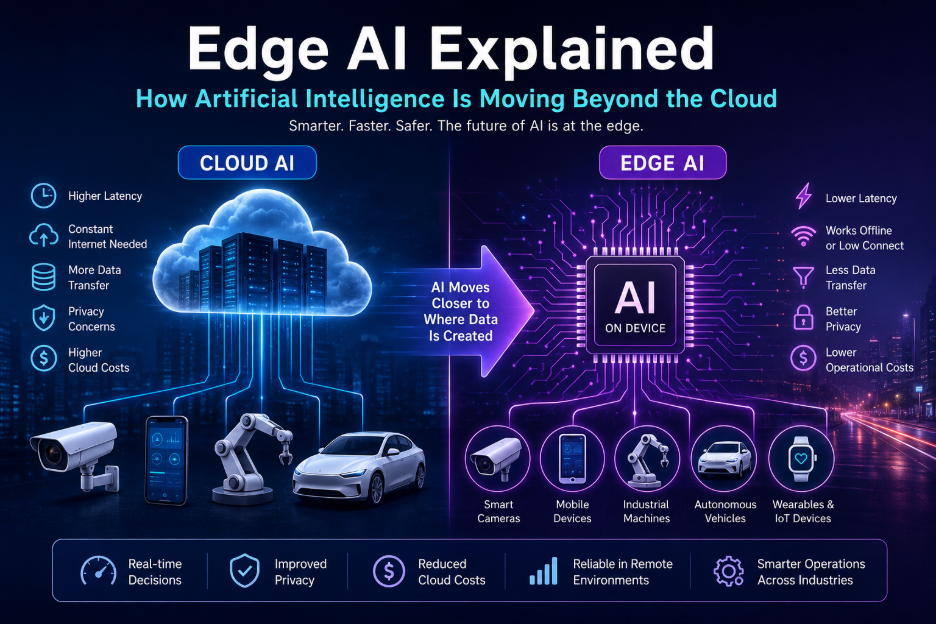
This approach is known as Edge AI, and it is changing how smart devices, applications, and connected systems make decisions. Instead of sending every piece of information to a remote cloud server, Edge AI allows devices to process data locally—often in real time.
What Is Edge AI?
Edge AI refers to the combination of Artificial Intelligence and edge computing.
In a traditional cloud-based AI system, a device collects data and sends it to a remote server. The cloud processes the information and sends the result back to the device.
For example, consider a smart security camera.
Traditional AI approach:
Camera → Internet → Cloud → AI processing → Result → Camera
Edge AI approach:
Camera → Local AI processing → Result
The second approach can significantly reduce the time required to make a decision because the device does not need to continuously communicate with a distant cloud server.
Why Is AI Moving to the Edge?
The rapid growth of connected devices is generating enormous amounts of data. Smartphones, cameras, vehicles, industrial machines, wearables, and IoT devices constantly collect information.
Sending all this data to the cloud can create challenges related to:
- Network bandwidth
- Latency
- Privacy
- Cloud processing costs
- Internet connectivity
- Real-time decision-making
Edge AI addresses many of these challenges by processing information closer to its source.
1. Faster Decision-Making
One of the biggest advantages of Edge AI is speed.
When AI processing happens locally, devices don’t always have to wait for a response from a remote cloud server. This is particularly important for applications where milliseconds can matter.
For example, an autonomous vehicle may need to identify an obstacle immediately. Waiting for data to travel to a cloud server and return could introduce unnecessary delay.
Edge AI allows the vehicle’s onboard systems to analyze information locally and respond much faster.
2. Improved Privacy
Data does not always need to leave the device.
With Edge AI, sensitive information can potentially be processed locally instead of being continuously uploaded to the cloud.
This can be particularly useful for applications involving:
- Personal devices
- Healthcare technology
- Smart homes
- Security systems
- Industrial environments
Local processing can reduce the amount of sensitive data transmitted over networks.
3. Reduced Cloud Costs
Cloud computing can become expensive when applications generate and process huge amounts of data.
Imagine thousands of cameras continuously uploading video footage to the cloud. The amount of data could be enormous.
Edge AI can analyze the footage locally and send only important information to the cloud—for example, an alert when an unusual event is detected.
This can reduce data transfer and cloud processing requirements.
4. Offline and Low-Connectivity Operation
Not every environment has reliable internet connectivity.
Factories, remote locations, vehicles, and field operations may experience limited or intermittent network access.
Edge AI allows devices to continue performing certain AI tasks even when they cannot maintain a constant connection to the cloud.
Where Is Edge AI Being Used?
Edge AI is already finding applications across many industries.
Smartphones
Modern smartphones increasingly include AI capabilities directly on the device.
Features such as:
- Face recognition
- Voice processing
- Camera enhancement
- Translation
- Image classification
- Personalized recommendations
can use on-device AI to provide faster responses while reducing the need to send every piece of data to the cloud.
Smart Cameras
Security cameras can use Edge AI to identify objects, people, vehicles, or unusual activity.
Instead of recording and uploading everything, an intelligent camera can analyze video locally and send an alert only when a relevant event occurs.
Healthcare
Edge AI has potential applications in healthcare devices that need to analyze information quickly.
Wearable devices, monitoring systems, and medical equipment can use AI models to identify patterns and provide immediate insights.
In situations where fast responses are important, local processing can be particularly valuable.
Manufacturing
Factories generate huge volumes of information from sensors and machines.
Edge AI can analyze this data near the machines themselves to identify problems, predict equipment failures, and improve production efficiency.
For example, an AI-powered system could detect unusual vibration patterns in industrial equipment and alert maintenance teams before a major failure occurs.
Autonomous Vehicles
Self-driving and advanced driver-assistance systems rely on rapid analysis of information from cameras, radar, lidar, and other sensors.
Edge AI enables vehicles to process much of this information locally, helping them respond to their surroundings with minimal latency.
Retail
Retail stores can use Edge AI for inventory monitoring, customer analytics, checkout automation, and security.
Local AI processing can help stores analyze events in real time without constantly transmitting large amounts of raw video or sensor data.
Edge AI vs Cloud AI
Edge AI and Cloud AI are not necessarily competitors. In many modern systems, they work together.
| Feature | Edge AI | Cloud AI |
| Processing location | Device or nearby edge server | Remote cloud server |
| Latency | Very low | Depends on network |
| Internet dependency | Lower | Higher |
| Privacy | Can keep data local | Data may be transmitted |
| Computing power | Limited by device | Extremely high |
| Scalability | More distributed | Highly scalable |
| Best suited for | Real-time decisions | Large-scale processing and training |
A powerful architecture may combine both approaches.
For example, an edge device could perform immediate analysis while the cloud handles large-scale data storage, model training, and deeper analytics.
How Does Edge AI Work?
Edge AI typically involves several components working together.
1. Data Collection
Sensors, cameras, microphones, and other devices collect information from the environment.
2. AI Model
A machine learning or deep learning model is deployed on the edge device.
The model may have been trained using powerful cloud infrastructure before being optimized for local execution.
3. Local Processing
The device analyzes incoming data and produces predictions or decisions.
4. Cloud Integration
The cloud can still be used for tasks such as:
- Model updates
- Data storage
- Analytics
- Monitoring
- Centralized management
- Retraining AI models
This creates a hybrid AI architecture, where edge devices and cloud platforms complement each other.
Challenges of Edge AI
Despite its advantages, Edge AI also comes with challenges.
Limited Hardware Resources
Edge devices typically have less processing power, memory, and storage than large cloud servers.
AI models therefore need to be optimized to run efficiently.
Model Optimization
Large AI models can require significant computational resources.
Techniques such as quantization, pruning, and model compression can help reduce model size and computational requirements.
Device Management
Managing thousands or millions of AI-enabled devices can be complicated.
Organizations need reliable systems for:
- Software updates
- AI model updates
- Security patches
- Monitoring
- Device configuration
Security
While local processing can improve privacy, edge devices themselves can become targets for cyberattacks.
Protecting AI models, device hardware, data, and communication channels is therefore essential.
The Future of Edge AI
The future of Edge AI is closely connected to the growth of IoT, 5G, robotics, autonomous systems, and intelligent devices.
As AI chips become more powerful and energy-efficient, increasingly sophisticated AI models will be capable of running directly on devices.
We may see more intelligent systems in:
- Smart cities
- Autonomous transportation
- Industrial automation
- Consumer electronics
- Healthcare devices
- Robotics
- Agriculture
- Retail environments
- Connected homes
Instead of thinking of AI as something that exists only inside massive data centers, we can increasingly think of intelligence as something distributed across the devices around us.
Edge AI and the Next Generation of Intelligent Technology
The movement from cloud-only AI toward distributed intelligence represents an important evolution in computing.
Cloud platforms will continue to play a major role because they provide massive computing resources, storage, and centralized AI infrastructure. But edge devices can complement these capabilities by handling time-sensitive and privacy-sensitive tasks locally.
The result is not simply “AI without the cloud.”
It is a future where AI works across the cloud and the edge, with each layer performing the tasks it is best suited for.
Final Thoughts
Edge AI is making artificial intelligence faster, more responsive, and increasingly accessible across everyday devices and industrial systems.
By bringing AI processing closer to the source of data, organizations can reduce latency, improve privacy, lower data-transfer requirements, and build systems that remain functional even with limited connectivity.
As technology continues to evolve, the question may no longer be “Should AI run in the cloud or on the device?”
Instead, the future may be about finding the right balance between cloud intelligence and edge intelligence.
For businesses and technology innovators, understanding Edge AI today can help prepare for a future where intelligent decision-making is built directly into the devices and environments around us.
The next generation of AI isn’t just getting smarter—it is getting closer.
