
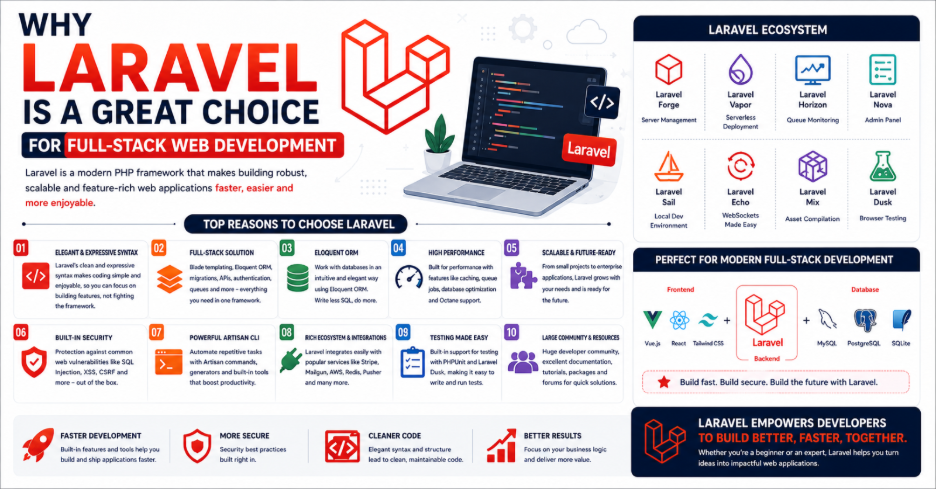
Choosing a framework for a new web project is not a small decision. It shapes how fast a team can build, how easy the code is to maintain a year later, and how well the application holds up once real users start hitting it. Among the many options available to PHP developers, Laravel has earned a reputation as one of the strongest choices for full-stack web development, and there are solid reasons why.
Laravel was created by Taylor Otwell and has grown into the most widely used PHP framework in the world. It powers everything from small business websites to large-scale enterprise applications, and its ecosystem has matured to the point where it can compete with frameworks written in newer languages. With the release of Laravel 13 in March 2026, requiring PHP 8.3 and adding a first-party Laravel AI SDK, the framework continues to move with the times rather than falling behind them.
What Makes Laravel a Full-Stack Framework
A full-stack framework is one that lets a developer handle both the server side and, to a large extent, the client-facing side of an application without constantly switching tools. Laravel fits this description well.
On the back end, Laravel gives developers a clean structure for routing, authentication, database management, and business logic. On the front end, Blade templating, Livewire, and Inertia.js allow developers to build interactive interfaces without needing a completely separate JavaScript framework, though Laravel also works smoothly alongside Vue, React, or Alpine.js when a project calls for it. This flexibility is one of the main reasons developers keep coming back to Laravel for full-stack web development.
Elegant Syntax That Speeds Up Development
One of the first things developers notice about Laravel is how readable the code looks. Taylor Otwell built Laravel around the idea that writing code should feel expressive rather than tedious. Common tasks such as form validation, sending emails, or scheduling background jobs take just a few lines of code instead of dozens.
This matters more than it might seem at first. A framework with clear, consistent syntax reduces the learning curve for new team members and cuts down on bugs caused by confusing or repetitive code. For agencies and in-house teams alike, faster development cycles mean lower costs and quicker time to market.
Eloquent ORM Makes Database Work Simple
Laravel’s Eloquent ORM is often named as one of the framework’s best features, and for good reason. Instead of writing raw SQL queries for every database interaction, developers can work with database records as if they were regular PHP objects. Relationships between tables, such as one-to-many or many-to-many, are defined in plain, readable methods.
This does not just save time. It also makes the codebase easier to read for anyone who joins the project later, which is a real concern for long-term full-stack web development projects that may pass through several hands over the years.
Built-In Security Features
Security is not something a development team should have to bolt on after the fact, and Laravel treats it as a core part of the framework rather than an afterthought. It includes protection against SQL injection, cross-site scripting, and cross-site request forgery right out of the box. Password hashing uses industry-standard algorithms, and the authentication system is easy to extend for two-factor authentication or passkey login, a feature Laravel has continued to strengthen in its most recent releases.
For businesses handling sensitive user data, this built-in approach to security is a genuine advantage over frameworks that leave more of this work to the developer.
A Rich Ecosystem of Tools
Laravel is not just a framework on its own. It comes with a family of official tools that extend what it can do:
- Laravel Forge and Laravel Vapor simplify server management and deployment.
- Laravel Sanctum and Laravel Passport handle API authentication for single-page applications and mobile apps.
- Laravel Horizon gives developers a dashboard to monitor queues.
- Laravel Echo and Laravel Reverb support real-time features like live notifications and chat.
- Laravel Nova offers a ready-made admin panel for managing application data.
This ecosystem means a team rarely has to look outside Laravel to solve a common problem, which keeps a full-stack project consistent from top to bottom.
Strong Community and Long-Term Support
A framework is only as good as the community behind it, and Laravel’s community is one of the largest and most active in the PHP world. Documentation is thorough, tutorials are plentiful, and packages built by third-party developers cover almost every use case imaginable through Packagist and Laravel-specific package directories.
Laravel also follows a predictable release cycle and support policy, so businesses planning long-term projects know how long a given version will continue to receive bug fixes and security patches. This kind of stability is hard to find in less mature frameworks.
Laravel and Modern Application Needs
Web applications today are expected to do more than serve static pages. They need APIs for mobile apps, real-time features, queue-based background processing, and increasingly, integration with AI-driven tools. Laravel has kept pace with these expectations. Recent versions have added features such as native support for JSON:API responses, improved job and queue handling, and a first-party AI SDK that gives developers a unified way to work with text generation, embeddings, and vector search inside their applications.
For teams that want to build a full-stack application without stitching together a dozen unrelated libraries, this steady stream of first-party improvements is a meaningful advantage.
Cost-Effective for Startups and Enterprises Alike
Because Laravel is open source and free to use, startups can build a complete product without licensing costs eating into their budget. At the same time, its scalability and structure make it suitable for enterprise applications that need to handle heavy traffic and complex business logic. This dual appeal is part of why Laravel development services remain in steady demand across both small businesses and large organizations.
