
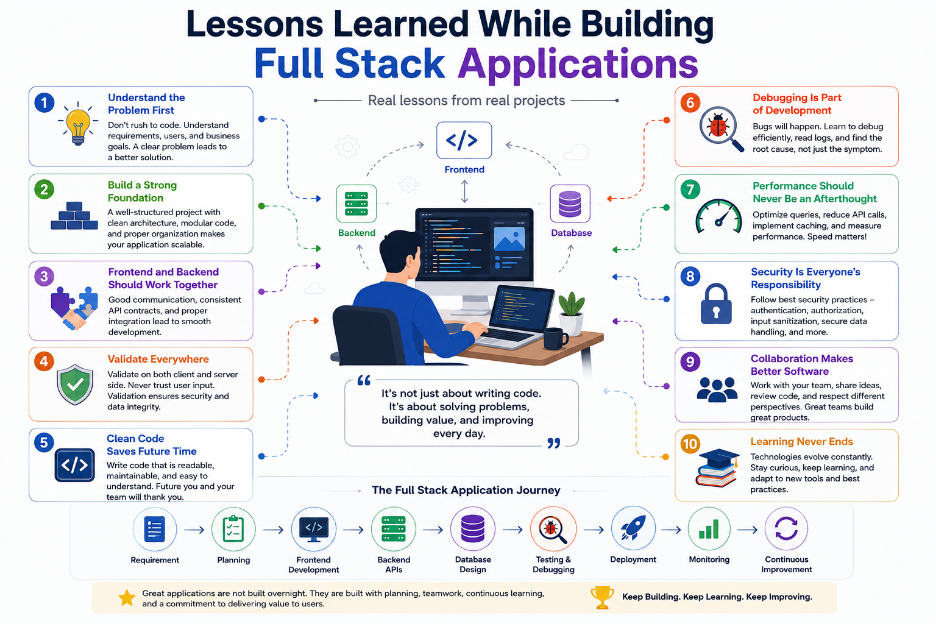
Building a full stack application is much more than writing frontend components or backend APIs. It’s about creating reliable, scalable, and maintainable solutions that solve real business problems.
When I first started building full stack applications, I believed success was measured by how quickly I could complete a feature. As I gained experience, I realized that successful software development is about much more than delivering functionality—it’s about building applications that are secure, maintainable, performant, and easy for teams to work on.
Here are some of the most valuable lessons I’ve learned throughout my journey.
1. Understand the Problem Before Writing Code
One of the biggest mistakes developers make is jumping directly into implementation.
Before writing a single line of code, ask:
- What problem are we solving?
- Who are the users?
- What are the business requirements?
- What are the possible edge cases?
A clear understanding of the problem always leads to better solutions.
2. Build a Strong Foundation
A well-structured project is easier to maintain and scale.
Important considerations include:
- Clear folder structure
- Reusable components
- Layered architecture
- Modular services
- Proper API organization
Good architecture saves countless hours as the project grows.
3. Frontend and Backend Should Work Together
Frontend and backend are not separate worlds—they are two parts of the same solution.
Successful applications depend on:
- Consistent API contracts
- Clear response formats
- Proper validation
- Effective error handling
- Good communication between teams
When both sides are aligned, development becomes much smoother.
4. Validation Should Exist Everywhere
Never rely only on frontend validation.
The frontend improves user experience, while the backend protects data integrity and security.
Always validate:
- User inputs
- File uploads
- API requests
- Business rules
Trust, but always verify.
5. Clean Code Saves Future Time
Code is read far more often than it is written.
Writing clean, readable, and maintainable code makes debugging, collaboration, and future enhancements significantly easier.
Simple code is professional code.
6. Debugging Is Part of Development
Every project encounters bugs.
Instead of treating debugging as a setback, treat it as an opportunity to understand the system more deeply.
Effective debugging involves:
- Reading logs
- Inspecting API requests
- Understanding database behaviour
- Identifying root causes instead of symptoms
Some of the greatest learning happens while solving production issues.
7. Performance Should Never Be an Afterthought
Applications should not only function correctly—they should perform efficiently.
Small optimizations can make a big difference:
- Optimize database queries
- Reduce unnecessary API calls
- Implement pagination
- Cache frequently accessed data
- Load resources efficiently
Performance directly impacts user satisfaction.
8. Security Is Everyone’s Responsibility
Security is not just a backend concern.
Every full stack developer should consider:
- Authentication
- Authorization
- Input sanitization
- Secure file handling
- Protecting sensitive data
- Preventing common vulnerabilities such as SQL Injection and XSS
Building secure software starts with secure coding practices.
9. Collaboration Makes Better Software
Great applications are built by great teams.
Working with designers, QA engineers, DevOps professionals, and product managers has taught me that communication is just as important as coding.
Asking questions, sharing ideas, and reviewing each other’s work leads to stronger products.
10. Learning Never Ends
Technology changes constantly.
New frameworks, tools, and best practices continue to emerge.
The most valuable skill is not knowing everything—it’s having the willingness to keep learning and adapting.
Every project teaches something new.
Final Thoughts
Building full stack applications has taught me that software development is much more than writing code.
It’s about understanding users, designing scalable systems, solving complex problems, collaborating with teams, and continuously improving both technical and professional skills.
Every application presents new challenges, and every challenge becomes an opportunity to grow.
The journey of a Full Stack Developer isn’t about mastering every technology—it’s about building solutions that create value, one project at a time.
What is the biggest lesson you’ve learned while building software? I’d love to hear your experiences in the comments.
