
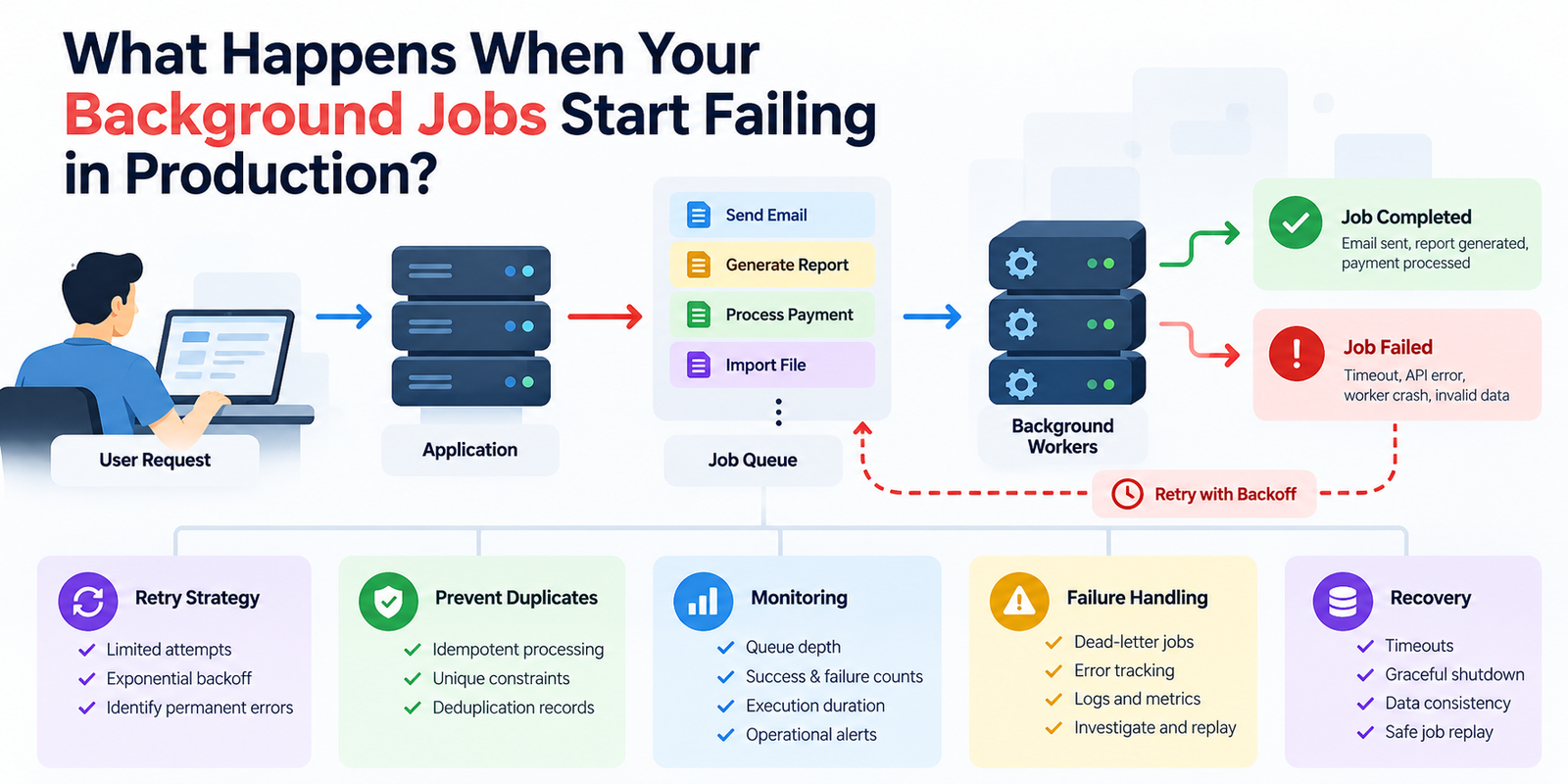
Modern applications do more than process user requests. They send emails, generate reports, import large files, process payments, and deliver notifications.
Many of these operations take time and should not block the user from receiving a response. This is where background jobs and queue systems become essential.
But what happens when these jobs fail in production?
The challenge is not simply executing a task in the background. It is ensuring that the task can recover from failures without losing data, duplicating operations, or affecting the user experience.
1. Why Background Jobs Fail
Background jobs depend on multiple components working together.
Common failure scenarios include:
- Third-party APIs becoming unavailable.
- Database connections timing out.
- Queue workers running out of memory.
- Invalid data causing processing errors.
- Network interruptions during external requests.
- Jobs taking longer than their configured execution limits.
A job that works perfectly in development may fail under real production workloads.
Reliable systems anticipate failures instead of assuming every operation will succeed.
2. The Role of Queues and Workers
A queue separates task creation from task execution.
Instead of making a user wait for an email to be sent or a report to be generated, the application can place the task in a queue and return a response immediately.
A typical workflow looks like this:
User Request → Application → Job Queue → Background Worker → Processing → Status Update
This separation improves responsiveness and allows background processing capacity to scale independently from the main application.
However, a queue alone does not guarantee reliability. Workers must also handle failures, interruptions, and growing workloads.
3. Retries Are Not a Complete Solution
When a temporary failure occurs, retrying a job can be effective.
For example, a temporary network error may disappear after a short delay. But retrying every failure indefinitely can create more problems.
A reliable retry strategy should include:
- Limited attempts: Prevent endless execution.
- Exponential backoff: Increase the delay between retries.
- Failure classification: Retry temporary errors, but identify permanent errors that require intervention.
- Failed-job tracking: Record exhausted attempts for investigation.
- Operational alerts: Notify the team when failures require attention.
Retries should be deliberate, not automatic repetition without limits.
4. Preventing Duplicate Processing
One of the most important challenges in background processing is duplicate execution.
A worker might successfully perform an operation but crash before recording that it completed. The queue may then deliver the same job again.
This can lead to duplicate emails, repeated records, or multiple external requests.
To reduce this risk, systems should use idempotent processing wherever possible.
Depending on the operation, this may involve unique constraints, idempotency keys, deduplication records, or checking whether an operation has already completed.
The key principle is simple: a repeated execution should not create unintended additional effects.
5. Monitoring Jobs in Production
A job that fails silently can be more dangerous than one that immediately exposes an error.
Production systems need visibility into:
- Queue depth and processing delays.
- Successful and failed job counts.
- Retry frequency and failure reasons.
- Job execution duration.
- Jobs that exceed expected processing times.
- Backlogs that continue to grow.
Logs help explain individual failures, while metrics and alerts reveal broader operational problems.
Monitoring should help teams identify failures before they become significant user-facing issues.
6. Designing for Recovery
Reliable background processing requires more than retries and logging.
A well-designed system should also consider:
- Timeouts: Prevent individual jobs from running indefinitely.
- Graceful worker shutdown: Allow running tasks to finish safely where possible.
- Dead-letter or failed-job handling: Isolate tasks that cannot be processed successfully.
- Recovery procedures: Make it possible to investigate and replay eligible jobs safely.
- Data consistency: Ensure partial processing does not leave the system in an invalid state.
Recovery is part of the architecture, not an afterthought.
7. Applying These Principles in Laravel
In Laravel applications, queues, jobs, retry configuration, failed-job tracking, and queue workers provide the foundation for asynchronous processing.
However, the framework cannot automatically guarantee that every business operation is safe to retry.
Developers must still design appropriate timeouts, failure handling, idempotency controls, logging, and monitoring based on the operation being performed.
For example, retrying a report-generation job may be straightforward, while retrying a payment-related operation requires stronger safeguards against duplicate effects.
The implementation should reflect the business risk, not just the technical convenience.
