
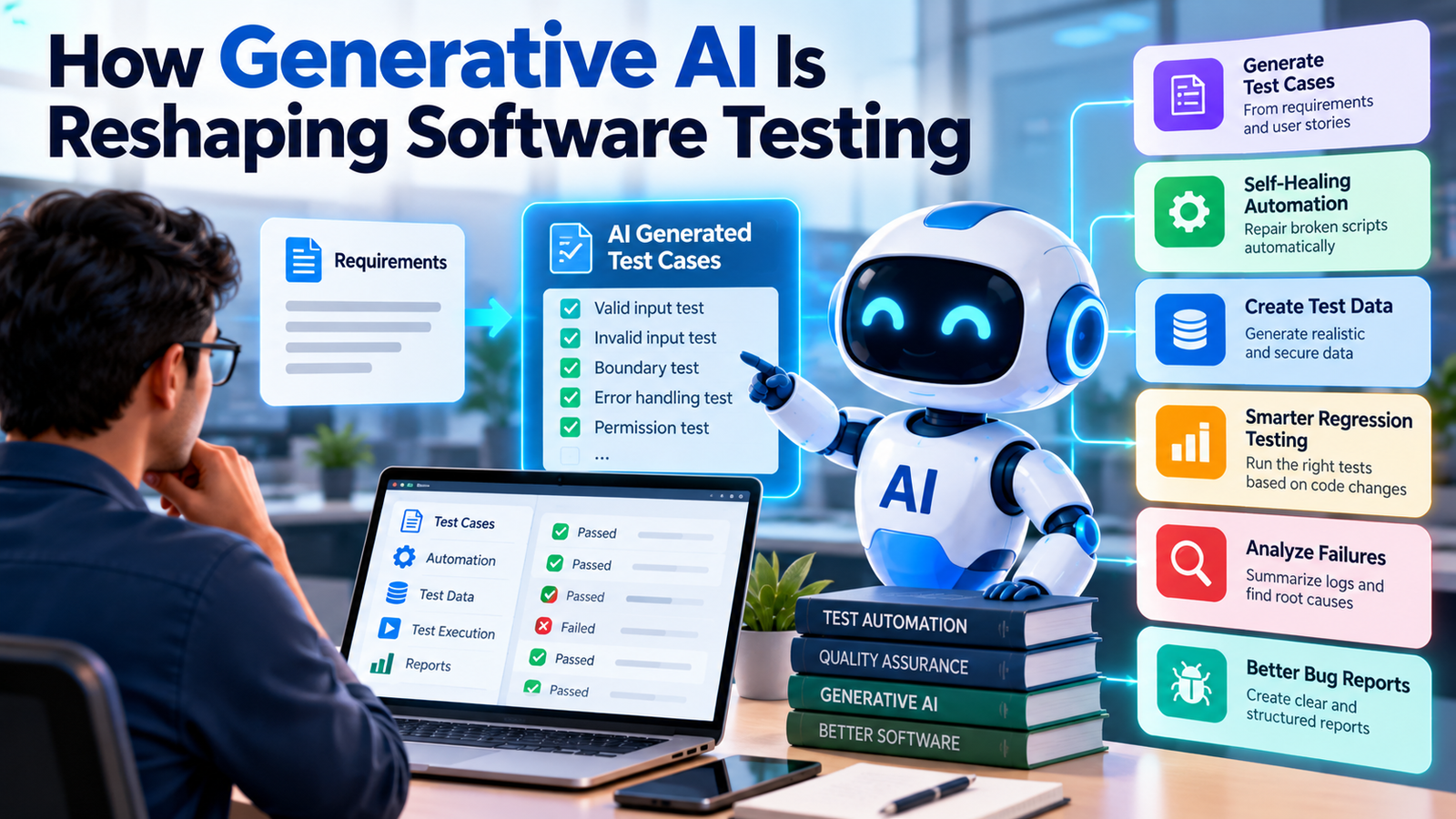
Software testing is changing as applications become more complex and development teams release updates more frequently. Testers often spend hours writing test cases, fixing automation scripts, preparing test data, and analyzing errors.
Generative AI in software testing helps automate repetitive tasks, improve testing efficiency, and give QA teams more time to focus on software quality.
AI tools can generate test cases, create synthetic data, analyze failures, and assist with automation maintenance. However, human review remains essential to ensure accurate results.
What Is Generative AI in Software Testing?
Generative AI in software testing uses artificial intelligence to create and analyze testing materials from requirements, user stories, and error logs.
For example, a tester can provide a login requirement and ask an AI tool to generate test cases for valid credentials, incorrect passwords, empty fields, and locked accounts.
The tester then reviews the suggestions and selects the relevant cases.
The goal is to reduce repetitive work, not replace human judgment.
Why Does Software Testing Need AI?
QA teams face several challenges during software development:
- Frequent releases leave less time for regression testing.
- UI changes can break automation scripts.
- Test data can be difficult to prepare.
- Flaky tests produce inconsistent results.
- Large error logs take time to analyze.
Generative AI can help address these challenges by speeding up routine testing activities.
However, teams must verify AI-generated results before relying on them.
7 Ways Generative AI Is Changing Software Testing
1. AI Test Case Generation
AI can generate test cases from user stories, requirements, and API specifications.
For example, it can suggest tests for valid inputs, invalid passwords, empty fields, and error messages.
This helps testers identify additional scenarios. However, every generated test should be reviewed for accuracy.
2. Self-Healing Test Automation
UI changes can cause automated tests to fail when element identifiers or selectors change.
AI-assisted tools can identify possible changes and suggest updated selectors.
This reduces test maintenance effort. However, developers must verify that the repaired tests still check the correct functionality.
3. Synthetic Test Data
AI can generate sample customer profiles, orders, invoices, and other test records.
This reduces the need to use real customer data and helps teams prepare larger datasets.
Generated data must still follow business rules to ensure reliable test results.
4. Smarter Regression Testing
Regression testing checks whether existing features continue to work after code changes.
AI tools can analyze code changes and suggest relevant tests to run first.
For example, changes to a checkout module may require tests for payments, cart calculations, and order creation.
Although this approach provides faster feedback, teams should still run broader regression tests when necessary.
5. Faster Analysis of Flaky Tests
Flaky tests pass and fail inconsistently without relevant code changes.
AI can analyze test logs and identify possible causes, such as timing problems, network failures, or inconsistent test data.
This helps testers investigate problems faster.
6. Better Bug Reports
AI can convert rough notes and error logs into structured bug reports.
These reports can include reproduction steps, expected results, actual results, and suggested severity.
AI can also identify patterns across multiple defects. However, testers should determine the final severity based on business impact.
7. Agentic AI Testing
Agentic AI testing uses AI agents to perform testing activities toward a defined goal.
For example, an agent might attempt to register a user, log in, add a product to the cart, and complete checkout.
This approach can reduce manual effort for simple workflows. However, agents may miss errors or report success too early.
Human supervision remains important for reliable results.
Benefits of Generative AI in Software Testing
Generative AI offers several potential benefits for QA teams.
- Less manual work: Automates repetitive testing tasks.
- Faster feedback: Helps analyze errors and test failures.
- Broader test coverage: Suggests additional test scenarios.
- Simpler maintenance: Assists with updating automation scripts.
- Better documentation: Creates structured test cases and bug reports.
The results depend on the quality of the input, the tools used, and the review process.
Risks and Limitations of AI Testing
Despite its benefits, generative AI has important limitations.
Incorrect results: AI may generate test cases based on features or API fields that do not exist.
Limited business knowledge: It may not understand specific business rules or customer requirements.
Privacy concerns: Sharing confidential data with unapproved AI tools can create security risks.
Incomplete coverage: A large number of generated tests does not guarantee that important scenarios are covered.
Unreliable automation: AI-assisted repairs may select the wrong UI element or hide a genuine defect.
Therefore, teams should treat AI-generated output as a draft that requires verification.
Will Generative AI Replace Software Testers?
Generative AI is changing software testing, but human testers remain essential.
AI can help write basic test cases, generate data, and summarize errors. Meanwhile, testers must understand requirements, identify risks, investigate unusual behavior, and verify results.
Testers who learn to use AI tools effectively can spend more time on complex testing activities.
The future of QA depends on combining AI efficiency with human experience and judgment.
How to Start Using AI in Your QA Process
Follow these steps to introduce generative AI into your testing workflow.
- Choose one task: Start with test case generation, test data creation, or log analysis.
- Check privacy rules: Use approved tools and protect confidential information.
- Run a small pilot: Test the tool on one feature or development sprint.
- Review the output: Verify generated tests and reports before using them.
- Measure results: Track time saved, defects found, and maintenance effort.
- Expand gradually: Introduce more use cases after confirming their value.
This approach helps teams adopt AI without unnecessarily disrupting existing processes.
Skills Software Testers Should Develop
As AI becomes more common in QA, testers should strengthen their technical and analytical skills.
Important skills include:
- Writing clear prompts.
- Reviewing AI-generated results.
- Understanding API testing.
- Analyzing error logs.
- Performing exploratory testing.
- Understanding CI/CD pipelines.
- Recognizing AI limitations.
These skills help testers use AI effectively while maintaining software quality.
Frequently Asked Questions
What Is Generative AI in Software Testing?
It uses AI tools to generate test cases, test data, automation scripts, and bug reports while assisting with test result analysis.
Can AI Generate Test Cases Automatically?
Yes. AI can create test case drafts from requirements and user stories. Testers should review them before use.
What Is Self-Healing Test Automation?
It uses tools to identify changes in UI elements and suggest or apply updates to broken test selectors.
What Are the Main Risks of AI Testing?
The main risks include incorrect output, privacy concerns, missing business context, and incomplete test coverage.
Will AI Replace Manual Testers?
AI can automate repetitive tasks, but human testers remain important for risk assessment, exploratory testing, and final quality decisions.
Final Thoughts
Generative AI is reshaping software testing by helping QA teams automate repetitive tasks and analyze problems more efficiently.
It can generate test cases, prepare synthetic data, assist with automation maintenance, and summarize failures. However, AI-generated results are not always accurate.
Successful adoption requires appropriate tools, clear requirements, human review, and measurable goals.
Start small, verify every result, and keep people responsible for important testing decisions.
By combining generative AI with experienced testers, development teams can improve efficiency while maintaining software quality.
