
In today’s digital landscape, APIs (Application Programming Interfaces) serve as the backbone of modern software applications. From mobile apps and web platforms to cloud services and enterprise systems, APIs enable seamless communication between different software components. A well-designed and reliable API not only improves system performance but also enhances developer productivity and user satisfaction.
As organizations increasingly adopt microservices, cloud computing, and distributed architectures, the importance of building reliable APIs has never been greater. A poorly designed API can lead to performance bottlenecks, security vulnerabilities, and maintenance challenges. On the other hand, a reliable API creates a strong foundation for scalable and maintainable applications.
Understanding API Reliability
API reliability refers to the ability of an API to consistently deliver accurate responses, maintain performance under varying workloads, and remain available to users when needed. Reliability is not just about keeping an API online; it also involves ensuring predictable behavior, data integrity, security, and efficient error handling.
Developers often focus on implementing business logic, but reliability should be considered from the very beginning of the development process. Designing APIs with reliability in mind can significantly reduce future technical debt and operational issues.
1. Design APIs with Clear and Consistent Standards
One of the most important aspects of API development is maintaining consistency. Developers consuming your API should be able to predict how endpoints behave based on established conventions.
Best Practices:
- Use meaningful and descriptive endpoint names.
- Follow RESTful principles whenever applicable.
- Maintain consistent naming conventions.
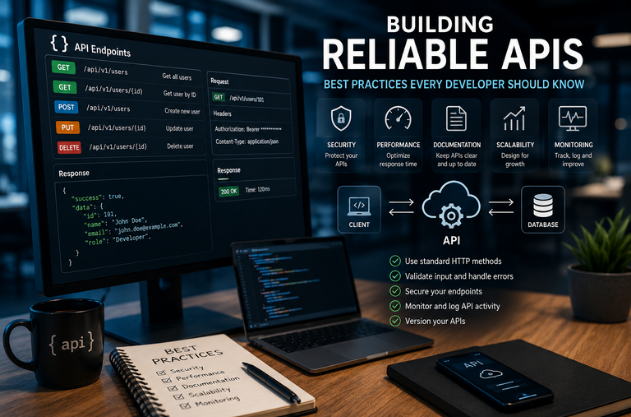
- Use standard HTTP methods appropriately.
- Version your APIs to support future enhancements.
Example:
Instead of:
GET /getUserData
Use:
GET /users/{id}
A consistent API structure improves readability, reduces confusion, and accelerates integration efforts.
2. Prioritize Security from Day One
Security should never be treated as an afterthought. APIs often expose sensitive business data and functionality, making them attractive targets for attackers.
Key Security Measures:
Authentication and Authorization
Implement robust authentication mechanisms such as:
- OAuth 2.0
- JWT (JSON Web Tokens)
- API Keys
- Single Sign-On (SSO)
Ensure users can access only the resources they are authorized to use.
Data Validation
Always validate incoming requests:
- Check required fields
- Validate data formats
- Prevent SQL injection attacks
- Prevent Cross-Site Scripting (XSS)
HTTPS Everywhere
Encrypt all communication using HTTPS to protect data during transmission.
Rate Limiting
Prevent abuse by limiting the number of requests a client can make within a specific timeframe.
Security-focused APIs help protect both users and organizations from costly breaches and service disruptions.
3. Implement Proper Error Handling
Errors are inevitable in software systems. However, how your API handles errors significantly impacts developer experience.
Good Error Response Example:
{
“success”: false,
“message”: “User not found”,
“error_code”: “USER_404”
}
Benefits:
- Easier debugging
- Faster issue resolution
- Better user experience
- Improved monitoring
Common HTTP Status Codes
| Code | Meaning |
| 200 | Success |
| 201 | Resource Created |
| 400 | Bad Request |
| 401 | Unauthorized |
| 403 | Forbidden |
| 404 | Not Found |
| 500 | Internal Server Error |
Providing clear and meaningful error messages helps developers identify and resolve issues quickly.
4. Focus on Performance and Scalability
As applications grow, APIs must handle increasing traffic without compromising performance.
Performance Optimization Techniques
Pagination
Avoid returning large datasets in a single request.
Instead of:
GET /users
Use:
GET /users?page=1&limit=20
Caching
Implement caching for frequently requested data.
Benefits include:
- Reduced database load
- Faster response times
- Improved user experience
Database Optimization
- Use indexes effectively
- Optimize queries
- Avoid unnecessary database calls
Asynchronous Processing
For long-running operations:
- Use queues
- Background jobs
- Event-driven architectures
These techniques help APIs remain responsive even under heavy traffic conditions.
5. Maintain Comprehensive Documentation
No matter how powerful an API is, it becomes difficult to use without proper documentation.
Effective API Documentation Should Include:
- Endpoint descriptions
- Request parameters
- Sample requests
- Sample responses
- Error codes
- Authentication requirements
Popular tools include:
- Swagger
- OpenAPI Specification
- Postman Collections
Well-documented APIs significantly reduce onboarding time for developers and improve adoption rates.
6. Monitor and Log Everything
Monitoring is critical for maintaining reliability in production environments.
Important Metrics to Track:
- Response times
- Error rates
- Request volume
- CPU usage
- Memory consumption
- Database performance
Logging Best Practices:
Log:
- API requests
- Responses
- Errors
- Authentication failures
Avoid logging:
- Passwords
- Sensitive personal information
- Security tokens
Proper monitoring enables teams to detect and resolve issues before they impact users.
7. Build APIs for Future Growth
Applications evolve continuously, and APIs should be designed with flexibility in mind.
Recommendations:
API Versioning
Example:
/api/v1/users
/api/v2/users
Versioning allows new features without breaking existing integrations.
Backward Compatibility
Whenever possible:
- Preserve existing functionality
- Deprecate features gradually
- Communicate changes clearly
Modular Architecture
Separate concerns into manageable services to simplify maintenance and future expansion.
Planning for growth ensures long-term API sustainability.
Real-World Development Experience
During real-world software projects, implementing API integrations often involves much more than simply connecting frontend and backend systems. Developers must handle authentication, validation, filtering, pagination, error management, and performance optimization simultaneously.
For example, while integrating search functionality across multiple dashboards, developers often face challenges such as:
- Managing dynamic filters
- Handling large datasets efficiently
- Ensuring fast response times
- Maintaining consistent API responses
- Supporting future feature enhancements
A reliable API architecture helps overcome these challenges by providing structured endpoints, optimized database queries, and robust error handling mechanisms.
These practical experiences highlight why API reliability is not just a technical requirement but a business necessity.
Conclusion
Reliable APIs are the foundation of modern software systems. They enable seamless communication between applications, support scalability, and improve user experiences. By focusing on consistency, security, performance, documentation, monitoring, and future scalability, developers can build APIs that remain dependable as business requirements evolve.
As technology continues to advance, organizations that invest in robust API development practices will be better positioned to deliver high-quality digital experiences, accelerate innovation, and maintain a competitive advantage in the software industry.
Building reliable APIs is not just about writing code—it is about creating a stable, secure, and scalable ecosystem that empowers both developers and users.
