
Introduction
A feature that works successfully on a developer’s local machine is not necessarily ready for production.
In a real-world environment, an application must handle real users, unexpected inputs, security threats, increasing traffic, database failures, network issues, and changing business requirements.
Therefore, there is an important difference between working software and production-ready software.
For a Full Stack Developer, production readiness means thinking beyond basic functionality. It also requires careful attention to architecture, code quality, security, database performance, testing, deployment, monitoring, and maintainability.
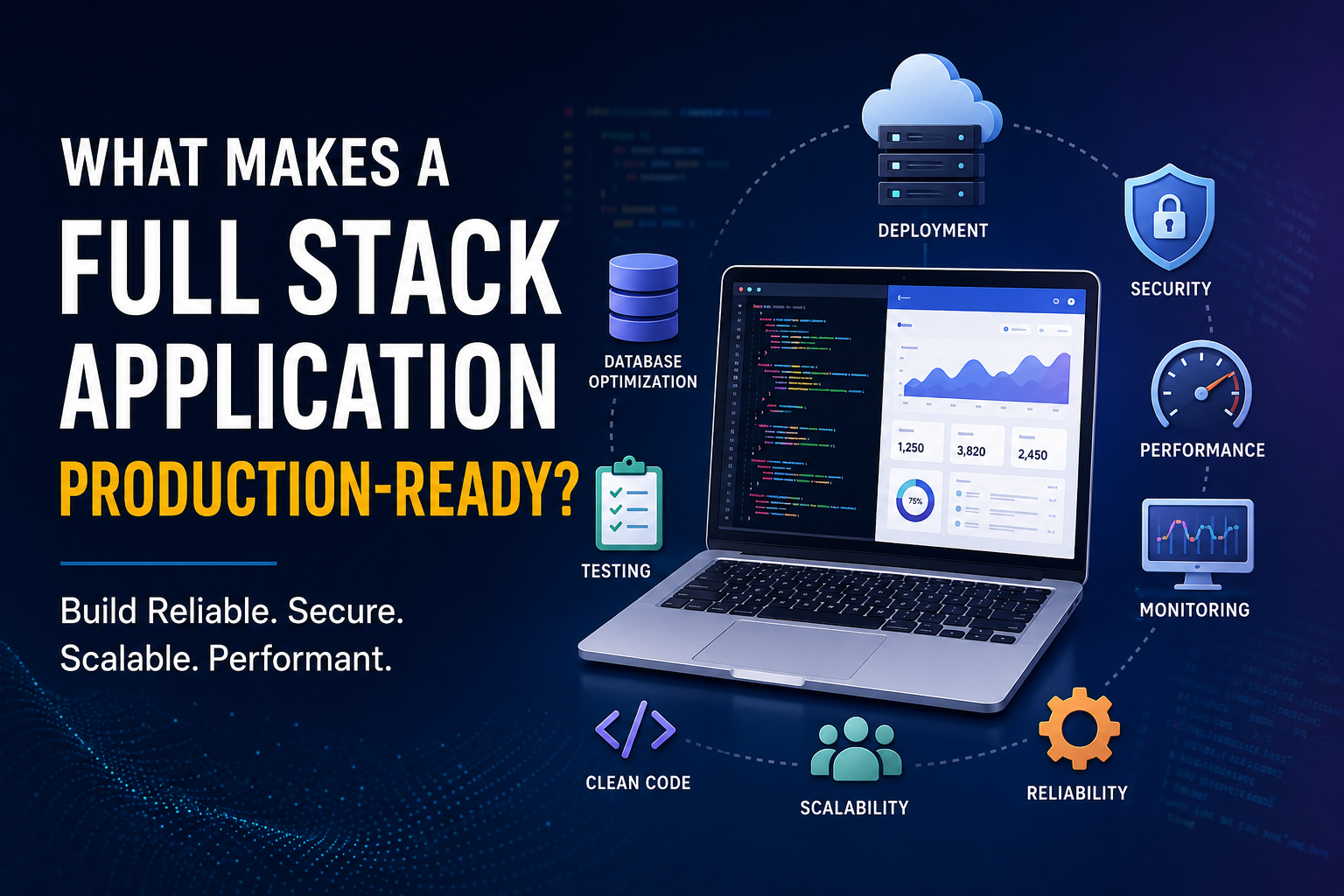
So, what actually makes a Full Stack application production-ready?
1. A Clear and Reliable Architecture
A production-ready application begins with a well-structured architecture.
However, the goal is not to create the most complicated architecture possible. Instead, developers should build a structure that is easy to understand, maintain, and extend.
A good architecture provides clear separation between different responsibilities, including:
- Frontend
- API layer
- Business logic
- Database access
- Authentication
- External services
When these responsibilities are clearly separated, developers can modify one part of the system without unnecessarily affecting another part.
As a result, a well-designed architecture reduces complexity as the application grows.
Moreover, clear architecture makes it easier for new team members to understand the project and contribute to development.
2. Clean and Maintainable Code
Production software is often maintained for months or even years.
Because of this, code that works today but is difficult to understand tomorrow can become a major source of technical debt.
Production-ready code should focus on:
- Meaningful naming
- Reusable components
- Small and focused functions
- Clear project structure
- Separation of responsibilities
- Consistent coding standards
- Avoiding unnecessary duplication
The objective is not to write more code. Rather, developers should write code that the entire team can understand and maintain.
In addition, clean code makes debugging, testing, and future improvements much easier.
3. Strong Security
Security should be considered from the beginning of development rather than added after the application is completed.
A production-ready Full Stack application should properly handle:
- Authentication
- Authorization
- Password protection
- Input validation
- Secure API communication
- Sensitive data
- File uploads
- Session or token management
For example, hiding an admin button in the frontend is not enough to protect an administrative operation.
Instead, the backend must independently verify whether the authenticated user has permission to perform that action.
Therefore, the frontend controls the user experience, while the backend controls the security boundary.
Furthermore, secure development practices help reduce the risk of unauthorized access, data exposure, and other security problems.
4. Reliable API Design
APIs provide the communication layer between the frontend and backend.
For this reason, a production-ready API should provide:
- Clear endpoint naming
- Appropriate HTTP methods
- Consistent response structures
- Meaningful status codes
- Request validation
- Proper error handling
- Pagination for large datasets
- Authentication and authorization
For instance, an API should clearly distinguish between successful requests, validation failures, authentication failures, and server-side errors.
Consequently, predictable APIs make frontend integration easier and reduce unnecessary complexity.
Additionally, consistent API responses make testing and troubleshooting more efficient.
5. Database Reliability and Performance
The database is one of the most important components of a Full Stack application.
As the amount of data increases, inefficient database operations can significantly affect application performance.
Therefore, production-ready database design should consider:
- Proper table structure
- Relationships
- Indexes
- Query optimization
- Transactions
- Data integrity
- Migrations
- Backup and recovery
For example, retrieving thousands of records when a user only needs the first 20 is inefficient.
Instead, pagination and optimized queries can reduce database and API load.
Moreover, appropriate indexing can improve the speed of frequently used database queries.
6. Proper Validation and Error Handling
Applications should always expect incorrect input and unexpected failures.
For this reason, validation should happen at the appropriate layers.
Frontend validation can provide immediate feedback to users. Meanwhile, backend validation protects the application and ensures that business rules are enforced.
A production-ready application should also handle failures gracefully.
Rather than showing a generic error or leaving users confused, the application should:
- Return appropriate status codes
- Provide meaningful messages
- Log useful technical information
- Avoid exposing sensitive details
- Give users a clear next step
As a result, good error handling improves both application reliability and user experience.
In addition, clear error information helps development teams identify and resolve problems more quickly.
7. Comprehensive Testing
A production-ready application cannot depend only on manual testing or a developer’s confidence.
Instead, testing should cover both normal and unexpected scenarios.
Depending on the application, this may include:
- Unit testing
- Integration testing
- API testing
- End-to-end testing
- Regression testing
- Security testing
- Performance testing
Developers should test more than the happy path.
For example, teams should ask:
- What happens if the user submits an empty form?
- What happens if the API is unavailable?
- What happens if the user does not have permission?
- What happens if the database returns no results?
By considering these situations before production, teams can prevent costly problems later.
Furthermore, regular testing helps developers introduce new features without accidentally breaking existing functionality.
8. Performance Optimization
A production-ready application should provide a responsive experience even as usage increases.
However, several factors can affect application performance, including:
- Slow database queries
- Too many API requests
- Large frontend bundles
- Unnecessary rendering
- Large images
- Inefficient backend logic
Common optimization techniques include:
- Database indexing
- Query optimization
- Pagination
- Caching
- Lazy loading
- Code splitting
- Reducing unnecessary API requests
Performance should not be treated as something to fix only after users start complaining.
Instead, performance should be considered throughout the development process.
After all, fast and responsive software contributes directly to a better user experience.
9. CI/CD and Automated Delivery
A reliable production environment requires a reliable delivery process.
Typically, a CI/CD pipeline may follow this sequence:
Code Push → Build → Automated Tests → Quality Checks → Deployment
Automation helps reduce manual mistakes and provides faster feedback when a change introduces a problem.
Moreover, automated processes allow teams to release features more consistently.
A mature deployment process should also make releases repeatable rather than dependent on a developer manually performing a series of steps.
As a result, CI/CD can improve deployment reliability while reducing unnecessary manual work.
10. Environment and Configuration Management
Development, testing, staging, and production environments often require different configurations.
Therefore, applications should separate environment-specific values such as:
- Database credentials
- API keys
- Service URLs
- Application configuration
- Authentication secrets
Sensitive credentials should never be hardcoded directly into the source code.
Instead, secure configuration methods should be used to manage environment-specific values.
Consequently, proper configuration management makes deployments safer and reduces the risk of accidentally exposing sensitive information.
In addition, separating configurations allows teams to manage multiple environments more efficiently.
11. Logging and Monitoring
Once an application is deployed, developers need visibility into what is happening.
Production monitoring can help answer important questions, such as:
- Is the application running correctly?
- Are API response times increasing?
- Are users encountering errors?
- Are background jobs failing?
- Is the database performing efficiently?
Useful observability practices include:
- Application logs
- Error tracking
- Performance monitoring
- Infrastructure metrics
- Health checks
- Alerts
Without monitoring, production problems can remain invisible until users report them.
Therefore, effective monitoring allows teams to identify problems earlier and respond more quickly.
Additionally, useful logs can provide valuable information when developers investigate production issues.
12. Scalability
An application that works for 100 users may behave very differently when it has thousands or millions of users.
Because of this, production-ready architecture should consider how the system can grow.
Scalability may involve:
- Caching
- Database optimization
- Load balancing
- Horizontal scaling
- Asynchronous processing
- Efficient API design
- CDN usage
However, not every application needs a complex distributed architecture from day one.
Instead, teams should understand the expected scale and avoid architectural decisions that unnecessarily limit future growth.
As usage increases, a scalable system should provide a clear path for handling additional traffic and data.
13. Backup and Recovery
Failures can happen even when an application is carefully designed.
For example, database corruption, infrastructure failures, accidental deletions, or deployment problems can result in data loss.
Production systems should therefore consider:
- Regular backups
- Backup verification
- Recovery procedures
- Disaster recovery planning
- Rollback strategies
A backup is useful only if it can actually be restored when needed.
For this reason, teams should regularly verify their backup and recovery procedures.
Moreover, a clear recovery plan can reduce downtime when unexpected failures occur.
14. Production Readiness Is a Team Responsibility
Production readiness is not the responsibility of a single developer.
Instead, it requires collaboration between:
- Developers
- QA Engineers
- DevOps Engineers
- Product Managers
- Security Teams
- Operations Teams
Each role contributes to making the application reliable.
For example, developers focus on code and functionality, while QA teams focus on quality and application behavior.
Meanwhile, DevOps teams focus on deployment and infrastructure.
Security teams focus on protecting the system, while product teams ensure that the feature solves the intended business problem.
As a result, production readiness becomes a shared responsibility across the entire team.
A Simple Production-Readiness Checklist
Before releasing a Full Stack application or feature, teams should ask:
Functionality
- Does the feature meet the requirement?
Security
- Are authentication and authorization implemented correctly?
Validation
- Are invalid inputs handled?
Database
- Are queries efficient and data properly structured?
API
- Are responses consistent and errors meaningful?
Frontend
- Are loading, empty, and error states handled?
Testing
- Have normal and edge cases been tested?
Performance
- Can the application handle expected usage?
Deployment
- Is the release process reliable?
Monitoring
- Will we know if something goes wrong?
Recovery
- Can we safely recover from a failure?
If the answer to these questions is yes, the application is much closer to being production-ready.
Working Software vs Production-Ready Software
There is an important difference between working software and production-ready software.
Working Software
- Feature works
- Basic flow is completed
- Works in the development environment
Production-Ready Software
- Feature works reliably
- Secure
- Tested
- Performant
- Maintainable
- Observable
- Scalable where required
- Recoverable
- Ready for real users
Ultimately, the second standard is what real-world software engineering demands.
Final Thoughts
Building a Full Stack application is not simply about connecting a frontend to a backend and making the feature work.
Instead, production readiness requires a broader engineering mindset.
“Production-ready software is not defined by whether it works once. It is defined by how reliably it continues to work in the real world.”
So, what do you think is the most important part of making a Full Stack application production-ready: Security, Testing, Performance, Scalability, or Monitoring?
