
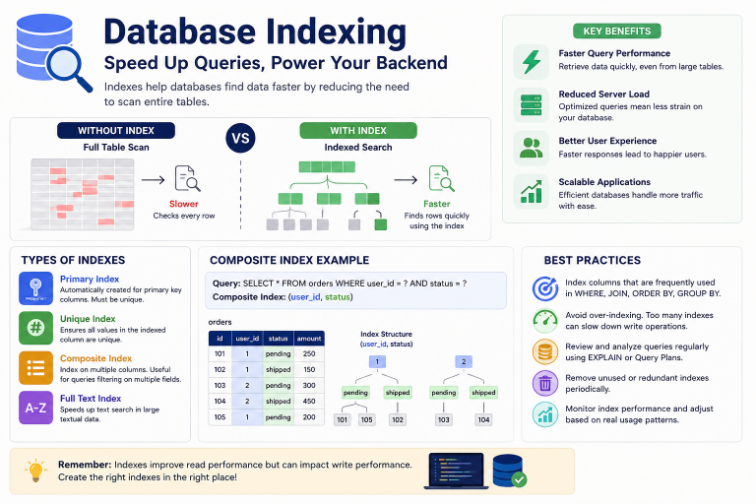
Database indexing is an important technique for improving the performance of backend applications. Properly designed indexes allow databases to locate records more efficiently instead of scanning an entire table. This can significantly reduce query execution time, especially when working with large datasets.
Understanding Database Indexes
An index is a data structure maintained by the database to make data retrieval faster. Similar to an index in a book, it allows the database to locate specific records without checking every row in a table.
Indexes are particularly useful for columns that are frequently used in filtering, searching, sorting, and joining operations.
Choosing Columns to Index
Not every database column should be indexed. Indexes should generally be created for columns that are frequently involved in:
- WHERE conditions
- JOIN operations
- ORDER BY clauses
- GROUP BY operations
- Unique constraints
For example, if an application frequently searches users by email address, creating an index on the email column can improve lookup performance.
Using Composite Indexes
A composite index contains multiple columns and can be useful when queries commonly filter by more than one field.
For example, an application that frequently searches orders using both user_id and status may benefit from an index containing those columns.
The order of columns in a composite index is important because databases use the index based on its defined column sequence.
Avoiding Excessive Indexes
Although indexes improve read performance, they also have costs. Every time data is inserted, updated, or deleted, related indexes may need to be updated.
Creating unnecessary indexes can therefore increase storage requirements and slow down write operations.
Indexes should be added based on actual query requirements rather than indexing every column automatically.
Analyzing Query Performance
Database tools such as query execution plans can help developers understand how queries are being executed. These plans can reveal whether the database is using an index or performing an expensive full-table scan.
Regular query analysis helps identify slow operations and opportunities for optimization.
Index Maintenance
As applications grow, database indexes should be reviewed periodically. Changes in data distribution, query patterns, and application features can make some indexes less useful over time.
Removing unused indexes and reviewing frequently executed queries can help maintain consistent database performance.
Balancing Read and Write Performance
The goal of indexing is not simply to maximize query speed. A good indexing strategy balances read performance with insert, update, and delete performance.
By analyzing application access patterns and creating indexes only where they provide meaningful benefits, backend systems can achieve faster queries while keeping database operations efficient and scalable.
