
When organizations think about cybersecurity, they often focus on protecting their own servers, applications, networks, and employees.
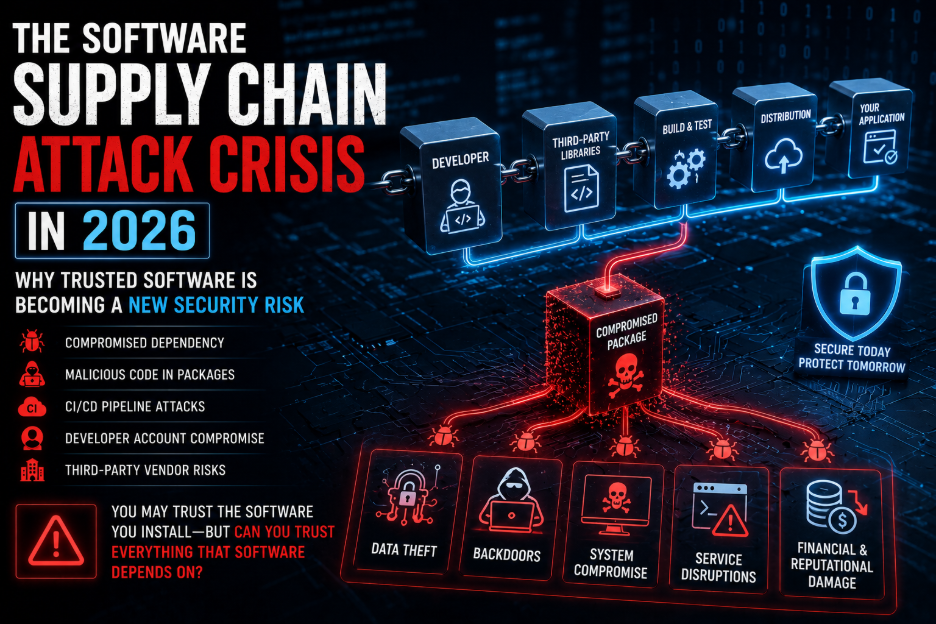
But modern software is rarely built entirely from scratch.
A single application can depend on hundreds or even thousands of external components, including open-source libraries, third-party packages, cloud services, APIs, development tools, and software vendors.
This creates a hidden security problem.
What happens when something you trust becomes compromised?
Attackers are increasingly looking beyond the final target and searching for weaknesses somewhere inside the software ecosystem. Instead of attacking a large company directly, they may compromise a developer account, inject malicious code into an open-source package, target a software vendor, or manipulate a build pipeline.
This is known as a software supply chain attack.
As organizations become increasingly dependent on open-source software, cloud platforms, automation, and third-party services, securing the software supply chain has become an essential part of modern cybersecurity.
What Is a Software Supply Chain?
A software supply chain includes all the components, tools, people, and services involved in creating and delivering software.
This can include:
- Developers
- Source-code repositories
- Open-source libraries
- Third-party packages
- APIs
- Build systems
- CI/CD pipelines
- Cloud infrastructure
- Software vendors
- Deployment platforms
- Package managers
For example, a web application might contain code written by an internal development team while also relying on hundreds of external packages.
The organization may trust its own code, but a vulnerability or malicious modification inside one of those dependencies could potentially affect the entire application.
What Is a Software Supply Chain Attack?
A software supply chain attack occurs when an attacker compromises a trusted component or process within the software development and delivery chain.
Instead of attacking the final organization directly, the attacker targets something that the organization already trusts.
The basic strategy looks like this:
Compromise trusted component → distribute malicious code → reach downstream users
This approach can be extremely powerful because the malicious component may enter an environment through a legitimate development or software-update process.
Why Attackers Target the Supply Chain
Direct attacks against large organizations can be difficult.
Companies may have:
- Firewalls
- Endpoint security
- Intrusion detection
- Security teams
- Multi-factor authentication
- Network segmentation
But a smaller third-party vendor or widely used software dependency may have fewer security controls.
If attackers compromise that trusted component, they may gain access to many downstream organizations.
One successful compromise can therefore have a much larger impact than attacking individual companies one by one.
The Open-Source Dependency Problem
Open-source software has transformed modern development.
Developers can install a package and immediately gain access to functionality that would otherwise take weeks or months to build.
For example, an application might depend on packages for:
- Authentication
- Database connections
- Image processing
- Logging
- Encryption
- Data validation
- HTTP requests
- User interfaces
The advantage is enormous.
But every dependency introduces another potential point of failure.
A developer may know exactly what their own code does without fully understanding the security of every dependency used by the application.
Malicious Packages
One common supply chain technique involves publishing a malicious package that looks legitimate.
Attackers may create package names that resemble popular libraries.
This technique is sometimes called typosquatting.
For example, if a legitimate package has a name similar to:
example-library
an attacker might publish something with a nearly identical name, hoping developers accidentally install it.
A malicious package could potentially:
- Steal environment variables
- Collect credentials
- Modify files
- Download additional malware
- Access sensitive systems
- Send data to an external server
This is why developers should verify package names, maintain trusted registries, and review dependencies carefully.
Compromising Legitimate Packages
Attackers don’t always create fake packages.
Sometimes they attempt to compromise legitimate ones.
If an attacker gains access to a maintainer’s account or development environment, they may be able to modify a package that already has thousands or millions of users.
The malicious code can then be distributed through normal package updates.
From the perspective of a developer installing the update, everything may appear legitimate.
This makes compromised dependencies particularly dangerous.
Developer Account Attacks
Developers have become valuable targets because they often have access to critical systems.
A compromised developer account could potentially provide access to:
- Source code
- Package repositories
- Cloud environments
- CI/CD systems
- Deployment credentials
- API keys
- Production infrastructure
Attackers may target developers through:
- Phishing
- Credential theft
- Malware
- Session hijacking
- Weak authentication
- Compromised devices
Protecting developer identities is therefore a critical part of software supply chain security.
CI/CD Pipeline Attacks
Modern development relies heavily on automation.
Continuous Integration and Continuous Deployment (CI/CD) pipelines automatically:
- Retrieve source code.
- Install dependencies.
- Run tests.
- Build applications.
- Package software.
- Deploy it to production.
This automation improves development speed, but it also creates a valuable target.
If attackers compromise a CI/CD environment, they may be able to manipulate the software before it reaches customers.
The dangerous part is that the final application could appear to have been built normally.
Secrets in Development Environments
Development environments often contain sensitive credentials.
Examples include:
- API keys
- Database passwords
- Cloud credentials
- Access tokens
- Signing keys
- Deployment credentials
If these secrets are accidentally committed to source control or exposed through a compromised dependency, attackers may use them to move deeper into the environment.
Security teams therefore need strong secrets-management practices.
Sensitive credentials should never be treated as ordinary source-code configuration.
Software Updates Can Become an Attack Vector
Users are generally encouraged to keep software updated.
And for good reason—updates often contain important security fixes.
But supply chain attacks demonstrate an uncomfortable reality:
A trusted update can become an attack vector if the update mechanism itself is compromised.
This is why software vendors need strong controls around:
- Code signing
- Build systems
- Release processes
- Developer accounts
- Update infrastructure
Trust must extend beyond the software itself to the process used to create and distribute it.
The SolarWinds Lesson
One of the most widely discussed examples of a software supply chain compromise involved SolarWinds.
Attackers compromised part of the company’s software build environment and inserted malicious code into legitimate software updates.
Organizations that installed the affected updates effectively received compromised software through a trusted channel.
The incident demonstrated how a single compromised software vendor could become a gateway to numerous downstream organizations.
It also changed how governments and enterprises think about software supply chain security.
Why Traditional Security Isn’t Enough
Traditional cybersecurity often focuses on detecting suspicious activity after software reaches an environment.
Supply chain attacks create a different challenge.
The malicious component may initially look legitimate.
It may be:
- Properly packaged
- Digitally signed
- Installed through an approved process
- Deployed by an authorized system
The problem is not necessarily that the software entered through an obviously malicious channel.
The problem is that the trusted channel itself may have been compromised.
Organizations therefore need security controls throughout the software development lifecycle.
What Is an SBOM?
One important technology for improving software supply chain visibility is the Software Bill of Materials, commonly known as an SBOM.
An SBOM is essentially an inventory of the components used to build a software product.
It can identify:
- Libraries
- Packages
- Versions
- Dependencies
- Components
- Relationships between software elements
Think of it like an ingredients list for software.
If a vulnerability is discovered in a particular library, an organization with a reliable SBOM can more quickly determine which applications contain that component.
Why SBOMs Matter
Without a complete dependency inventory, security teams may not know exactly what software components exist inside their applications.
That makes vulnerability management difficult.
With an SBOM, organizations can ask:
“Which applications depend on this vulnerable package?”
This allows security teams to prioritize remediation more effectively.
An SBOM doesn’t automatically make software secure, but it provides important visibility into what the software actually contains.
How Organizations Can Secure the Software Supply Chain
1. Maintain Dependency Inventories
Organizations should know which third-party components their applications use.
Dependencies should be:
- Identified
- Versioned
- Reviewed
- Monitored
- Updated
Unknown dependencies create unnecessary security risk.
2. Use Trusted Package Sources
Developers should obtain dependencies from trusted repositories and verify package names carefully.
Avoid downloading libraries from random websites or unknown sources.
3. Pin Dependency Versions
Automatically accepting every new dependency version can introduce unexpected changes.
Version pinning helps teams control exactly which software components are being used.
However, pinned dependencies must still be reviewed and updated when security fixes become available.
4. Scan Dependencies
Security tools can analyze third-party packages for known vulnerabilities.
Automated dependency scanning can identify problems before software reaches production.
5. Protect Developer Accounts
Developer accounts should receive strong security controls.
Organizations should consider:
- Multi-factor authentication
- Hardware security keys
- Strong access policies
- Privileged access management
- Regular access reviews
A developer account should never be treated as an ordinary user account if it can modify production software.
6. Secure CI/CD Systems
Build and deployment systems should be protected like production infrastructure.
Important measures include:
- Strong authentication
- Minimal permissions
- Isolated build environments
- Secret management
- Build monitoring
- Audit logging
CI/CD systems should receive the same security attention as servers and databases.
The Principle of Least Privilege
A major defense against supply chain attacks is least privilege.
Every developer, application, package, service, and automated pipeline should receive only the permissions it actually needs.
For example, a build process that only needs to compile an application should not automatically have unrestricted access to production databases.
If a component is compromised, limited permissions can reduce the attacker’s ability to move further.
Code Signing and Software Integrity
Code signing allows organizations to verify that software came from a trusted source and hasn’t been modified unexpectedly.
Software vendors can digitally sign:
- Applications
- Updates
- Packages
- Containers
- Firmware
Signature verification provides an additional layer of trust between software producers and consumers.
However, signing alone isn’t enough.
If attackers compromise the legitimate build process and malicious code is signed during that process, the signature may still be valid.
This is why organizations need security throughout the entire build lifecycle.
Container and Cloud Supply Chains
Modern applications increasingly use containers and cloud-native infrastructure.
Developers may depend on:
- Container images
- Base images
- Cloud services
- Infrastructure-as-code modules
- Third-party APIs
Each component can introduce additional dependencies.
Organizations should therefore scan container images and infrastructure components just as carefully as traditional application dependencies.
AI Is Changing the Supply Chain Threat
Artificial intelligence is likely to influence software supply chain attacks in both offensive and defensive ways.
Attackers can potentially use AI to:
- Generate malicious code
- Search for vulnerable dependencies
- Automate reconnaissance
- Create convincing phishing messages
- Analyze source code
Defenders can also use AI to:
- Detect suspicious code
- Analyze dependency relationships
- Identify unusual developer behavior
- Prioritize vulnerabilities
- Monitor repositories
- Detect anomalies in build pipelines
This creates another technology race between attackers and defenders.
The Human Factor
Technology alone cannot eliminate supply chain risk.
Developers and security teams need to understand that every external component represents a trust relationship.
Before introducing a dependency, teams should consider:
- Who maintains it?
- Is it actively maintained?
- How widely is it used?
- Does it have known vulnerabilities?
- Where does it come from?
- What permissions does it require?
- What happens if the project is compromised?
Security needs to become part of the development process rather than something added after an application is completed.
A Secure Software Development Lifecycle
A strong software supply chain strategy should begin during development.
A secure lifecycle can look like:
Plan → Code → Review → Scan → Build → Test → Sign → Deploy → Monitor
Security checks should exist at every stage.
This approach reduces the chance that malicious or vulnerable components reach production.
What Developers Can Do
Developers play an important role in protecting the software supply chain.
Good practices include:
- Verify package names before installation.
- Keep dependencies updated.
- Remove unused dependencies.
- Avoid unnecessary third-party packages.
- Use lock files where appropriate.
- Never commit secrets to repositories.
- Enable strong authentication.
- Review dependency changes.
- Use security scanning tools.
- Report suspicious packages.
A small amount of caution during development can prevent significant security problems later.
What Security Teams Should Monitor
Security teams should pay attention to unusual activity involving:
- Developer accounts
- Package repositories
- CI/CD pipelines
- Dependency changes
- Build artifacts
- Cloud credentials
- Deployment systems
Unexpected changes to software components should be investigated quickly.
Monitoring should extend beyond production systems into the development ecosystem.
The Future of Software Supply Chain Security
Software development will continue becoming more distributed.
Applications will increasingly combine:
- Open-source packages
- AI-generated code
- Cloud services
- APIs
- Containers
- External SaaS platforms
- Automated development tools
This means the software supply chain will become even more complex.
Future security strategies are likely to place greater emphasis on:
- Automated dependency analysis
- SBOMs
- Software provenance
- Strong identity controls
- Reproducible builds
- Automated security testing
- AI-assisted code analysis
- Continuous monitoring
Organizations will need to understand not just what software they run, but where every important component came from and how it was built.
Conclusion
Modern software is built on trust.
Developers trust packages. Organizations trust vendors. Users trust software updates. Automated pipelines trust source repositories and dependencies.
Attackers understand these relationships.
Rather than breaking directly into a heavily protected organization, they can attempt to compromise something the organization already trusts.
That makes the software supply chain one of the most important security challenges of modern technology.
Organizations can reduce this risk by maintaining accurate dependency inventories, protecting developer accounts, securing CI/CD pipelines, scanning third-party components, using SBOMs, implementing least privilege, and continuously monitoring the development environment.
The goal isn’t to eliminate every third-party dependency.
It’s to understand them.
Because in modern cybersecurity, the biggest threat may not be the software you don’t trust—it may be the software you trust the most.
