
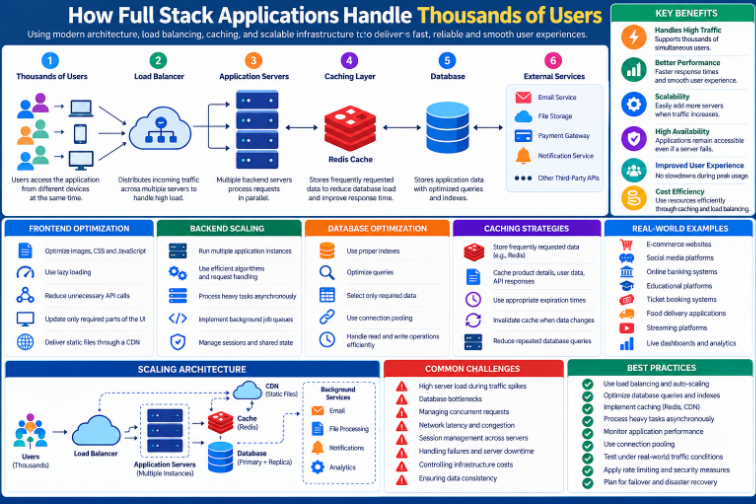
Modern web applications are expected to serve thousands or even millions of users without becoming slow or unavailable. E-commerce websites, social media platforms, online banking systems, educational portals, and booking applications must handle large numbers of users accessing information and performing actions at the same time. As the number of users increases, developers face challenges related to application performance, database operations, network traffic, and server capacity.
Full stack development involves building both the frontend and backend of an application, along with the systems that store and manage its data. When an application serves only a small number of users, a basic server and database may be sufficient. However, as traffic increases, the application needs a carefully designed architecture that can process requests efficiently, distribute workloads, and maintain reliable performance.
Modern technologies such as load balancing, caching, database optimization, asynchronous processing, and cloud infrastructure help applications manage increasing numbers of users. Understanding these techniques allows full stack developers to build applications that remain responsive, reliable, and scalable as their user base grows.
Understanding Application Scalability
Scalability refers to an application’s ability to handle increasing workloads without experiencing unacceptable performance problems. A scalable application can accommodate additional users, requests, and data by using resources more efficiently or adding computing capacity.
For example, an online shopping website may receive a few hundred visitors during normal hours but experience thousands of simultaneous visitors during a major sale. A scalable architecture helps the website handle the increased demand without significantly affecting the shopping experience.
Scalability depends on several parts of the application, including frontend performance, backend processing, database design, network communication, and infrastructure configuration.
Understanding Concurrent Users and Requests
Thousands of users accessing an application does not necessarily mean that thousands of requests arrive at precisely the same moment. However, many users may perform operations simultaneously, creating a high volume of concurrent requests.
For example, users may log in, search for products, update profiles, submit forms, and retrieve information at the same time. The backend must process these requests without allowing one slow operation to unnecessarily block others.
Developers must consider request volume, response time, concurrent connections, and the amount of work performed by each request when designing an application for large numbers of users.
The Role of the Frontend
The frontend is the part of an application that users interact with through their browsers or devices. Although server infrastructure handles much of the processing, frontend optimization also plays an important role in supporting large user populations.
Developers can improve frontend performance by optimizing images, reducing unnecessary JavaScript, lazy loading resources, minimizing repeated API calls, and avoiding unnecessary component updates.
For example, an e-commerce application does not need to download every product image when a user first opens the page. It can load images as the user scrolls through the product list.
An efficient frontend reduces unnecessary network traffic and improves the user experience, particularly for users with slower internet connections or less powerful devices.
Efficient Backend Processing
The backend receives requests from the frontend, executes application logic, communicates with databases, and returns responses.
When many users access an application simultaneously, inefficient backend operations can increase response times and overload the server. Developers must ensure that requests are processed efficiently and that expensive operations do not consume unnecessary resources.
Techniques such as asynchronous processing, efficient algorithms, reusable service logic, and appropriate resource management help improve backend performance.
For example, a backend can process a user’s order immediately while placing tasks such as sending confirmation emails into a background job queue. This reduces the amount of work that must be completed before the user receives a response.
Load Balancing
Load balancing is a technique used to distribute incoming traffic across multiple servers or application instances.
Instead of sending every request to a single server, a load balancer directs requests to available servers according to its configuration and routing strategy. This helps prevent individual servers from becoming overloaded.
For example, an application may run three backend instances. A load balancer distributes incoming requests among those instances so that the application can handle more traffic than a single instance might support.
Load balancing can also improve availability when configured with health checks and appropriate failure-handling mechanisms. However, it does not automatically solve every bottleneck, particularly if all instances depend on an overloaded database.
Horizontal and Vertical Scaling
Applications can be scaled in two primary ways: vertical scaling and horizontal scaling.
Vertical scaling means increasing the resources of an existing server, such as adding more CPU capacity or memory. This can be a straightforward way to improve performance, although the server has practical limits.
Horizontal scaling means adding more servers or application instances to distribute the workload. It is commonly used in cloud-based and distributed applications.
Horizontal scaling can provide greater flexibility, but it requires applications to handle shared state, session management, routing, and data consistency appropriately.
The right strategy depends on the application’s architecture, workload, budget, and reliability requirements.
Database Optimization
Databases are often one of the most important performance considerations when applications serve many users. Every request that retrieves, inserts, updates, or deletes information may require database operations.
Poorly designed queries, missing indexes, unnecessary data retrieval, and excessive database connections can create bottlenecks.
Developers can improve database performance by using suitable indexes, optimizing queries, selecting only the required fields, and designing data structures carefully.
For example, an online store can use an index on a frequently searched product identifier to retrieve matching records more efficiently.
Database optimization reduces processing time and helps the application handle increasing request volumes.
Database Connection Pooling
Opening a new database connection for every request can create unnecessary overhead. When many users access an application simultaneously, repeated connection creation may consume significant database resources.
Connection pooling addresses this problem by maintaining a reusable set of database connections. Application requests can use available connections rather than repeatedly establishing new ones.
Properly configured connection pools improve resource utilization and can reduce connection overhead. However, the pool size must be chosen carefully because too many connections can overload the database rather than improve performance.
Caching Frequently Requested Data
Caching stores frequently accessed information temporarily so that the application does not need to perform the same expensive operation repeatedly.
For example, a shopping website may receive thousands of requests for popular products. Instead of retrieving the same information from the database every time, the application can cache suitable product data and reuse it until the information changes or expires.
Caching can be implemented at different levels, including browser caches, content delivery networks, application memory, and dedicated caching systems such as Redis.
Effective caching reduces repeated processing and database load. Developers must also consider cache expiration and invalidation to prevent users from receiving outdated information.
Content Delivery Networks
A Content Delivery Network (CDN) is a distributed network of servers that delivers content from locations closer to users.
Websites often contain static resources such as images, stylesheets, JavaScript files, fonts, and downloadable assets. Serving these resources through a CDN can reduce latency and decrease the amount of traffic handled directly by the application’s main servers.
For example, a website with users across different regions can deliver images from nearby CDN locations instead of transferring every file from one central server.
This improves content delivery performance and allows backend servers to focus on processing application requests.
Asynchronous Processing and Background Jobs
Some tasks do not need to be completed before the user receives an immediate response. Examples include sending emails, generating reports, processing uploaded files, and preparing notifications.
Background job systems allow these tasks to be processed separately from the main request-response cycle. The backend can place a job in a queue, return a response to the user, and let a worker process the task afterward.
This approach helps prevent slow background operations from blocking user-facing requests.
For example, when a user uploads a large image, the application can accept the upload and schedule image processing as a background task rather than making the user wait for every processing step to finish.
Managing Sessions and Shared State
Applications often need to remember information about users, such as authentication status, preferences, or shopping cart contents.
When an application runs on multiple servers, storing all session information only in the memory of one server can create problems. A user whose requests reach another server may not have access to the same session data.
Developers can address this by using appropriate session strategies, signed tokens, or shared session storage. The choice depends on security requirements and application design.
Managing shared state correctly helps ensure that users receive a consistent experience even when requests are handled by different application instances.
Monitoring and Performance Testing
An application should be tested and monitored to understand how it behaves under different workloads.
Performance testing helps developers measure response times, throughput, resource usage, and error rates under simulated traffic. Load testing examines performance at expected traffic levels, while stress testing explores how the system behaves beyond its anticipated capacity.
Monitoring tools can track server health, database performance, API response times, memory consumption, and application errors.
These measurements help developers identify bottlenecks before they affect large numbers of users and determine when additional resources or architectural changes are needed.
Real-World Applications
Scalable full stack architectures are used in many industries and services.
Some common examples include:
- E-commerce websites handling large numbers of shoppers.
- Social media platforms processing posts, comments, and notifications.
- Online banking applications managing account requests and transactions.
- Educational platforms supporting simultaneous learners.
- Ticket-booking systems handling sudden traffic spikes.
- Food delivery applications processing orders and location updates.
- Streaming platforms delivering media to users across different regions.
- Business dashboards processing large volumes of operational data.
Each application has different scalability requirements, but all benefit from efficient processing, suitable infrastructure, and reliable data management.
Challenges of Handling Thousands of Users
Supporting a large number of users introduces several technical and operational challenges.
Some common challenges include:
- Increased server CPU and memory usage.
- Database bottlenecks and slow queries.
- Network congestion and higher latency.
- Managing concurrent requests and shared state.
- Maintaining consistent data across multiple services.
- Handling traffic spikes and unexpected failures.
- Controlling cloud infrastructure costs.
- Detecting performance problems before users are affected.
These challenges cannot always be solved by adding more servers. Developers must identify the actual bottlenecks and select solutions that match the application’s requirements.
Best Practices for Building Scalable Applications
Developers can improve application scalability by following established engineering practices.
Some recommended practices include:
- Keep frontend resources optimized.
- Use efficient backend algorithms and request handling.
- Optimize database queries and indexes.
- Implement caching where appropriate.
- Use load balancing when multiple application instances are required.
- Process suitable background tasks asynchronously.
- Configure connection pools carefully.
- Monitor application performance and error rates.
- Test applications under realistic workloads.
- Secure APIs and apply appropriate rate limits.
- Plan for failures and recovery.
- Review infrastructure costs as traffic increases.
Following these practices helps applications remain responsive and maintainable as the number of users grows.
Conclusion
Handling thousands of users is an important challenge in modern full stack development. As application traffic increases, developers must ensure that the frontend, backend, database, and supporting infrastructure work together efficiently.
Techniques such as load balancing, horizontal scaling, caching, database optimization, connection pooling, content delivery networks, and background processing help applications manage higher workloads. Performance testing and continuous monitoring allow development teams to identify bottlenecks and make informed improvements.
Scalability is not achieved through a single technology or configuration. It results from careful architecture, efficient code, reliable infrastructure, and ongoing measurement. By applying these principles, full stack developers can build applications that support growing user demand while maintaining performance, availability, security, and a positive user experience.
