
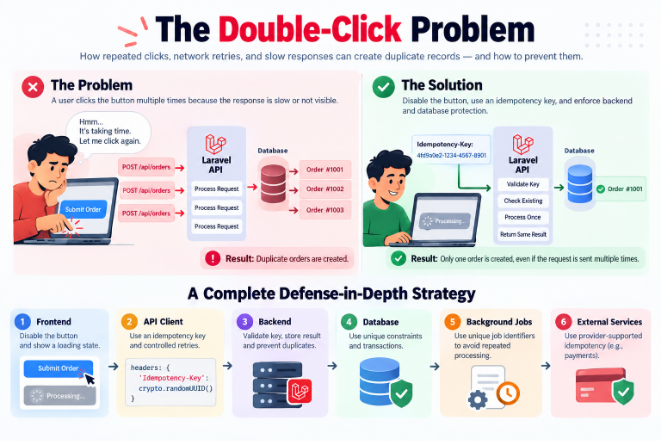
Introduction
Have you ever clicked a Submit button, waited for a few seconds, and clicked it again because nothing seemed to happen?
This is a common situation in web applications. When a request takes longer than expected, users may assume that the application has not responded and try again. However, the first request might still be processing in the background.
As a result, the same operation may be executed multiple times, creating duplicate database records, sending repeated email notifications, processing background jobs more than once, or charging a customer multiple times.
In full-stack development, preventing duplicate API requests is not just a frontend responsibility. It requires a coordinated approach involving the frontend, backend, database, and external services.
1. Understanding the Double-Click Problem
The double-click problem occurs when a user unintentionally triggers the same action multiple times before the application finishes processing the original request.
For example, imagine a user placing an order in an online shopping application. After clicking the Place Order button, the application takes several seconds to respond. The user clicks the button again, assuming the first click was unsuccessful.
If both requests reach the backend and are processed independently, the application may create two separate orders for a single purchase intention.
This problem can occur even when the user clicks only once. Network interruptions, automatic retries, and uncertain server responses can cause the same request to be submitted again.
The fundamental issue is that the application must distinguish between a genuinely new operation and another attempt to perform an operation that has already been initiated.
2. Common Causes of Duplicate API Requests
Several factors can lead to duplicate requests in full-stack applications.
Repeated user interactions: Users may click buttons multiple times when the interface does not provide immediate feedback or appears unresponsive.
Slow server responses: Complex database queries, external API calls, or resource-intensive operations can increase response times, encouraging users to retry.
Network failures and retries: A request may reach the server successfully even if the response never reaches the client. Retrying the request without checking its outcome can execute the operation again.
Duplicate event handlers: Incorrect event listener management or repeated component initialization can cause a single interaction to trigger multiple requests.
Concurrent requests: Two requests may arrive at the backend almost simultaneously, before the application has completed checking or processing the first request.
Background job duplication: Job retries, queue redelivery, and application failures can cause background tasks to execute more than once.
Understanding these causes helps developers select appropriate prevention strategies instead of relying on a single solution.
3. The Role of the Frontend in Preventing Duplicate Requests
The frontend is the first line of defense against accidental repeated submissions.
A well-designed interface should communicate clearly when an operation is in progress. Loading indicators, disabled buttons, and progress messages help users understand that their action has been received.
For example, after a user submits a registration form, the application can temporarily disable the Submit button and display a processing message until the request completes.
This approach improves the user experience and reduces unnecessary requests.
However, frontend protection has limitations. Users can refresh the page, open multiple browser tabs, send requests through other clients, or experience network retries. Frontend controls alone cannot guarantee that an operation will happen only once.
Therefore, the frontend should prevent accidental repetition, while the backend must enforce the rules that protect the actual operation.
4. Backend Idempotency: The Key to Safe Request Handling
Idempotency is an important concept in reliable API design.
An operation is idempotent when repeating the same operation produces the same intended result as performing it once.
For example, setting a user’s notification preference to disabled repeatedly should leave the preference disabled. Each repetition should not create additional side effects.
However, creating a new order is generally not naturally idempotent. Repeating the same order-creation request can create multiple records unless the application implements additional safeguards.
One common technique is the use of idempotency keys.
An idempotency key is a unique identifier associated with a particular intended operation. When a client retries that operation, it sends the same key. The backend uses the key to recognize the repeated attempt and return the existing result instead of executing the operation again.
A reliable implementation should store the key, associate it with the relevant user and operation, and retain the result needed to respond to subsequent requests.
The backend should also detect situations where the same key is reused with a different request payload.
Idempotency keys are especially useful for payment processing, order creation, booking systems, and other operations where duplicate execution can have significant consequences.
5. The Importance of Database-Level Protection
Even when the frontend and backend contain appropriate safeguards, concurrent requests can still create problems if the database does not enforce important business rules.
Consider an event registration system where a user is allowed to register only once for a particular event.
If two requests arrive simultaneously, both might check whether a registration exists before either request has created a record. Both requests may then attempt to create a registration.
This is a race condition.
Database unique constraints provide a reliable way to enforce rules such as allowing only one registration per user and event. Transactions and appropriate locking strategies can also help maintain consistency when multiple operations access the same data concurrently.
The database acts as the final layer of protection for the rules it can enforce.
However, uniqueness constraints should reflect actual business requirements. Two identical purchases, for instance, may be legitimate if a customer intentionally places two separate orders.
6. Handling Network Failures and Automatic Retries
Network failures make duplicate prevention more challenging because the client may not know whether the original operation succeeded.
Imagine the following sequence:
- A client sends a request to create an order.
- The backend successfully saves the order.
- The server attempts to return a successful response.
- The connection fails before the client receives that response.
- The client retries the request.
From the client’s perspective, the outcome is uncertain. From the server’s perspective, the order has already been created.
Automatically retrying every failed request can therefore be dangerous, especially for operations that create records or trigger external side effects.
A safer retry strategy distinguishes between temporary failures and permanent errors. It uses a bounded retry policy, appropriate delays, and the same idempotency key for retries of the same operation.
When the outcome remains uncertain, checking the operation’s status can be safer than blindly submitting a new request.
The key principle is that a failed response does not necessarily mean a failed operation.
7. Preventing Duplicate Background Jobs and External Side Effects
Duplicate execution is not limited to HTTP requests.
Full-stack applications often rely on background queues to send emails, generate reports, process uploads, or update external systems. Queue workers may retry jobs after failures, and some queue systems provide at-least-once delivery rather than guaranteeing that every job is delivered only once.
Consequently, the same job may be processed more than once.
Developers can reduce this risk through unique job identifiers, deduplication mechanisms, database constraints, and idempotent job design.
External services require additional care. For example, a payment provider may offer its own idempotency mechanism to prevent repeated payment attempts from creating multiple charges.
A robust application must consider the complete business workflow rather than protecting only the initial API endpoint.
8. A Defense-in-Depth Strategy
Reliable duplicate prevention requires multiple layers of protection because each layer addresses a different failure scenario.
Frontend protection: Prevent accidental repeated clicks and clearly communicate that a request is being processed.
API client protection: Use controlled retry policies and avoid automatically repeating operations when their outcomes are uncertain.
Backend protection: Identify repeated operations and return consistent results when an existing operation has already been completed.
Database protection: Enforce business rules using unique constraints, transactions, and appropriate concurrency controls.
Background job protection: Make jobs safe to retry and prevent duplicate processing where necessary.
External service protection: Use provider-supported idempotency features for operations such as payments whenever available.
Together, these measures make applications more resilient to user behavior, network failures, and concurrent execution.
9. Testing Duplicate-Request Scenarios
Duplicate prevention should be tested under realistic conditions rather than only during normal application usage.
Developers should verify how the application behaves when users click a button repeatedly, two requests arrive concurrently, a network connection fails after the server completes an operation, or a background job is retried.
Tests should also confirm that reusing an idempotency key returns the expected result, while reusing it with a different payload is handled safely.
For applications with important business operations, it is equally important to verify that legitimate new operations are not accidentally blocked.
Concurrency testing is particularly valuable because a solution that works for sequential requests may still fail when multiple requests arrive at nearly the same time.
Conclusion
The double-click problem may seem like a small user-interface issue, but it can lead to serious consequences, including duplicate records, repeated notifications, inconsistent data, and multiple financial transactions.
Preventing these issues requires more than disabling a button. The frontend must provide clear feedback, the backend must recognize repeated operations, and the database must enforce critical business rules.
Network retries, background jobs, and external service calls must also be considered when designing a reliable solution.
The objective is not necessarily to ensure that every request is transmitted exactly once. In distributed systems, that guarantee is difficult to achieve.
Instead, the goal is to ensure that repeated attempts do not unintentionally repeat the same business operation.
By applying idempotency, database constraints, concurrency control, and thoughtful retry strategies, developers can build full-stack applications that remain reliable even when requests are slow, connections fail, or users click more than once.
