
Introduction
Modern applications rarely operate as isolated pieces of software.
A single user action might involve a frontend application, multiple backend services, databases, authentication providers, message queues, and third-party APIs—all communicating across a network.
From the user’s perspective, everything may appear to be one application. Behind the scenes, however, several independent components must coordinate to deliver a consistent and reliable experience.
This is where distributed systems become important.
As applications grow, distributing responsibilities across multiple services can improve scalability, flexibility, and availability. However, it also introduces new challenges involving network communication, data consistency, partial failures, latency, and operational complexity.
The most important lesson is that distributing a system does not automatically make it more scalable, reliable, or maintainable.
It changes the nature of the problems engineers must solve.
Understanding these trade-offs is essential for building modern software systems that can grow without becoming unnecessarily fragile.
1. What Is a Distributed System?
A distributed system consists of multiple independent computing components that communicate over a network to accomplish a shared objective.
Each component may perform a specific responsibility, while the overall system behaves like a unified application.
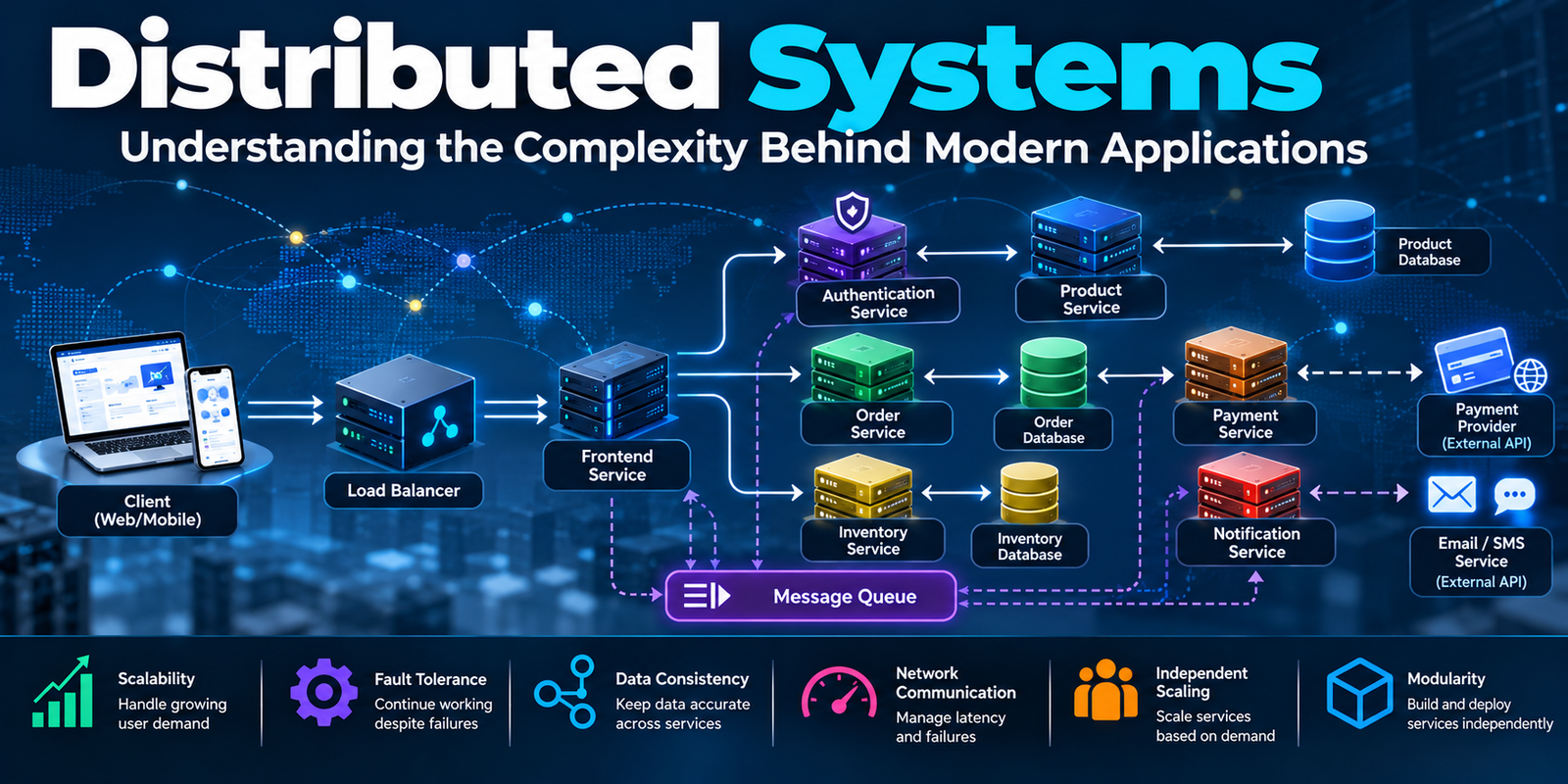
Consider an e-commerce platform.
A typical architecture might contain:
- Frontend service: Handles user interactions and presentation.
- Authentication service: Manages identity and access.
- Product service: Manages product information.
- Order service: Handles order creation and lifecycle.
- Payment service: Coordinates payment operations.
- Inventory service: Tracks product availability.
- Notification service: Sends emails and other notifications.
- Database and messaging infrastructure: Store data and coordinate asynchronous operations.
When a customer places an order, these components may need to work together.
The user sees a single checkout experience, but the underlying workflow crosses multiple system boundaries.
This separation can improve modularity and independent scaling. It also means the application must handle communication failures, coordination, and partial completion.
A distributed system is not simply an application with multiple services. It is a system whose correctness depends on coordination across independent components.
2. Why Do Modern Applications Use Distributed Architectures?
Distributed architectures are not necessary for every application. They become valuable when particular requirements justify their additional complexity.
Independent scaling
Different parts of an application may have different workloads.
For example, a product search service might receive significantly more requests than an administrative reporting service.
With an appropriately designed architecture, these workloads can scale independently.
Independent deployment
When service boundaries are well defined, teams can sometimes deploy one service without releasing the entire application.
This can improve development flexibility and reduce coordination overhead.
Fault isolation
A failure in an optional service does not necessarily have to bring down the entire application.
For example, a recommendation service may become unavailable while product browsing and checkout continue to function.
Team ownership
Different teams can own specific business capabilities, establish clear interfaces, and develop their components independently.
However, these benefits depend on good architecture, operational maturity, and well-defined responsibilities.
Adding more services without those foundations can increase complexity rather than reduce it.
3. The Hidden Cost of Network Communication
In a traditional application, one function can call another function within the same process.
In a distributed system, communication often involves network requests.
That changes the engineering assumptions.
A network request can experience:
- Latency
- Timeouts
- Connection failures
- Partial responses
- Message loss
- Temporary service unavailability
Imagine a checkout request that depends on five services.
Even if every service is individually reliable, the overall workflow can become less reliable when success depends on all five responding correctly.
Every additional synchronous dependency introduces another potential failure point and another source of latency.
This is why service boundaries should be designed carefully.
A function call is not the same as a network call.
Network communication introduces uncertainty that must be handled explicitly.
4. Partial Failure: One of the Hardest Distributed Systems Problems
In a simple application, a failure may be relatively straightforward to identify.
In a distributed system, one component can fail while the others continue running.
For example:
A customer places an order. The order service records it successfully, but the payment service times out.
What actually happened?
- Was the payment request never received?
- Did the payment fail?
- Did the payment succeed but the response get lost?
- Is the payment service temporarily unavailable?
- Should the order be cancelled, retried, or marked as pending?
The order service cannot safely assume that a timeout means the payment did not happen.
This is a partial failure.
The system must distinguish between a confirmed failure and an operation whose outcome is unknown.
A robust design uses explicit operation states, appropriate timeouts, safe retry policies, and reconciliation mechanisms.
The goal is not merely to detect an error. It is to understand what the error means for the business workflow.
5. Data Consistency Across Services
Data consistency becomes more challenging when information is distributed across multiple services or databases.
Consider an order that requires:
- Creating an order.
- Reserving inventory.
- Processing payment.
- Confirming the order.
- Sending a notification.
These operations may involve different data stores and independent services.
If payment succeeds but inventory reservation fails, the system must decide how to recover.
A single database transaction cannot automatically guarantee atomicity across every independent service and database.
One approach is a Saga pattern, where a business workflow consists of coordinated steps and, when necessary, compensating actions.
For example:
- Create the order.
- Reserve inventory.
- Process payment.
- If a later step fails, initiate an appropriate recovery action, such as releasing the reservation or requesting a refund.
Compensating actions are not always perfect reversals. A refund, for example, is a new business operation rather than erasing the original payment.
This distinction matters when designing financial and business-critical workflows.
The appropriate consistency model depends on the business requirement.
Some operations require strong consistency. Others can tolerate a short delay before all components reflect the same state.
6. Eventual Consistency: When Immediate Synchronization Is Not Necessary
In some distributed systems, updates do not become visible across every component immediately.
Instead, data converges over time.
This is known as eventual consistency.
Imagine a user updates their profile information.
The primary service saves the change, but a search index or analytics system receives the update a little later.
For a short period, different parts of the application may display different versions of the information.
That may be acceptable for search results or analytics. It may not be acceptable for every financial transaction or authorization decision.
The important questions are:
- How stale can the data become?
- Which operations require the latest value?
- What should users see while updates propagate?
- How are failed updates recovered?
- How do we detect and resolve inconsistencies?
Eventual consistency is not inherently good or bad.
It is an architectural choice that must match the business requirements.
7. The CAP Theorem and Engineering Trade-Offs
The CAP theorem describes an important limitation in distributed data systems.
When a network partition prevents components from communicating, a system must make trade-offs between:
- Consistency: Ensuring operations observe a sufficiently up-to-date, consistent view of data.
- Availability: Continuing to return responses to requests.
- Partition tolerance: Continuing to operate despite network communication failures.
The key insight is not that every system simply chooses any two properties at all times.
Rather, when a partition occurs, the system may have to prioritize consistency or availability for particular operations.
For example, a financial operation may reject a request if the system cannot safely verify the current state.
A less critical read operation might return a previously replicated value to preserve availability.
These choices depend on the consequences of incorrect or unavailable information.
Engineers should understand the consistency requirements of each business operation instead of applying one universal strategy to the entire application.
8. Retries, Timeouts, and Idempotency
Retries can improve resilience, but they can also introduce serious problems.
Imagine a payment request times out.
The client retries the request because it does not know whether the first attempt succeeded.
If the payment service processes both requests independently, the customer could be charged twice.
This is why retry strategies must be designed together with idempotency.
Timeouts
Prevent operations from waiting indefinitely and consuming resources unnecessarily.
Retries
Allow selected temporary failures to recover, using bounded attempts and appropriate backoff.
Idempotency
Helps ensure that repeating the same logical operation does not create unintended duplicate effects.
For example, a payment API can use an idempotency key to recognize repeated attempts belonging to the same logical payment request.
These mechanisms solve different problems.
A timeout limits waiting. A retry attempts recovery. Idempotency protects against duplicate effects.
Together, they can make distributed workflows safer.
9. Message Queues and Asynchronous Communication
Not every operation needs to complete during the user’s request.
Consider sending a confirmation email after an order is placed.
Making the customer wait for the email provider can increase response time and make checkout dependent on an external service.
An asynchronous approach can separate these responsibilities:
User Request → Create Order → Record Notification Event → Return Response
A background worker then processes the notification.
This can improve responsiveness and isolate the user-facing workflow from slower operations.
However, asynchronous processing introduces its own responsibilities:
- Failed message handling
- Retry policies
- Duplicate delivery
- Message ordering
- Dead-letter queues
- Queue monitoring
- Recovery after worker failures
A queue does not automatically guarantee that every message will be processed exactly once.
Many systems provide at-least-once delivery, meaning consumers must be prepared to receive duplicate messages.
The consumer should therefore handle repeated processing safely.
Asynchronous architecture reduces some dependencies, but it does not eliminate the need for reliable coordination.
10. Observability: Understanding What Happens Across Services
Debugging a distributed system is different from debugging a single application.
A request may pass through several services before completing.
When something fails, developers need to understand:
- Where the request started.
- Which services processed it.
- How long each operation took.
- Where the failure occurred.
- Whether a dependency timed out.
- Whether retries were attempted.
- Whether the business operation ultimately succeeded.
Three important observability signals are:
Logs: Record events and useful contextual information.
Metrics: Show patterns such as error rates, latency, throughput, and resource usage.
Distributed traces: Help follow a request across service boundaries.
Correlation IDs or trace IDs can help connect related events across services.
Without appropriate observability, a distributed system may be operationally complex even when its individual services are well designed.
Monitoring should be considered part of the architecture, not something added only after production incidents occur.
11. Security Across Service Boundaries
In a distributed architecture, requests may cross several internal and external boundaries.
Security cannot depend only on the assumption that internal services are trustworthy.
Each service should enforce the appropriate authentication, authorization, and data-access rules.
Important considerations include:
- Service-to-service authentication
- Authorization at the correct boundary
- Least-privilege access
- Secure secret management
- Encryption in transit
- Sensitive-data protection
- Audit logging
- Rate limiting
- Network access controls
For example, an authenticated user should not gain administrative access simply because a request reaches an internal service.
Security decisions must be enforced wherever the relevant operation is performed.
The goal is to make security consistent across the system without introducing unnecessary coupling.
12. Scaling Services Without Creating New Bottlenecks
Independent scaling can be a major benefit of distributed architecture, but it does not guarantee better performance.
A service may scale successfully while its database becomes overloaded.
A queue may accumulate messages faster than workers can process them.
An API gateway may become a bottleneck.
A shared dependency may limit the throughput of the entire system.
Scaling therefore requires understanding the complete request path.
Useful techniques include:
- Load balancing
- Horizontal scaling
- Caching
- Database indexing and query optimization
- Queue-based workload management
- Rate limiting
- Capacity planning
- Performance monitoring
The most important step is to measure where the bottleneck actually exists.
Adding more instances to the wrong component may increase cost without improving the system’s overall throughput.
13. Distributed Systems Increase Operational Complexity
Every independently deployed component creates additional operational responsibilities.
Teams may need to manage:
- Deployment pipelines
- Service discovery
- Configuration
- Secrets
- Logs and metrics
- Network policies
- Version compatibility
- Health checks
- Incident response
- Capacity planning
Service boundaries also introduce coordination requirements between teams.
For example, changing an API response can break another service if compatibility is not managed properly.
Clear contracts, backward-compatible changes, automated tests, and coordinated rollout strategies help reduce this risk.
A distributed system is not only a software architecture. It is also an operational commitment.
14. When Should You Choose a Distributed Architecture?
Distributed architecture is useful when the requirements justify its costs.
It may be appropriate when:
- Different business capabilities need independent scaling.
- Teams need clear ownership of separate services.
- Independent deployment provides meaningful value.
- Availability requirements justify redundancy.
- Workloads have distinct resource or performance needs.
- The organization can support the operational complexity.
However, a modular monolith can be a better starting point for many applications.
A modular monolith can provide clear internal boundaries while keeping deployment and communication simpler.
As requirements evolve, specific components can be separated when there is a measurable benefit.
The objective is not to adopt the most sophisticated architecture.
It is to choose the architecture that best fits the problem, team, budget, and operational requirements.
15. A Practical Framework for Distributed Systems Design
Before introducing a distributed component, ask the following questions.
1. What responsibility does this component own?
Define its purpose and boundaries clearly.
2. What data does it own?
Determine how data is stored, accessed, and updated.
3. How does it communicate with other components?
Choose synchronous or asynchronous communication based on the workflow.
4. What happens when communication fails?
Define timeouts, retries, idempotency, and recovery behavior.
5. What consistency does the business require?
Decide which operations need immediate consistency and which can tolerate delays.
6. How will failures be detected?
Plan logs, metrics, traces, alerts, and health checks.
7. How will changes be deployed safely?
Consider API compatibility, migrations, rollout strategies, and rollback procedures.
8. Is the additional complexity justified?
Compare the expected benefits with the long-term cost of operating the system.
These questions help turn distributed systems design into a deliberate engineering decision rather than a technology-driven exercise.
16. The Real Engineering Lesson
Distributed systems are often discussed in terms of microservices, containers, message brokers, cloud infrastructure, and scaling.
But these technologies are only part of the picture.
The deeper challenge is coordinating independent components while maintaining acceptable levels of correctness, reliability, performance, and security.
A successful distributed architecture requires engineers to think about:
- Partial failure
- Data ownership
- Consistency
- Network uncertainty
- Service boundaries
- Operational visibility
- Recovery strategies
- Long-term maintainability
These concerns become increasingly important as the number of independent components grows.
The best engineers do not distribute a system simply because the technology allows them to.
They understand what the distribution provides, what new problems it creates, and whether the trade-off is worthwhile.
Final Thoughts
Modern applications are becoming increasingly interconnected.
Behind a seemingly simple user experience, several services may communicate, exchange data, and coordinate business operations.
Distributed systems make it possible to build applications with independent scaling, flexible deployment, and greater fault isolation.
But those benefits come with real engineering responsibilities.
Network communication can fail. Data can become temporarily inconsistent. Retries can create duplicate operations. Services can become unavailable. Operational complexity can grow faster than expected.
These challenges cannot be solved by choosing the right framework alone.
They require thoughtful architecture, clear contracts, deliberate consistency models, reliable recovery mechanisms, and strong observability.
The goal is not to distribute everything. The goal is to distribute responsibilities when doing so creates meaningful value.
As software engineers, we should understand not only how distributed systems work, but also when they are necessary, which trade-offs they introduce, and how to operate them responsibly.
“The real complexity of distributed systems is not connecting services. It is making independent components behave like one reliable system.”
Final Takeaway
Understand the problem before choosing the architecture.
Design service boundaries around clear responsibilities.
Expect network failures.
Protect data integrity.
Make retries safe.
Monitor the entire system.
And introduce distributed complexity only when the benefits justify the cost.
Discussion Question
What do you think is the hardest challenge in distributed systems: data consistency, network failures, service coordination, or operational complexity?
#SoftwareEngineering #DistributedSystems #SystemDesign #SoftwareArchitecture #BackendDevelopment #Scalability #Microservices #EngineeringMindset
