
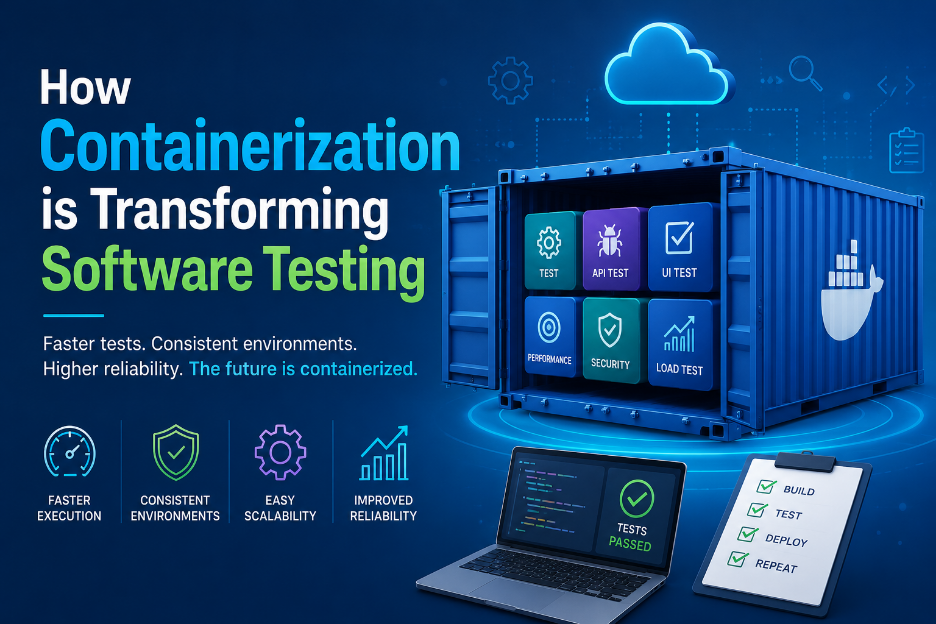
In today’s fast-paced software development landscape, quality assurance teams are under constant pressure to deliver reliable software at greater speed. As organizations embrace Agile, DevOps, and Continuous Delivery practices, traditional testing approaches often struggle to keep up with increasing complexity and release frequency.
Containerization has emerged as one of the most impactful technologies driving this transformation. By providing lightweight, portable, and consistent environments, containers are helping QA teams overcome some of the biggest challenges in software testing.
This article explores how containerization is reshaping testing strategies, improving efficiency, and enabling teams to deliver higher-quality software faster than ever before.
Understanding Containerization
Containerization is a form of virtualization that packages an application along with all its dependencies, libraries, and configurations into a single, portable unit called a container.
Unlike traditional virtual machines that require a complete operating system for each instance, containers share the host operating system kernel, making them significantly lighter and faster.
Popular container technologies include:
- Docker
- Kubernetes
- Podman
- OpenShift
- Amazon ECS
Containers ensure that software runs consistently across different environments, whether on a developer’s machine, a QA environment, or a production server.
Challenges in Traditional Software Testing
Before understanding the benefits of containerization, it’s important to recognize the common issues faced by testing teams.
1. Environment Inconsistencies
One of the most frequent causes of testing failures is environmental mismatch.
Examples include:
- Different library versions
- Missing dependencies
- Configuration differences
- Operating system variations
This often leads to the infamous statement:
“It works on my machine.”
Such inconsistencies create delays, increase debugging effort, and reduce confidence in test results.
2. Slow Environment Setup
Setting up a new testing environment traditionally requires:
- Installing operating systems
- Configuring services
- Managing dependencies
- Updating software versions
This process can take hours or even days.
3. Resource Consumption
Virtual machines consume substantial CPU, memory, and storage resources. Running multiple test environments simultaneously becomes costly and difficult to scale.
4. Dependency Management Issues
Modern applications rely on:
- Databases
- Message queues
- APIs
- Third-party services
- Microservices
Reproducing all dependencies for testing can be complex and error-prone.
5. Scalability Challenges
As automated test suites grow, traditional infrastructures struggle to execute tests quickly enough to support rapid release cycles.
How Containerization Solves These Challenges
Containerization addresses many of these long-standing testing problems.
1. Consistent and Reproducible Test Environments
Containers package everything needed to run an application:
- Runtime
- Libraries
- Frameworks
- Environment variables
- Configuration files
This means the exact same environment can be used across:
- Development
- QA
- Staging
- Production
Benefits include:
- Elimination of environment-related defects
- Reduced debugging effort
- Higher confidence in test results
- Improved collaboration between teams
For testers, consistency dramatically improves reliability and repeatability.
2. Faster Environment Provisioning
Containers can be created and started within seconds.
Instead of spending hours configuring environments manually, QA engineers can:
- Pull a container image
- Launch the container
- Begin testing immediately
This accelerates:
- Functional testing
- Regression testing
- Performance testing
- Integration testing
Teams gain quicker feedback and faster delivery cycles.
3. Improved Test Isolation
Containerization allows each test environment to run independently.
This eliminates issues such as:
- Shared resource conflicts
- Data contamination
- Environment instability
Testers can perform:
- Parallel test execution
- Independent feature validation
- Multiple configuration testing
without impacting other tests.
Isolation improves reliability and reduces flaky test results.
4. Seamless CI/CD Integration
Modern DevOps pipelines depend on automation.
Containers integrate naturally with CI/CD tools such as:
- Jenkins
- GitHub Actions
- GitLab CI/CD
- Azure DevOps
- CircleCI
A typical workflow might involve:
- Building application containers.
- Deploying testing environments automatically.
- Running automated test suites.
- Publishing results.
- Destroying temporary environments.
This provides:
- Faster feedback
- Reduced infrastructure costs
- Greater automation coverage
- More efficient release pipelines
5. Scalability for Automated Testing
Large automation suites often require significant infrastructure.
Containers enable easy horizontal scaling by allowing multiple test instances to run simultaneously.
For example:
- 1 container executes Smoke Tests
- 5 containers execute Regression Tests
- 10 containers execute Browser Compatibility Tests
This dramatically reduces execution time.
Organizations can execute hundreds or thousands of automated tests in parallel without major infrastructure investments.
Containerization and Test Automation
Test automation frameworks benefit significantly from container technology.
Selenium Testing
Containers can host:
- Selenium Grid Hub
- Browser Nodes
- Test Execution Services
Benefits include:
- Easy browser provisioning
- Consistent browser versions
- Parallel execution
- Reduced maintenance effort
Teams no longer need dedicated browser servers.
API Testing
Tools such as:
- Postman
- Newman
- Rest Assured
can execute inside containers.
Advantages include:
- Reproducible API environments
- Easier dependency management
- Better CI/CD integration
Performance Testing
Load testing solutions like:
- JMeter
- Gatling
- Locust
can run in containerized environments.
This enables:
- Distributed load generation
- Rapid scaling
- Better resource utilization
Teams can simulate realistic traffic without purchasing additional infrastructure.
Containerization in Microservices Testing
Microservices architectures have become increasingly popular.
However, testing microservices introduces new challenges:
- Service dependencies
- Version compatibility
- Network communication
- Environment complexity
Containers simplify microservices testing by:
Independent Service Testing
Each microservice can run in its own container.
Benefits include:
- Easier debugging
- Faster deployment
- Greater isolation
Integration Testing
QA teams can quickly assemble environments containing:
- Multiple services
- Databases
- Caches
- Messaging systems
This creates realistic testing scenarios.
End-to-End Validation
Entire application ecosystems can be recreated using container orchestration platforms such as Kubernetes.
This improves confidence before production releases.
The Future of Containerized Testing
Containerization continues to evolve alongside cloud-native technologies.
Emerging trends include:
- Kubernetes-based testing environments
- Ephemeral test environments
- AI-driven test execution
- Test environment automation
- Serverless testing strategies
As applications become more distributed and complex, containerization will play an increasingly important role in ensuring software quality.
Organizations investing in container-based testing today are positioning themselves for greater scalability, efficiency, and agility in the future.
Conclusion
Containerization is no longer just a deployment technology. It has become a critical enabler of modern software testing.
By delivering consistent environments, faster provisioning, better isolation, improved scalability, and seamless CI/CD integration, containers help QA teams overcome many of the limitations of traditional testing approaches.
Whether you are performing manual testing, automation testing, API validation, performance testing, or microservices testing, containerization can significantly enhance efficiency and reliability.
For QA professionals, embracing containerization is not simply about adopting a new tool. It is about building a testing strategy that supports speed, quality, and continuous innovation in an increasingly competitive software landscape.
