
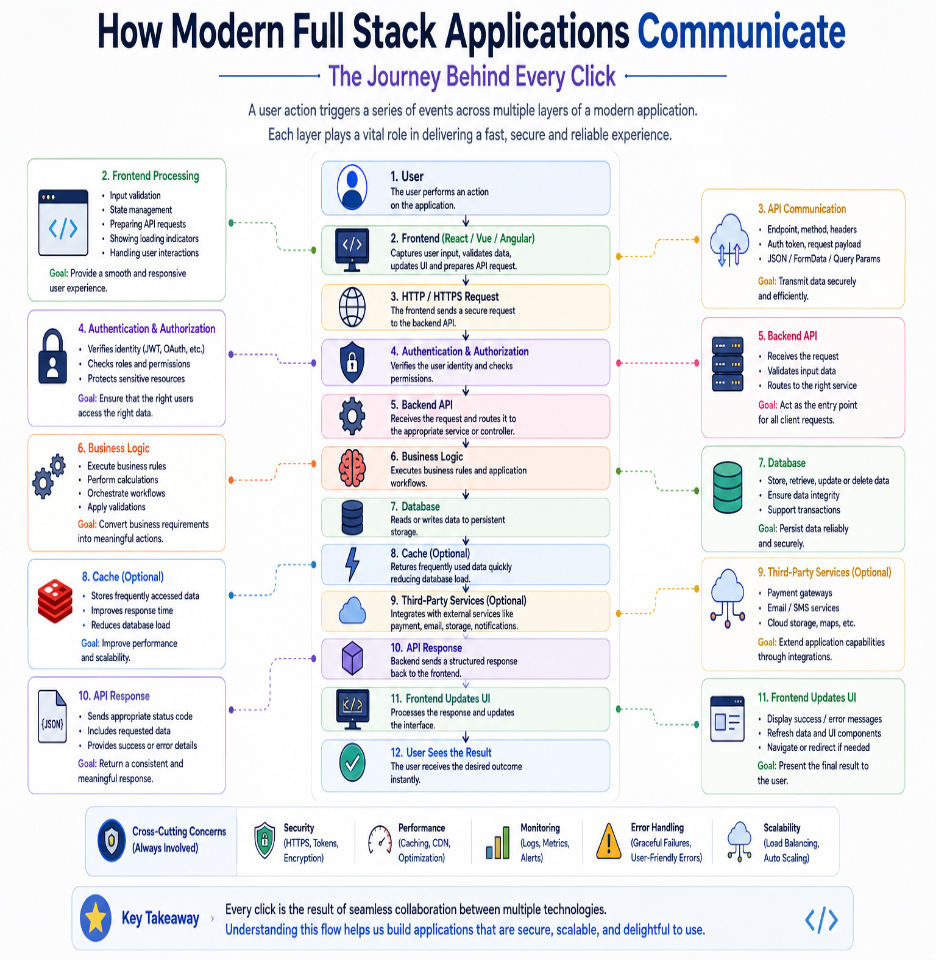
Understanding the Technology Behind Every User Interaction
Every interaction within a modern web application—whether it’s logging in, submitting a form, placing an order, or updating a profile—initiates a sophisticated communication process that takes place in just a few milliseconds.
While users experience a fast and intuitive interface, a well-orchestrated sequence of frontend, backend, database, and network operations works behind the scenes to process each request efficiently and securely.
For Full Stack Developers, understanding this end-to-end communication pipeline is fundamental. It enables us to design scalable architectures, build reliable APIs, optimize application performance, and deliver seamless user experiences.
End-to-End Communication Flow
👤 User
│
▼
💻 Frontend (React / Vue / Angular)
│
▼
🌐 HTTP / HTTPS Request
│
▼
🔐 Authentication & Authorization
│
▼
⚙️ Backend API
│
▼
🧠 Business Logic
│
▼
🗄️ Database
│
▼
⚡ Cache (Optional)
│
▼
🌍 Third-Party Services (Optional)
│
▼
📦 API Response
│
▼
🖥️ Frontend Updates the User Interface
│
▼
✅ User Receives the Result
1. User Interaction
Every application workflow begins with a user action, such as clicking a button, submitting a form, uploading a file, or performing a search.
The frontend captures the event and initiates the process while ensuring the application responds smoothly to the user’s interaction.
2. Frontend Processing
Modern frontend frameworks such as React, Vue.js, and Angular are responsible for managing the user interface and preparing requests for the backend.
Typical responsibilities include:
- Validating user input
- Managing application state
- Preparing API requests
- Displaying loading indicators
- Handling navigation and user interactions
Performing these operations on the client side improves responsiveness and reduces unnecessary server requests.
3. API Communication
Once validation is complete, the frontend sends an HTTP or HTTPS request to the backend.
A typical request contains:
- API endpoint
- HTTP method
- Request headers
- Authentication token
- Request payload
Secure communication over HTTPS ensures data remains protected while traveling between the client and the server.
4. Authentication and Business Logic
Before processing any request, the backend verifies the user’s identity and determines whether they have permission to perform the requested action.
After successful authentication and authorization, the application executes its business logic, including operations such as:
- Creating or updating records
- Processing transactions
- Managing workflows
- Generating reports
- Applying business rules
This layer transforms business requirements into functional software behavior.
5. Database and External Integrations
The backend communicates with the database to retrieve, insert, update, or delete information.
6. Response and User Interface Update
After completing all required operations, the backend generates a structured response and sends it back to the frontend.
The frontend then updates the user interface by:
- Displaying success or error notifications
- Refreshing application data
- Updating dashboards
- Redirecting users when necessary
Although this entire process involves multiple system components, users experience it as a single, seamless interaction.
Why Understanding This Communication Flow Matters
A strong understanding of the complete application lifecycle enables developers to:
- Design scalable and maintainable systems
- Build consistent and reliable APIs
- Improve application performance
- Strengthen security practices
- Troubleshoot issues more effectively
- Collaborate efficiently across development teams
A Full Stack Developer’s responsibility extends beyond writing frontend and backend code. It involves understanding how every layer of the application communicates to deliver a secure, efficient, and reliable user experience.
Final Thoughts
Modern software applications are built upon continuous communication between multiple components, including the frontend, APIs, backend services, databases, caching layers, and external integrations.
Each layer has a clearly defined responsibility, and together they create the responsive, scalable, and secure applications that users rely on every day.
Understanding this communication pipeline not only improves technical expertise but also enables developers to build systems that are easier to maintain, scale, and evolve over time.
Great Full Stack Developers don’t simply build features—they understand the architecture, communication, and engineering principles that make those features possible.
Which layer of the communication pipeline do you find the most interesting or challenging—Frontend, APIs, Backend, Databases, or System Architecture? Share your perspective in the comments.
