
Modern applications need to respond quickly, even when handling thousands of user requests. If an application retrieves data from the database every time, response times can become slower and the database may experience heavy load.
Redis helps solve this problem by storing frequently accessed data in memory, allowing applications to retrieve information much faster.
What is Redis?
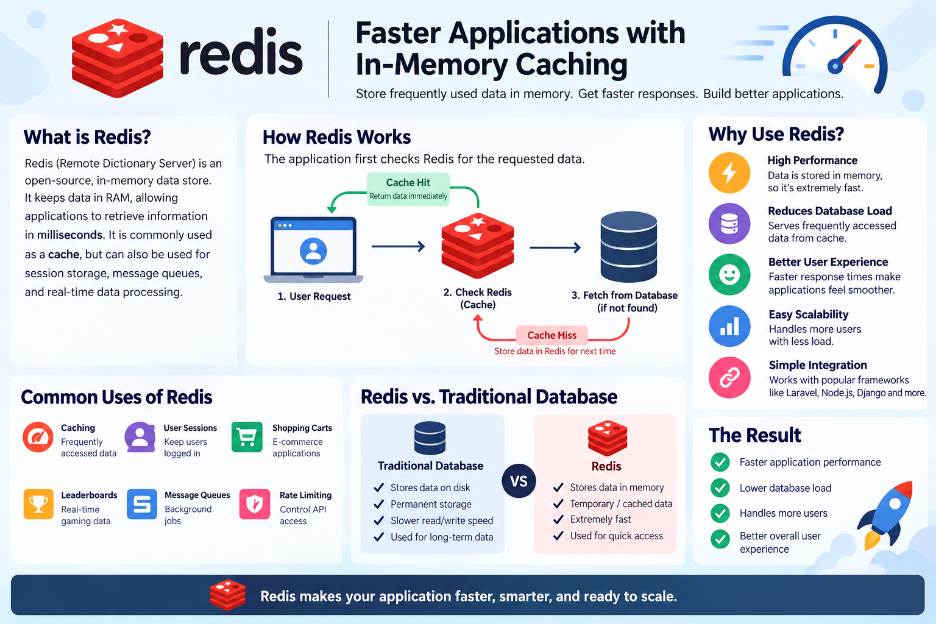
Redis (Remote Dictionary Server) is an open-source, in-memory data store. It is most commonly used as a cache to improve application performance, but it can also be used for session storage, message queues, and real-time data processing.
Unlike traditional databases that store data on disk, Redis stores data in RAM (Random Access Memory). Since RAM is much faster than disk storage, Redis can return data in just a few milliseconds.
How Does Redis Work?
When a user requests information, the application first checks whether the required data is available in Redis.
- If the data is found in Redis, it is returned immediately. This is called a cache hit.
- If the data is not available, the application retrieves it from the database. This is called a cache miss. The retrieved data is then stored in Redis so future requests can be served much faster.
The basic workflow looks like this:
User Request → Redis Cache → Database (if needed) → User Response
This approach reduces unnecessary database queries and improves the overall performance of the application.
Why Use Redis?
Redis provides several benefits that make it popular in modern web applications.
- High Performance – Since data is stored in memory, Redis can retrieve information much faster than a traditional database.
- Reduced Database Load – Frequently accessed data is served from Redis instead of repeatedly querying the database.
- Better User Experience – Faster response times make applications feel more responsive.
- Easy Scalability – Redis helps applications handle a larger number of users efficiently.
- Simple Integration – Redis works with popular frameworks such as Laravel, Node.js, Spring Boot, Django, and many others.
Common Uses of Redis
Redis is used in many real-world applications. Some common use cases include:
- Caching frequently accessed data
- User Sessions to keep users logged in
- Shopping Carts in e-commerce applications
- Real-Time Leaderboards for gaming applications
- Message Queues for background jobs
- Rate Limiting to control how often users can access an API
These features make Redis a valuable tool for building fast and scalable applications.
Redis vs. Traditional Database
Redis and traditional databases are designed for different purposes.
A traditional database stores information permanently and is used for long-term data storage.
Redis is mainly used to store temporary or frequently accessed data, allowing applications to retrieve information much faster.
A simple comparison is:
Traditional Database → Permanent data storage
Redis → Fast in-memory caching
Most modern applications use both together to achieve the best balance between performance and reliable data storage.
Redis in Modern Applications
Many popular platforms use Redis to improve speed and performance.
For example, an e-commerce website can store popular product details in Redis instead of querying the database every time a customer visits the page. Similarly, social media platforms use Redis to cache user profiles, notifications, and frequently accessed content to deliver a faster user experience.
By reducing repeated database queries, Redis helps applications remain responsive even during periods of heavy traffic.
Conclusion
Redis is one of the most popular caching technologies used in modern application development. By storing frequently accessed data in memory, it significantly reduces database load and improves application performance.
The Redis workflow is simple to remember:
User Request → Redis Cache → Database (if needed) → Response
Whether you’re building a small web application or a large enterprise system, Redis is an excellent choice for improving speed, scalability, and the overall user experience.
