
Introduction
Artificial intelligence has spent the last few years learning how to read, write, see, reason, and generate content. The next major step is giving AI a physical body.
That is where humanoid robots come in.
In 2026, humanoid robotics is moving rapidly from science-fiction demonstrations toward real-world testing in factories, warehouses, logistics, healthcare environments, and other workplaces. Current deployments are still mostly focused on specific, repetitive tasks rather than fully autonomous general-purpose work, but the progress is significant. (humanoidsdata.com)
The idea behind Physical AI is straightforward: instead of AI existing only inside computers and cloud servers, intelligent systems can perceive the physical world, make decisions, and take action within it.
The result could fundamentally change how humans interact with machines.
What Is Physical AI?
Physical AI refers to artificial intelligence systems that can perceive and interact with the physical world.
Traditional AI operates primarily in digital environments. It can analyze a document, generate an image, write code, or answer questions.
Physical AI adds another dimension:
Perceive → Understand → Plan → Act
A physical AI system might:
- Use cameras and sensors to understand its surroundings.
- Recognize objects and people.
- Interpret a spoken instruction.
- Decide how to complete the task.
- Move its body and manipulate objects.
- Evaluate the result and adjust its actions.
This combination of AI models, robotics, sensors, actuators, and control systems is driving the development of increasingly capable humanoid robots.
Why Humanoid Robots?
Robots don’t necessarily need to look like humans to perform useful work.
Industrial robots, robotic arms, autonomous vehicles, and warehouse machines can be extremely effective at specialized tasks.
So why build a robot with two arms, two legs, and a human-like body?
The biggest argument is compatibility with environments designed for humans.
Factories, warehouses, offices, homes, stairs, doors, shelves, tools, and workstations have largely been designed around the human body.
A humanoid robot could potentially operate in these environments without requiring organizations to completely redesign their infrastructure.
How AI Is Making Robots Smarter
Earlier generations of robots were generally programmed for highly specific tasks.
For example:
Move this component from location A to location B.
Modern AI-powered robots are moving toward more flexible instructions.
A future worker might tell a robot:
“Take these boxes to the storage area and organize them.”
The robot would need to understand the instruction, identify the boxes, determine where the storage area is, plan a route, manipulate the boxes, and verify that the task was completed.
This requires several AI capabilities working together.
Computer Vision
Cameras allow robots to understand their surroundings.
Language Models
AI models can interpret human instructions and translate them into actionable tasks.
Vision-Language-Action Models
These models connect what a robot sees with what it should do.
Motion Planning
Robots need to calculate how their bodies should move without hitting objects or people.
Reinforcement Learning
Robots can improve their behavior through training and repeated interaction with environments.
Humanoid Robots Are Already Doing Real Work
The industry is still early, but humanoid robots are no longer limited to laboratory demonstrations.
Documented applications include material handling, production-part positioning, warehouse operations, hospital logistics, public guidance, and other bounded tasks. (humanoidsdata.com)
For example, Agility Robotics’ Digit has been used in commercial logistics operations, while Figure has reported extended operation of its humanoid systems in automotive manufacturing environments. (Physical AI Guide)
The important distinction is that today’s successful deployments generally involve well-defined tasks in controlled environments.
The industry has not yet reached the point where a general-purpose humanoid can reliably perform almost any household or workplace task without supervision.
Humanoid Robots in Manufacturing
Manufacturing could become one of the largest early markets for humanoid robots.
Factories contain many repetitive physical tasks, including:
- Moving components
- Loading machines
- Sorting parts
- Inspecting products
- Packaging
- Transporting materials
- Handling tools
Humanoid robots could potentially perform these tasks while working alongside existing automation systems.
This is particularly attractive in industries experiencing labor shortages or difficult working conditions.
Robots in Warehouses
Warehouses are another natural environment for humanoid robotics.
A robot could potentially:
- Pick up packages.
- Move containers.
- Sort products.
- Load shelves.
- Transport materials.
- Scan inventory.
- Move items between workstations.
The advantage of a humanoid form is flexibility.
Instead of designing a completely new machine for every physical task, companies could potentially train the same type of robot to perform different jobs.
Healthcare and Elder Care
Healthcare presents an entirely different challenge.
Robots operating around patients need to be safe, predictable, and extremely precise.
Potential applications include:
- Transporting supplies
- Delivering medication
- Moving equipment
- Assisting hospital staff
- Guiding visitors
- Supporting rehabilitation
- Assisting elderly people
However, robots physically interacting with vulnerable people require much higher safety standards than robots operating in a warehouse.
Could Humanoid Robots Work in Our Homes?
This is probably the most exciting—and most difficult—application.
Imagine a robot capable of:
- Cleaning rooms
- Folding clothes
- Preparing simple meals
- Loading a dishwasher
- Carrying groceries
- Organizing objects
- Assisting elderly family members
Some companies are already testing household-oriented humanoids and remote-assisted robotic services, but home robotics remains significantly less mature than industrial applications. (humanoidsdata.com)
Homes are unpredictable.
A factory might have clearly marked workstations and predictable objects.
A home might contain:
- Different furniture layouts
- Pets
- Children
- Fragile objects
- Narrow spaces
- Stairs
- Hundreds of unpredictable situations
Teaching a robot to reliably handle this variety is one of the industry’s biggest challenges.
The Biggest Challenge: Generalization
A robot successfully completing one task doesn’t mean it understands the task generally.
Consider asking a human:
“Put the cup on the table.”
A person can understand the instruction even if the cup is in a completely different location or the table looks different.
Robots still struggle with this kind of generalization.
They need to understand not just what to do but also:
- Where objects are.
- What can be touched.
- How objects behave.
- What actions are safe.
- How to recover from mistakes.
This is why the transition from impressive demonstrations to dependable everyday robots is so difficult.
Training Physical AI
Training a robot is fundamentally different from training a chatbot.
A language model can learn from enormous amounts of text available online.
Robots need physical experience.
They need data about:
- Movement
- Objects
- Physics
- Human interactions
- Different environments
- Successful actions
- Failed actions
One emerging approach involves combining real-world demonstrations, simulation, teleoperation, and AI training.
Researchers are also exploring systems in which AI agents break larger goals into robot-specific skills and then verify those actions before physical execution. Recent research highlights the importance of safety checks between high-level AI planning and actual robot movement. (arXiv)
Why 2026 Is an Important Year
The robotics industry is experiencing rapid momentum.
At the 2026 World Robot Conference in Beijing, more than 2,000 humanoid robots participated in competitions demonstrating capabilities ranging from running and soccer to other physical tasks. (AP News)
Meanwhile, companies are increasingly focused on commercial applications rather than demonstrations alone.
The industry is also attracting substantial investment. Unitree’s 2026 Shanghai IPO, for example, raised roughly $900 million, reflecting significant investor interest in humanoid robotics. (AP News)
But impressive demonstrations should not be confused with widespread deployment.
Many robots remain in testing, research, or tightly controlled environments.
Will Humanoid Robots Replace Human Workers?
This is one of the biggest questions surrounding physical AI.
The answer is unlikely to be as simple as yes or no.
Humanoid robots are most likely to initially automate specific tasks rather than entire occupations.
For example, a warehouse employee may continue supervising inventory and solving problems while robots handle repetitive material movement.
Similarly, a manufacturing worker may operate and maintain robotic systems rather than performing every physical movement manually.
The future workforce could therefore involve much more human-robot collaboration.
New Jobs Could Appear
Every major technological shift changes the types of jobs organizations need.
Humanoid robotics could create demand for:
- Robot technicians
- Robotics engineers
- AI engineers
- Robot trainers
- Automation specialists
- Safety engineers
- Fleet managers
- Robotics data specialists
Workers may increasingly need to understand how to collaborate with and supervise intelligent machines.
The Safety Challenge
Giving an AI system a physical body creates new safety concerns.
A chatbot making a wrong statement is one thing.
A robot making the wrong physical movement is something else entirely.
Safety systems therefore need to ensure that robots:
- Recognize humans.
- Avoid collisions.
- Respect restricted areas.
- Follow physical limits.
- Stop when uncertain.
- Verify actions before execution.
The combination of AI reasoning and deterministic safety controls will be particularly important as robots become more autonomous.
The Race to Build Humanoid Robots
Several companies are competing to develop capable humanoid platforms.
The industry includes companies such as:
- Unitree
- Figure AI
- Agility Robotics
- Boston Dynamics
- UBTECH
- XPeng Robotics
- Fourier Intelligence
- Tesla
Different companies are taking different approaches to hardware, AI models, manufacturing, and commercial deployment.
China is currently playing a particularly prominent role in the humanoid robotics ecosystem, with large numbers of companies and significant manufacturing activity. (Reuters)
From Demonstrations to Mass Production
One of the industry’s biggest hurdles isn’t simply building a robot that works.
It is building millions of robots that work reliably and economically.
Mass adoption requires:
- Lower hardware costs
- Reliable batteries
- Durable motors
- Better hands and actuators
- Efficient AI models
- Large training datasets
- Reliable supply chains
- Strong safety standards
- Affordable maintenance
The economics ultimately matter as much as the technology.
What Could Humanoid Robots Look Like in 2030?
By the end of the decade, we could see humanoid robots becoming significantly more common in industrial environments.
Possible developments include:
More Natural Conversations
Robots could understand complex instructions through normal speech.
Better Dexterity
Advanced robotic hands could manipulate increasingly delicate objects.
Faster Learning
Robots could learn new tasks from demonstrations rather than requiring extensive manual programming.
Multi-Purpose Robots
The same robot could perform different jobs depending on the environment.
Better Autonomy
Robots could operate for longer periods without human intervention.
Are We Really Entering the Age of Physical AI?
The answer is yes—but we’re still at the beginning.
The technology has reached an important transition point. AI models are becoming better at understanding visual information, language, and complex instructions, while robotic hardware is becoming more capable and affordable.
But reliable general-purpose physical intelligence remains difficult.
Even industry leaders disagree about how quickly robots will reach a true “ChatGPT moment.” Some predict major breakthroughs within the next few years, while others believe dependable general-purpose humanoids remain much further away. (Reuters)
That uncertainty is important.
The future of robotics isn’t guaranteed—but the direction of development is clear.
Conclusion
Artificial intelligence is moving beyond screens.
The next generation of AI won’t simply answer questions or generate content. It will increasingly perceive the physical world, make decisions, and perform actions within it.
Humanoid robots are one of the most ambitious expressions of this idea.
In 2026, they are already appearing in factories, warehouses, research environments, competitions, and early service applications. Yet the industry still has significant challenges to overcome before humanoid robots become common household or workplace assistants. (humanoidsdata.com)
The most important development may not be the robot’s human-like appearance. It is the intelligence behind it.
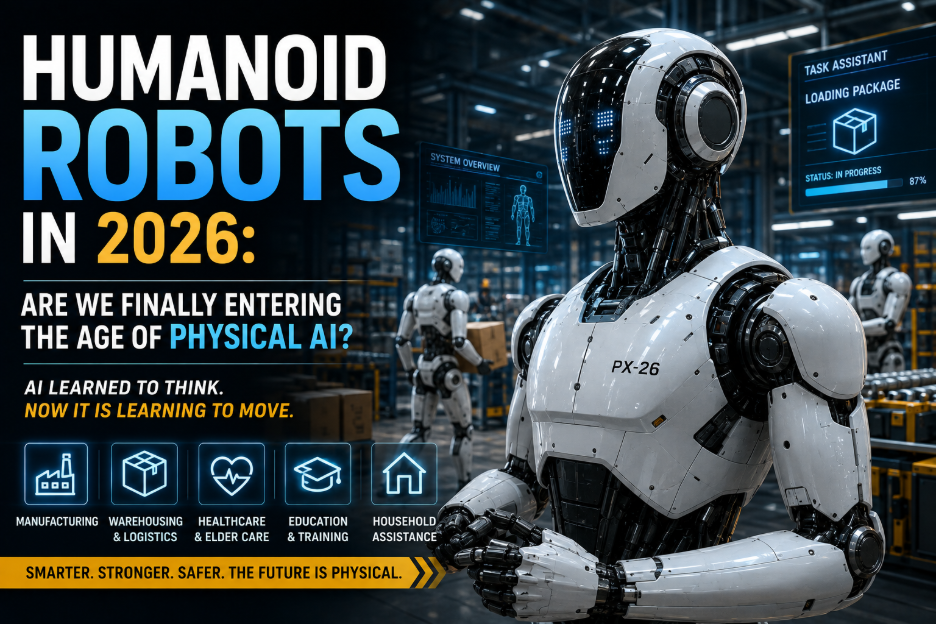
AI learned to think. Now it is learning to move.
And if physical AI reaches its full potential, the computer of the future may not sit on a desk—it may walk into the room and work alongside us.
