
Artificial Intelligence is becoming a core part of modern software development platforms. In the Pega ecosystem, one of the most interesting innovations introduced recently is Pega Knowledge Buddy—an AI-powered assistant designed to help developers, architects, and business users quickly find answers and guidance while working in the platform.
Many people see Knowledge Buddy as a simple chatbot inside Pega. However, behind the scenes, it is powered by a sophisticated combination of AI, enterprise knowledge retrieval, and contextual understanding. In this article, I want to explore how Pega Knowledge Buddy actually works, what makes it powerful, and how it is changing the developer experience in Pega.
The Challenge Pega Developers Often Face
Anyone who has worked on a Pega project knows that the platform is extremely powerful, but it also comes with a large amount of documentation, rules, and best practices. Developers often need to search for information such as:
• How a specific rule type works
• Best practices for data pages or integrations
• Guardrail recommendations
• Troubleshooting configuration issues
• Examples of rule implementation
Traditionally, developers had to switch between multiple resources such as Pega documentation, Pega Community, support articles, and internal project documents. This process often takes time and sometimes leads to confusion because the information is scattered across different places.
What Exactly is Pega Knowledge Buddy?
Pega Knowledge Buddy is an AI-powered knowledge assistant integrated into the Pega platform. Its main purpose is to allow users to ask questions in natural language and receive accurate answers based on trusted Pega knowledge sources.
Instead of searching through multiple websites or documents, developers can simply ask a question like:
“How do I configure a Data Page refresh strategy in Pega?”
Within seconds, Knowledge Buddy provides a clear explanation along with relevant guidance. The goal is to make knowledge access faster, smarter, and more contextual.
The Technology Behind Knowledge Buddy
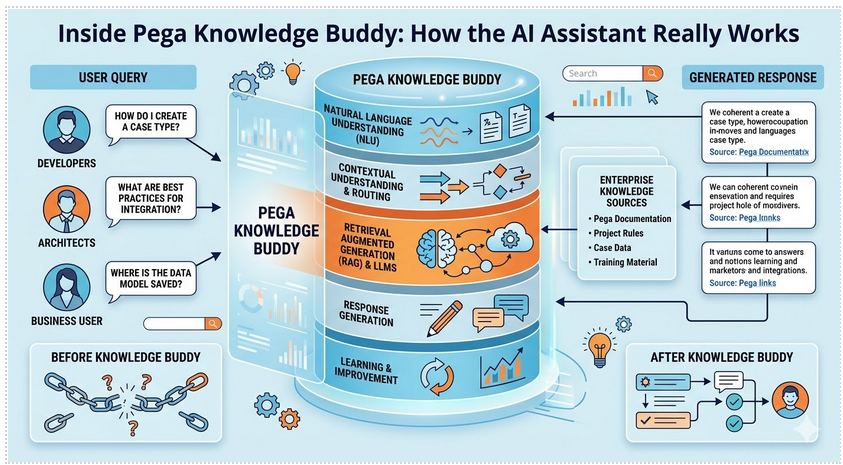
The real power of Knowledge Buddy comes from the way it combines Generative AI with intelligent knowledge retrieval. Rather than relying purely on AI-generated responses, it uses a method known as Retrieval-Augmented Generation (RAG).
This means that before generating an answer, the system first searches for relevant information from trusted sources and then builds a response using that information. This approach ensures that the answers are accurate, reliable, and aligned with official Pega guidance.
To understand this better, let’s look at the main stages involved when someone asks a question to Knowledge Buddy.
1. Understanding the User’s Question
The process begins when a user types a question in natural language. For example:
“How can I remove duplicates from a Page List in Pega?”
The AI first analyzes the question using Natural Language Processing (NLP). During this step, the system identifies important elements such as:
• The topic being discussed
• Relevant Pega concepts
• The user’s intent
In this example, the AI recognizes that the question relates to Page List properties, clipboard data, and utility functions in Pega.
This understanding allows the system to search for the most relevant information.
2. Searching the Knowledge Sources
After understanding the query, Knowledge Buddy searches across multiple knowledge repositories. These may include:
• Official Pega documentation
• Pega Community articles
• Knowledge base support content
• Implementation best practices
• Organization-specific documentation (if integrated)
However, unlike traditional search engines that rely on keywords, Knowledge Buddy uses semantic search powered by vector embeddings.
This technique converts text into numerical representations so the system can identify similar meanings rather than exact words.
For example, the system can understand that these two questions are similar:
“How to remove duplicates from a pagelist?”
“How to delete duplicate entries from a page list?”
Even though the wording is different, the meaning is the same. This makes knowledge retrieval far more effective.
3. Building the Context for the AI Model
Once relevant documents are found, Knowledge Buddy extracts the most useful information and builds a context for the AI model.
This context may include:
• Documentation excerpts
• Configuration steps
• Best practice recommendations
• Code examples or rule references
By feeding this information to the AI model, the system ensures that the response is based on real documentation rather than guesses.
This step is extremely important because it reduces the chances of AI hallucinations, which can sometimes occur in purely generative systems.
4. Generating the Final Response
After the relevant context is prepared, the AI model generates a structured answer for the user.
The response typically includes:
• A clear explanation of the concept
• Step-by-step guidance
• Recommendations based on best practices
• References to related documentation
For example, in response to a question about duplicates in a Page List, Knowledge Buddy may recommend using the pyRemoveDuplicatesFromPagelist utility function and explain how it works.
The final answer is designed to be immediately helpful for developers working inside the platform.
How Knowledge Buddy Improves Developer Productivity
Knowledge Buddy is not just a convenience feature—it significantly improves the development workflow.
One major advantage is speed. Developers no longer need to browse multiple documentation pages to find a single answer. The assistant consolidates the most relevant information into one clear response.
Another benefit is learning support. New developers often struggle with concepts such as rule resolution, case lifecycle design, or data modeling. Knowledge Buddy can explain these topics in simple terms, acting almost like an on-demand mentor.
It also helps maintain consistent best practices. Because the assistant retrieves information from trusted sources, developers are more likely to follow recommended implementation patterns and guardrail guidelines.
Enterprise Knowledge Integration
One powerful capability of Knowledge Buddy is its ability to integrate with enterprise knowledge repositories.
Organizations can connect their internal documentation, architecture standards, or project-specific knowledge bases. This allows Knowledge Buddy to provide answers that are not only based on general Pega knowledge but also aligned with company-specific practices.
For example, a developer could ask:
“What is our organization’s standard integration pattern for REST services?”
Knowledge Buddy could then provide guidance based on internal architecture documentation.
This makes the assistant highly valuable for large organizations managing complex Pega implementations.
Real Development Scenario
Consider a developer working on a Pega application who encounters an issue where a Data Page is not refreshing correctly.
Instead of searching through documentation, the developer asks Knowledge Buddy:
“Why is my Data Page not refreshing?”
The assistant may respond with possible reasons such as incorrect refresh strategy configuration, caching scope issues, or missing parameters. It may also suggest configuration options like Reload if older than, Refresh When conditions, or cache clearing strategies.
This immediate feedback can save significant debugging time.
The Future of AI in the Pega Platform
Knowledge Buddy represents an important step toward AI-assisted development in Pega. As AI capabilities evolve, we can expect these assistants to become even more powerful.
Future possibilities could include features such as:
• Intelligent rule recommendations
• Automated troubleshooting suggestions
• AI-generated rule configurations
• Context-aware development assistance
These advancements will likely transform the way developers interact with the Pega platform.Pega Knowledge Buddy is more than just an AI chatbot. It is a sophisticated knowledge assistant that combines natural language understanding, intelligent search, and generative AI to help developers access the right information at the right time.
By reducing the effort required to find documentation and best practices, Knowledge Buddy enables developers to focus more on building solutions rather than searching for answers.
As AI continues to reshape development platforms, tools like Knowledge Buddy will play a key role in making enterprise software development faster, smarter, and more efficient.
–TEAM ENIGMA
