
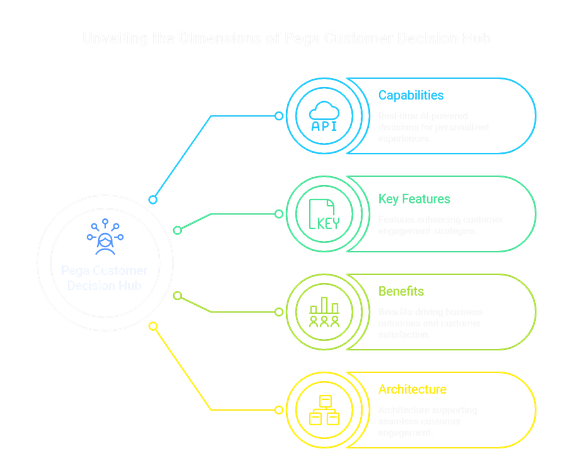
This document provides an overview of the Pega Customer Decision Hub, a centralized brain for optimizing customer interactions across all channels. It details the hub’s capabilities in making real-time, AI-powered decisions to deliver personalized experiences that drive business outcomes. The document explores the key features, benefits, and architecture of the Customer Decision Hub, highlighting its role in transforming customer engagement strategies.
Introduction to Pega Customer Decision Hub
The Pega Customer Decision Hub (CDH) is a powerful platform designed to centralize and optimize customer interactions. It acts as the “brain” of your customer engagement strategy, using artificial intelligence (AI) and real-time data to make the best possible decision for each customer at every touchpoint. This allows businesses to deliver personalized experiences that drive customer loyalty, increase revenue, and improve overall business outcomes.
In today’s competitive landscape, customers expect personalized and relevant interactions. Generic, one-size-fits-all approaches are no longer effective. The Customer Decision Hub enables businesses to move beyond these outdated methods and deliver truly individualized experiences that resonate with each customer’s unique needs and preferences.
Key Features and Capabilities
The Pega Customer Decision Hub offers a wide range of features and capabilities that enable businesses to optimize customer interactions:
- Real-time Decisioning: The hub analyzes customer data in real-time to make immediate decisions about the next best action to take. This ensures that interactions are always relevant and timely.
- AI-Powered Optimization: AI algorithms continuously learn from customer interactions and refine decision-making processes. This ensures that the hub is always improving its ability to deliver optimal outcomes.
- Centralized Decision Management: The hub provides a central location for managing all customer decisions. This ensures consistency and control across all channels.
- Omnichannel Orchestration: The hub can orchestrate customer interactions across all channels, including web, mobile, email, social media, and contact center. This ensures a seamless and consistent customer experience.
- Predictive Analytics: The hub uses predictive analytics to anticipate customer needs and proactively offer relevant products and services.
- Segmentation and Targeting: The hub allows businesses to segment customers based on various criteria and target them with personalized offers and messages.
- A/B Testing: The hub supports A/B testing, allowing businesses to experiment with different offers and messages to determine what works best.
- Reporting and Analytics: The hub provides comprehensive reporting and analytics capabilities, allowing businesses to track the performance of their customer engagement strategies.
Benefits of Using Pega Customer Decision Hub
Implementing the Pega Customer Decision Hub can provide numerous benefits for businesses:
- Improved Customer Experience: By delivering personalized and relevant interactions, the hub can significantly improve the customer experience.
- Increased Customer Loyalty: Personalized experiences lead to increased customer loyalty and retention.
- Higher Revenue: By offering relevant products and services at the right time, the hub can drive increased revenue.
- Reduced Costs: By automating decision-making processes, the hub can reduce operational costs.
- Improved Marketing ROI: By targeting customers with personalized offers, the hub can improve the return on investment (ROI) of marketing campaigns.
- Enhanced Compliance: The hub helps businesses comply with data privacy regulations by ensuring that customer data is used responsibly.
- Faster Time to Market: The hub’s centralized decision management capabilities allow businesses to quickly launch new offers and campaigns.
Architecture of the Customer Decision Hub
The Pega Customer Decision Hub is built on a robust and scalable architecture that can handle large volumes of data and complex decision-making processes. The key components of the architecture include:
- Data Layer: This layer stores customer data from various sources, including CRM systems, marketing automation platforms, and web analytics tools.
- Decision Engine: This engine uses AI algorithms to analyze customer data and make real-time decisions about the next best action to take.
- Orchestration Layer: This layer orchestrates customer interactions across all channels, ensuring a seamless and consistent experience.
- Analytics Layer: This layer provides comprehensive reporting and analytics capabilities, allowing businesses to track the performance of their customer engagement strategies.
- Interaction History: The hub maintains a detailed history of all customer interactions, providing valuable insights into customer behavior and preferences.
Use Cases
The Pega Customer Decision Hub can be used in a variety of industries and for a wide range of use cases, including:
- Financial Services: Offering personalized financial advice, detecting fraud, and cross-selling relevant products.
- Retail: Recommending products based on past purchases, offering personalized discounts, and improving customer service.
- Healthcare: Providing personalized health recommendations, scheduling appointments, and managing patient care.
- Telecommunications: Offering personalized service plans, resolving customer issues, and preventing churn.
- Insurance: Providing personalized insurance quotes, processing claims, and preventing fraud.
Conclusion
The Pega Customer Decision Hub is a powerful platform that enables businesses to deliver personalized and relevant customer experiences. By leveraging AI and real-time data, the hub can optimize customer interactions across all channels, driving customer loyalty, increasing revenue, and improving overall business outcomes. As customer expectations continue to rise, the Customer Decision Hub will become an increasingly essential tool for businesses looking to stay ahead of the competition.
–TeamEnigma
