
What is Pega Launchpad?
Pega Launchpad is a modern low-code application development platform introduced by Pega to help organizations rapidly build, deploy, and manage business applications. It is designed especially for small and medium-sized businesses, startups, and enterprise teams that need faster digital transformation with minimal coding effort.
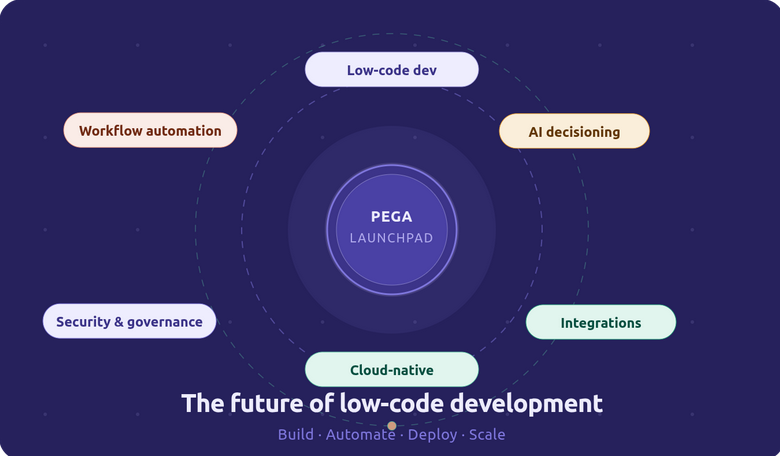
Pega Launchpad combines workflow automation, case management, artificial intelligence, and cloud-native architecture into a single platform. The primary goal of Launchpad is to simplify application development while maintaining enterprise-level scalability and security.
Traditional application development often requires large development teams, complex coding knowledge, long deployment cycles, and expensive infrastructure. Pega Launchpad reduces these challenges by providing drag-and-drop tools, prebuilt templates, reusable components, and AI-powered development assistance.
Key Objectives of Pega Launchpad
- Accelerate application development
- Reduce dependency on heavy coding
- Improve business process automation
- Enable faster deployment to cloud environments
- Support collaboration between business and IT teams
- Simplify maintenance and upgrades
Why Organizations Need Pega Launchpad
Modern businesses face increasing pressure to deliver digital services quickly. Customers expect fast responses, automated support, and seamless experiences. Pega Launchpad helps organizations achieve these goals by allowing developers and business users to work together efficiently.
Industries such as insurance, banking, healthcare, telecommunications, retail, and customer service can use Launchpad to automate workflows, manage customer requests, and improve operational efficiency.
Benefits of Low-Code Development
Low-code platforms like Pega Launchpad provide several advantages:
- Faster application delivery
- Lower development costs
- Reduced manual coding errors
- Easier collaboration between teams
- Rapid process changes and updates
- Improved customer experiences
Pega Launchpad represents a significant step toward modern digital transformation by enabling organizations to build enterprise-grade applications quickly and efficiently.
1. Low-Code Application Development
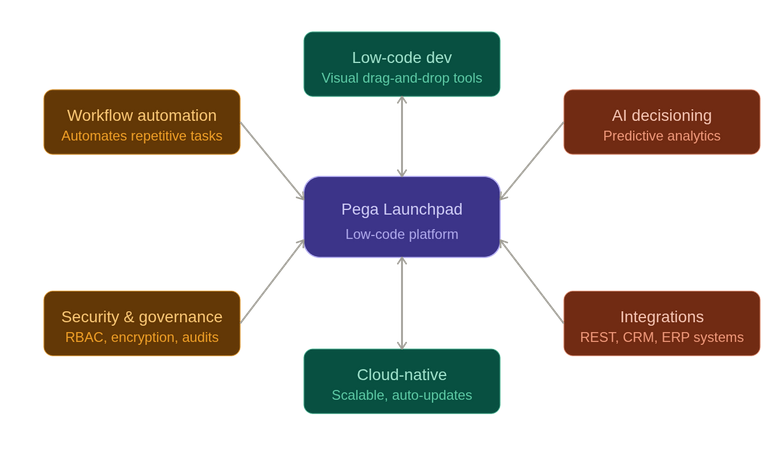
The most important feature of Pega Launchpad is its low-code environment. Developers can design applications using visual tools instead of writing thousands of lines of code.
Users can:
- Create workflows visually
- Configure business rules
- Build user interfaces
- Design forms and dashboards
- Integrate APIs and external systems
This reduces development time significantly.
2. Workflow Automation
Workflow automation is a core capability of Launchpad. Businesses can automate repetitive tasks and streamline operations.
Examples include:
- Insurance claim processing
- Customer onboarding
- Loan approval systems
- Employee leave requests
- Support ticket management
Automation reduces human effort and improves accuracy.
3. AI-Powered Decisioning
Pega Launchpad uses artificial intelligence to improve decision-making.
AI features include:
- Predictive analytics
- Customer recommendations
- Intelligent routing
- Automated prioritization
- Personalized user experiences
AI helps organizations make smarter and faster decisions.
4. Cloud-Native Architecture
Pega Launchpad is built for cloud deployment. It supports scalability, flexibility, and high availability.
Cloud benefits include:
- Faster deployment
- Lower infrastructure costs
- Automatic updates
- Better disaster recovery
- Improved scalability
5. Integration Capabilities
Modern businesses use multiple systems and applications. Pega Launchpad provides integration tools to connect with:
- REST APIs
- SOAP services
- Databases
- CRM systems
- ERP applications
- Third-party platforms
This enables seamless data exchange across systems.
6. Security and Governance
Security is critical for enterprise applications. Launchpad includes:
- Role-based access control
- Data encryption
- Authentication and authorization
- Audit tracking
- Compliance support
These features help organizations protect sensitive business data.
Overview of Architecture
Main Components
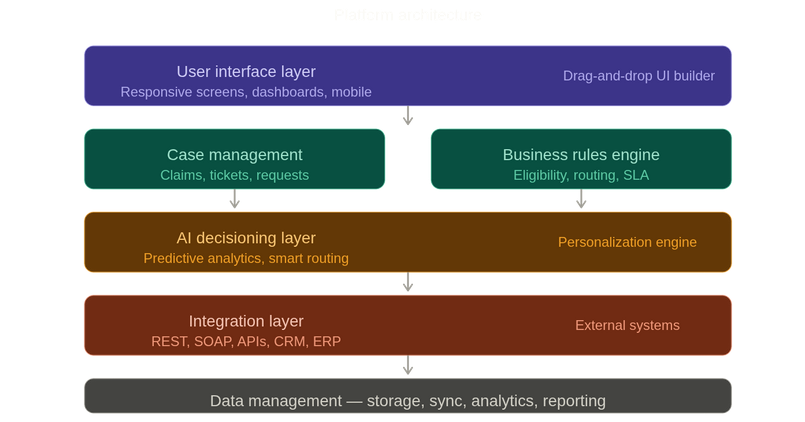
1. User Interface Layer
The UI layer provides screens, forms, dashboards, and portals used by customers and employees.
Features include:
- Responsive design
- Mobile-friendly interfaces
- Drag-and-drop UI creation
- Dynamic forms
- Reusable UI components
2. Case Management Engine
Case management is one of Pega’s strongest capabilities. A case represents a business process such as:
- Insurance claim
- Loan request
- Customer complaint
- Service ticket
The case lifecycle manages each step automatically.
3. Business Rules Engine
The business rules engine handles decision-making logic.
Examples:
- Eligibility validation
- Premium calculations
- Approval conditions
- Routing decisions
- SLA management
Business rules can be updated without changing application code.
4. Integration Layer
The integration layer connects Launchpad with external applications and services.
Common integrations include:
- Payment gateways
- Banking systems
- Identity verification services
- CRM platforms
- Email and SMS services
5. Data Management Layer
The data layer stores application data securely.
Functions include:
- Data persistence
- Database connections
- Data validation
- Data synchronization
- Reporting and analytics
Application Lifecycle
The typical lifecycle in Pega Launchpad includes:
- Requirement gathering
- Application design
- Workflow creation
- Integration setup
- Testing
- Deployment
- Monitoring and maintenance
This structured lifecycle helps organizations deliver reliable applications efficiently.
1. Insurance Industry
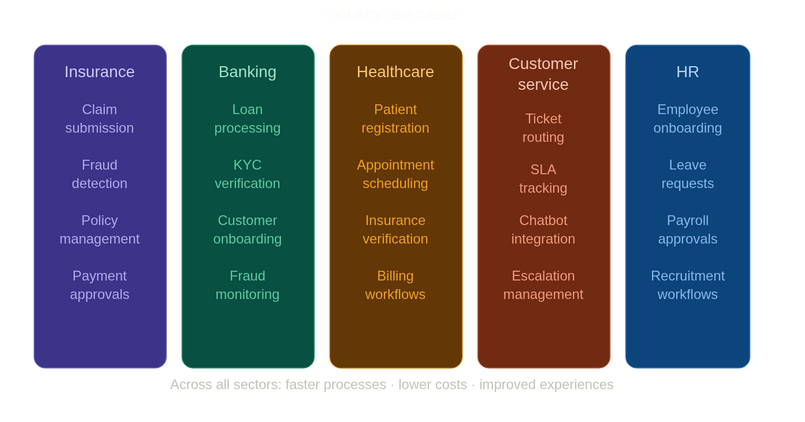
Example workflow:
- Customer submits claim
- System validates policy details
- AI detects fraud risks
- Claims team reviews request
- Payment approval is processed
- Customer receives status notifications
Benefits:
- Faster claim processing
- Reduced manual work
- Improved customer satisfaction
- Better fraud detection
2. Banking and Financial Services
Banks use Launchpad for:
- Loan processing
- Credit card applications
- Customer onboarding
- KYC verification
- Fraud monitoring
Automation improves processing speed and regulatory compliance.
3. Healthcare Industry
Healthcare organizations can automate:
- Patient registration
- Appointment scheduling
- Insurance verification
- Medical approvals
- Billing workflows
Benefits include improved patient experiences and operational efficiency.
4. Customer Service Management
Customer support teams can create automated ticketing systems.
Capabilities include:
- Ticket routing
- SLA tracking
- Escalation management
- Chatbot integration
- Real-time reporting
This improves response time and service quality.
5. Human Resource Management
HR departments can automate:
- Employee onboarding
- Leave requests
- Payroll approvals
- Recruitment workflows
- Performance reviews
Automation reduces paperwork and improves HR efficiency.
Business Impact of Pega Launchpad
Organizations using Launchpad can achieve:
- Faster digital transformation
- Reduced operational costs
- Better employee productivity
- Improved customer experiences
- Increased process transparency
- Higher business agility
The Future of Low-Code Platforms
The demand for low-code platforms is growing rapidly because businesses need faster and smarter digital solutions. Pega Launchpad is expected to play an important role in this transformation.
Future trends include:
- Increased AI automation
- Advanced predictive analytics
- Hyperautomation
- Improved cloud-native services
- Enhanced cybersecurity
- Greater mobile accessibility
Role of Artificial Intelligence
AI will continue improving the capabilities of Launchpad by enabling:
- Intelligent workflow optimization
- Automated decision-making
- Real-time customer personalization
- Smart virtual assistants
- Predictive business insights
Challenges and Considerations
Although Launchpad provides many benefits, organizations should also consider:
- Proper user training
- Governance and compliance
- Data security strategies
- Integration complexity
- Change management processes
Successful implementation requires planning, collaboration, and continuous improvement.
Conclusion
Pega Launchpad is a powerful low-code platform that helps organizations build modern business applications quickly and efficiently. By combining workflow automation, AI-powered decisioning, cloud-native architecture, and integration capabilities, Launchpad simplifies digital transformation.
Businesses across industries can use Pega Launchpad to automate processes, improve customer experiences, and reduce operational costs. As technology continues evolving, platforms like Launchpad will become increasingly important for organizations seeking agility, innovation, and competitive advantage.
Pega Launchpad demonstrates how low-code development can bridge the gap between business needs and technical implementation, making enterprise application development faster, smarter, and more accessible.
