
When users access a website or application, their requests need to reach the correct server. As applications grow, managing traffic, security, and multiple servers can become difficult.
A reverse proxy helps by sitting between users and backend servers and forwarding requests to the appropriate server.
What is a Reverse Proxy?
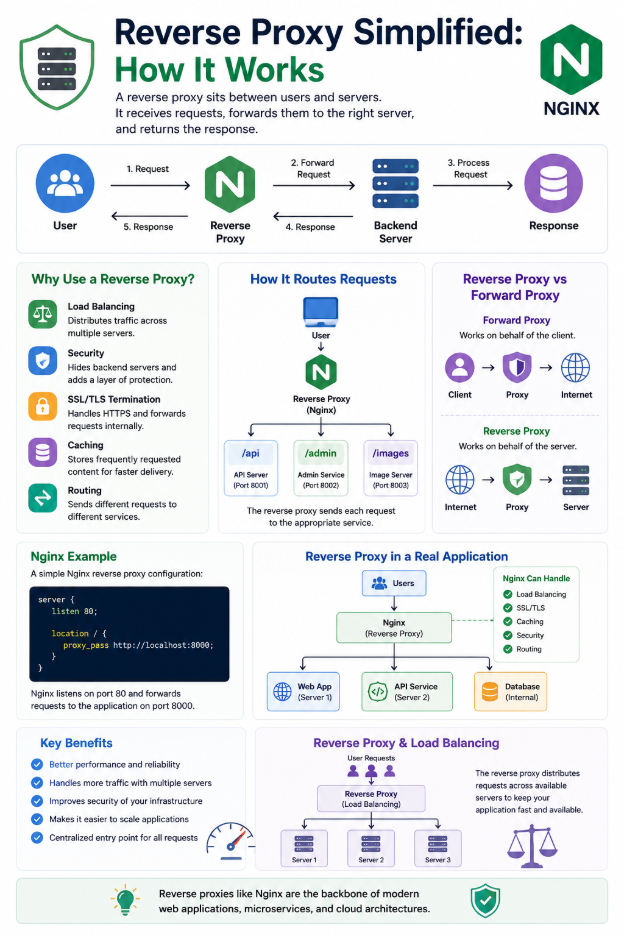
A reverse proxy is a server that receives requests from users and forwards them to one or more backend servers.
The basic flow is:
User → Reverse Proxy → Backend Server → Reverse Proxy → User
Popular reverse proxy tools include Nginx, Apache, and HAProxy.
How Does a Reverse Proxy Work?
When a user requests a website, the request first reaches the reverse proxy. The proxy decides where the request should go and forwards it to the appropriate backend server.
For example:
User requests /products
↓
Nginx receives the request
↓
Nginx forwards it to the backend
↓
Backend processes the request
↓
Response is returned to the user
The user does not need to know which backend server handled the request.
Why Use a Reverse Proxy?
Load Balancing
A reverse proxy can distribute traffic across multiple servers.
User Requests → Nginx → Server 1 / Server 2 / Server 3
This prevents a single server from handling all the traffic.
Security
The reverse proxy can act as a layer between users and backend servers, reducing the need to expose backend servers directly to the internet.
SSL/TLS
A reverse proxy can handle HTTPS connections and forward requests to backend servers.
User → HTTPS → Reverse Proxy → Backend
Caching
Frequently requested content can be cached by the reverse proxy. This reduces repeated requests to the backend and can improve response times.
Routing
A reverse proxy can send different requests to different services:
/api → Backend API
/admin → Admin Service
/images → Image Server
This is especially useful in applications with multiple services.
Reverse Proxy vs Forward Proxy
The main difference is who the proxy represents.
Forward Proxy → Client → Proxy → Internet
Reverse Proxy → Internet → Proxy → Server
A forward proxy manages outgoing client traffic, while a reverse proxy manages incoming traffic to servers.
Nginx as a Reverse Proxy
Nginx is widely used as a reverse proxy. A simple configuration looks like:
server {
listen 80;
location / {
proxy_pass http://localhost:8000;
}
}
Here, Nginx receives requests on port 80 and forwards them to the application running on port 8000.
Reverse Proxy in Modern Applications
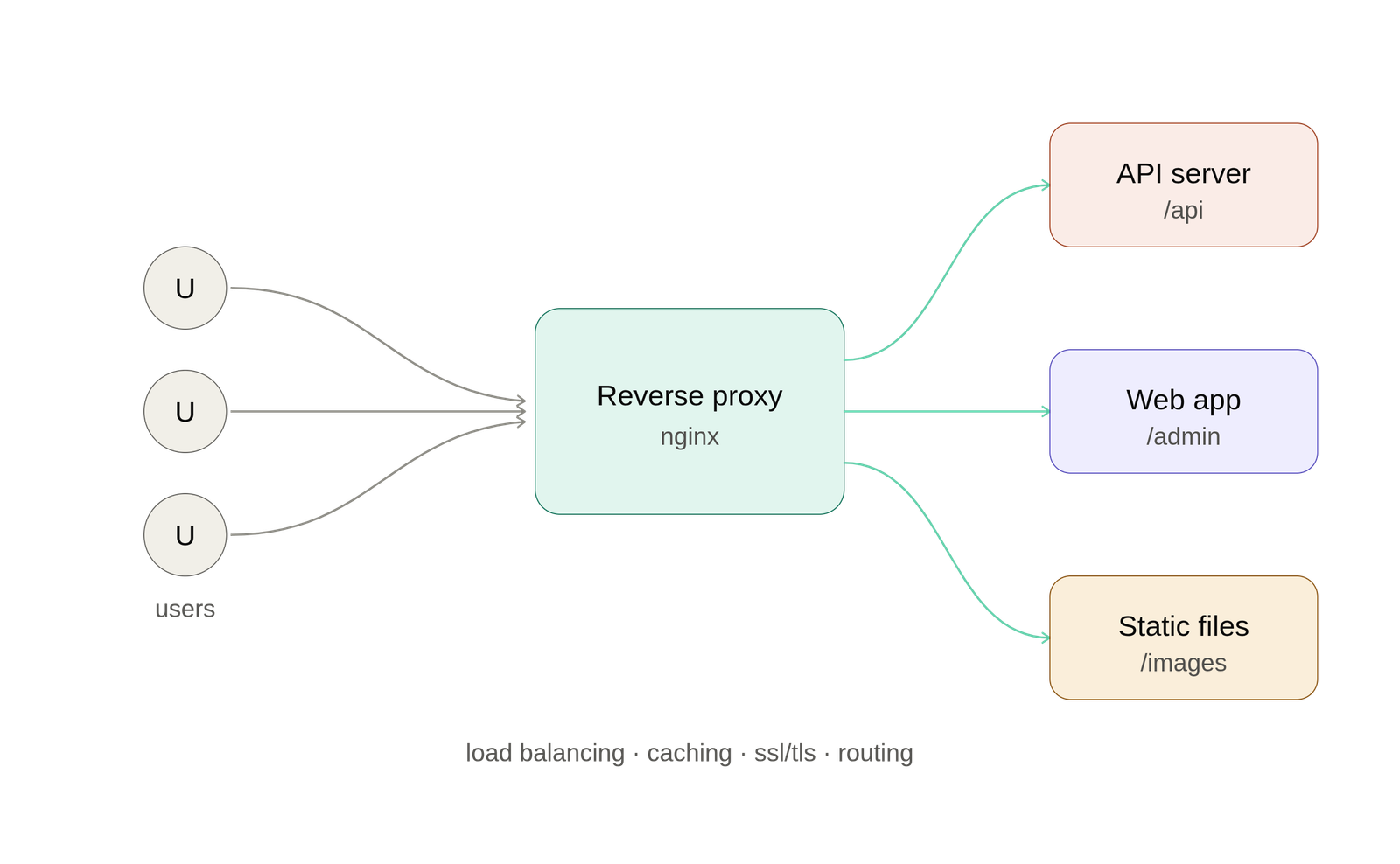
A reverse proxy can act as a single entry point for multiple services:
Users
↓
Nginx
↓
┌─────────┼─────────┐
↓ ↓ ↓
API Server Web App Static Files
This architecture is commonly used with microservices, containers, and cloud applications.
Key Benefits
- Load balancing — Distributes traffic across servers.
- Security — Adds a layer between users and backend servers.
- Caching — Reduces repeated backend requests.
- SSL/TLS — Handles HTTPS connections.
- Routing — Sends requests to the correct service.
- Scalability — Makes it easier to add more servers.
Conclusion
A reverse proxy acts as a middle layer between users and backend servers. It can handle routing, security, caching, HTTPS, and load balancing.
The basic concept is:
User → Reverse Proxy → Backend → Response
As applications grow and use multiple servers or services, reverse proxies such as Nginx become an important part of modern web architecture.
