
Introduction
For decades, we have interacted with computers through screens, keyboards, and mice. But technology is moving toward a different kind of experience—one where digital content can exist alongside the physical world.
This concept is known as spatial computing.
Spatial computing combines technologies such as augmented reality (AR), virtual reality (VR), mixed reality (MR), computer vision, artificial intelligence, and advanced sensors to allow people to interact with digital objects in three-dimensional environments.
In 2026, spatial computing is moving beyond gaming and entertainment. Businesses, educators, designers, engineers, healthcare professionals, and consumers are exploring ways to use immersive technology for work, learning, collaboration, and creativity.
So, what exactly is spatial computing, and why could it become one of the most important developments in personal computing?
What Is Spatial Computing?
Spatial computing refers to technologies that allow computers to understand and interact with the physical space around us.
Instead of treating the screen as the only place where digital information exists, spatial computing allows digital content to be positioned within a user’s environment.
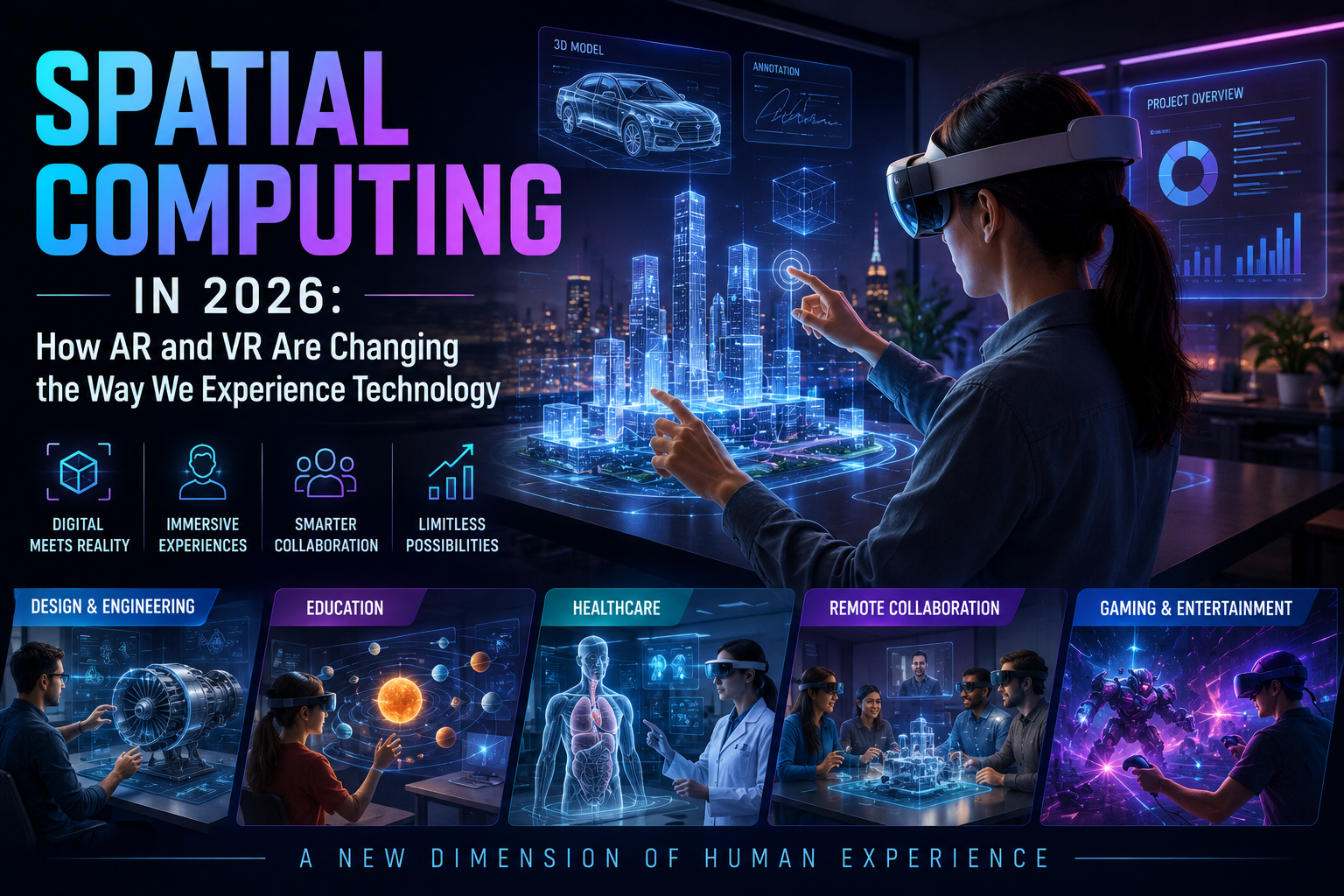
For example, imagine looking at a physical table and seeing a three-dimensional digital model of a car placed on top of it. You could walk around the model, resize it, inspect individual components, and interact with it using your hands.
That is the basic idea behind spatial computing.
It combines several technologies, including:
- Augmented reality
- Virtual reality
- Mixed reality
- Computer vision
- Artificial intelligence
- Spatial audio
- Gesture recognition
- Eye tracking
- Motion sensors
- 3D mapping
Together, these technologies allow computers to understand the user’s environment and respond to their movements.
AR vs VR vs MR
Although these technologies are often grouped together, they provide different experiences.
Augmented Reality
AR adds digital information to the real world.
For example, a navigation application could display directions directly over the road in front of you.
Virtual Reality
VR completely replaces the user’s physical surroundings with a digital environment.
It is commonly used for:
- Gaming
- Simulations
- Training
- Virtual tourism
- Entertainment
Mixed Reality
Mixed reality combines physical and digital environments more interactively.
Digital objects can appear to exist within the physical world and respond to it.
For example, a virtual object placed on a real desk could remain anchored to that desk while the user walks around it.
How Spatial Computing Works
Spatial computing requires several technologies to work together.
Cameras and Sensors
Cameras and sensors scan the environment to understand surfaces, objects, and movement.
They help devices determine:
- Where the user is
- Where objects are located
- How the environment is shaped
- How the user is moving
Computer Vision
Computer vision allows computers to interpret visual information from the surrounding environment.
It can recognize:
- Walls
- Tables
- Floors
- People
- Objects
- Movement
This enables digital content to interact more naturally with the physical world.
Eye Tracking
Eye-tracking technology determines where the user is looking.
Instead of moving a cursor manually, users can potentially select digital objects simply by looking at them.
Hand and Gesture Tracking
Modern spatial devices can recognize hand movements.
Users may be able to:
- Pinch
- Grab
- Point
- Rotate
- Move
- Resize
digital objects without traditional controllers.
Spatial Audio
Sound can also be positioned within a three-dimensional environment.
For example, a virtual speaker can appear to produce sound from a particular location in the room.
This creates a more realistic and immersive experience.
Spatial Computing in the Workplace
One of the most interesting applications of spatial computing is professional work.
Traditional computer monitors limit users to a fixed amount of screen space.
Spatial computing can create multiple virtual displays around the user.
A professional could potentially have:
- Email on one virtual screen
- Code on another
- Documentation on another
- Video meetings in another
- A 3D model floating nearby
This could create a large digital workspace without requiring multiple physical monitors.
Engineering and Product Design
Spatial computing has enormous potential for engineers and designers.
Instead of examining a product through a flat 2D screen, designers can view a full-scale 3D model.
For example, an automotive engineer could inspect a virtual vehicle before manufacturing a physical prototype.
Teams could:
- Examine designs
- Identify problems
- Modify components
- Collaborate remotely
- Simulate physical environments
This can reduce prototyping costs and speed up product development.
Healthcare Applications
Healthcare is another area where spatial computing could have a significant impact.
Doctors and medical students can use 3D models to better understand anatomy.
Potential applications include:
- Medical training
- Surgical planning
- Anatomy education
- Rehabilitation
- Remote assistance
- Medical visualization
A complex organ could be represented as an interactive three-dimensional model instead of a flat image.
This can make certain concepts easier to understand.
Education and Learning
Traditional education often relies on textbooks, presentations, and videos.
Spatial computing can make learning more interactive.
Imagine students studying ancient history by exploring a virtual reconstruction of an ancient city.
Or imagine biology students examining a three-dimensional human heart and viewing its internal structures.
Potential applications include:
- Virtual laboratories
- Historical simulations
- 3D science models
- Virtual field trips
- Engineering simulations
- Interactive training
Instead of simply reading about a subject, students can interact with it.
Gaming and Entertainment
Gaming remains one of the biggest markets for immersive technology.
Spatial computing allows games to move beyond traditional screens.
Players can interact with digital environments using:
- Hand gestures
- Eye movements
- Body movement
- Spatial controllers
- Voice commands
Virtual and mixed-reality games can make users feel physically present inside the game world.
Entertainment companies are also experimenting with immersive movies, concerts, sports experiences, and virtual events.
Remote Collaboration
Remote work has become a normal part of modern business.
Video calls provide communication, but participants still appear inside rectangular windows on a screen.
Spatial computing could create more immersive virtual meeting environments.
Employees could meet inside a shared 3D workspace where they can:
- Examine documents
- View presentations
- Manipulate 3D objects
- Draw on virtual boards
- Interact with colleagues
This could make remote collaboration feel more natural.
Artificial Intelligence and Spatial Computing
AI is making spatial computing significantly more powerful.
AI can help devices understand the environment and interpret user intentions.
For example, an AI-powered spatial assistant could understand:
“Move this object next to the laptop.”
The system would need to identify the object, understand the instruction, locate the laptop, and reposition the digital object appropriately.
AI can also assist with:
- Object recognition
- Natural-language interaction
- Scene understanding
- Real-time translation
- Personalized experiences
- Automated 3D content generation
The combination of AI and spatial computing could make immersive devices much easier to use.
The Rise of Spatial Interfaces
Traditional interfaces depend heavily on keyboards, mice, and touchscreens.
Spatial computing introduces new interaction methods.
Users can potentially control computers through:
- Eye movements
- Hand gestures
- Voice
- Head movement
- Touch
- Physical controllers
This creates a more natural relationship between humans and computers.
Instead of learning complicated menus, users may simply interact with digital objects as they would with physical objects.
Benefits of Spatial Computing
More Immersive Experiences
Users can interact with digital content in three dimensions instead of viewing everything on a flat screen.
Better Visualization
Complex designs, scientific models, and data can be represented spatially.
Improved Collaboration
Teams can interact with shared virtual objects regardless of their physical location.
New Learning Experiences
Students can explore concepts through interactive simulations.
Increased Productivity
Virtual workspaces can provide significantly more screen space without requiring multiple physical monitors.
Challenges of Spatial Computing
Despite its potential, spatial computing still faces several challenges.
High Hardware Costs
Advanced headsets and spatial devices can be expensive, limiting adoption among consumers and smaller organizations.
Battery Life
Immersive devices require significant processing power, which can affect battery performance.
Comfort
Users may experience discomfort when wearing headsets for extended periods.
Weight, heat, and display quality remain important considerations.
Limited Content
The technology is only as useful as the applications available for it.
Developers need to create compelling spatial experiences before widespread adoption can occur.
Privacy
Spatial devices can collect information about a user’s surroundings, movements, voice, and interactions.
This creates important questions about:
- Data ownership
- Camera access
- Environmental scanning
- Biometric information
- User tracking
Strong privacy protections will be essential as the technology develops.
Is Spatial Computing the Future of Computing?
Spatial computing is unlikely to completely replace smartphones, laptops, or traditional computers in the immediate future.
Instead, it is more likely to become another layer of computing.
Users may continue using smartphones for quick tasks, laptops for traditional productivity, and spatial devices for immersive experiences and specialized workflows.
Over time, however, the boundaries between these devices could become less obvious.
A lightweight pair of spatial glasses could eventually provide many of the capabilities currently associated with smartphones and computers.
What Could Spatial Computing Look Like in the Future?
Future spatial devices could become:
- Smaller
- Lighter
- More powerful
- More energy efficient
- Less expensive
- More comfortable
AI could make interaction even more natural.
Instead of opening applications manually, users could simply describe what they want.
For example:
“Show me today’s sales data.”
A spatial assistant could create a three-dimensional visualization directly in front of the user.
Or:
“Translate the conversation.”
The system could display translated speech in real time.
These experiences could make computing feel less like operating a machine and more like interacting with an intelligent environment.
The Future of Spatial Computing in 2026 and Beyond
The technology is still developing, but the direction is clear.
Computing is gradually moving from:
Screens → Interfaces → Environments
Instead of interacting with computers only through a display, users may increasingly interact with digital information within the spaces around them.
The combination of spatial computing, AI, faster wireless networks, advanced sensors, and more efficient processors could create entirely new categories of applications.
From virtual workplaces to immersive education and intelligent personal assistants, the possibilities are enormous.
Conclusion
Spatial computing represents a major shift in how humans interact with technology.
AR, VR, and mixed reality are transforming digital experiences by bringing computing into three-dimensional environments. As sensors, displays, AI, and processors become more advanced, spatial devices are becoming increasingly capable of understanding both users and their surroundings.
The technology still faces challenges involving cost, comfort, privacy, battery life, and software availability. However, its potential across industries such as healthcare, education, engineering, entertainment, and business is difficult to ignore.
The next generation of computing may not simply be something we look at.
It may be something we step into.
