

In modern software development, delivering high-quality code quickly is a constant challenge. Developers must balance feature development, bug fixes, performance optimization, and maintainability while meeting tight deadlines. One practice that has consistently helped teams achieve these goals is Test-Driven Development (TDD).
TDD is a software development methodology in which developers write automated tests before writing the actual implementation code. While some developers initially view TDD as an extra step that slows development, many experienced engineers consider it one of the most effective techniques for building reliable and maintainable software.
What is Test-Driven Development?
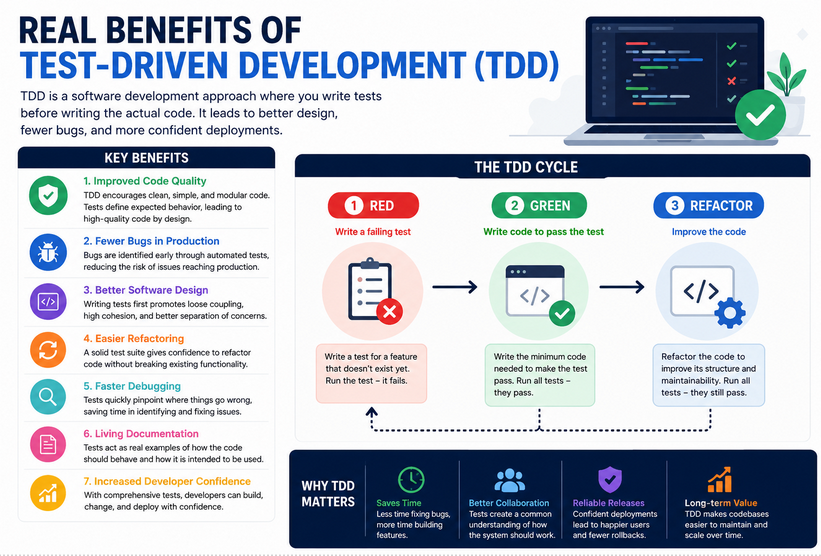
Test-Driven Development follows a simple cycle known as Red-Green-Refactor:
- Red – Write a test that fails because the functionality does not yet exist.
- Green – Write the minimum amount of code required to make the test pass.
- Refactor – Improve and clean up the code while ensuring all tests continue to pass.
This process is repeated continuously throughout development, allowing developers to build applications incrementally with confidence.
Improved Code Quality
One of the biggest benefits of TDD is improved code quality. Since developers write tests before implementation, they must think carefully about requirements, expected behavior, and edge cases before writing code.
This approach reduces the likelihood of introducing bugs and encourages developers to write cleaner, more predictable solutions. Rather than focusing solely on making code work, TDD promotes writing code that is both functional and reliable.
Fewer Bugs in Production
Software bugs can be costly, especially when discovered in production environments. TDD helps catch issues early in the development process by validating functionality through automated tests.
When every feature is backed by tests, developers can quickly identify whether a new change has introduced unexpected behavior. This reduces the risk of regressions and increases confidence during deployments.
As a result, teams often spend less time fixing production issues and more time building valuable features.
Better Software Design
An often-overlooked advantage of TDD is its impact on software architecture and design. Writing tests first naturally encourages developers to create modular, loosely coupled components that are easier to test.
Code that is difficult to test is often a sign of poor design. Through TDD, developers are pushed toward:
- Smaller functions
- Clear responsibilities
- Better separation of concerns
- Reduced dependencies
Over time, this leads to cleaner and more maintainable codebases.
Easier Refactoring
As applications grow, requirements change and code must be modified. Refactoring without proper test coverage can be risky because developers may accidentally break existing functionality.
TDD provides a safety net. With a comprehensive suite of automated tests, developers can confidently refactor code, optimize performance, or improve architecture while ensuring that the application’s behavior remains unchanged.
This ability to make changes safely becomes increasingly valuable as projects become larger and more complex.
Faster Debugging
Although writing tests requires an initial investment of time, it often reduces debugging effort significantly.
When a test fails, developers immediately know which functionality is affected. Instead of manually searching through large portions of the application, they can focus directly on the failing component.
This targeted troubleshooting process helps developers identify and fix issues more efficiently.
Improved Documentation
Well-written tests serve as a form of living documentation. They demonstrate how a feature is expected to behave and provide examples of how components should be used.
New team members can often understand a system faster by reviewing its tests than by reading extensive documentation.
Unlike traditional documentation, tests are updated whenever the code changes, making them more accurate and reliable over time.
Increased Developer Confidence
One of the most valuable benefits of TDD is confidence. Developers can make changes, add features, and refactor code knowing that automated tests will quickly detect any unintended side effects.
This confidence leads to faster development cycles and reduces the fear of modifying existing code.
Teams that consistently practice TDD often experience smoother releases and fewer last-minute surprises.
Challenges of TDD
Despite its advantages, TDD is not without challenges. Developers new to the methodology may initially feel that writing tests first slows them down.
Some common challenges include:
- Learning how to write effective tests.
- Maintaining test suites over time.
- Writing tests for highly complex systems.
- Initial increase in development effort.
However, as developers gain experience with TDD, these challenges typically become less significant, and the long-term benefits begin to outweigh the initial investment.
Conclusion
Test-Driven Development is more than just a testing technique—it is a development mindset that encourages thoughtful design, higher code quality, and greater reliability. By writing tests before implementation, developers gain a deeper understanding of requirements, catch bugs earlier, and build software that is easier to maintain and extend.
While TDD may require additional effort at the beginning of a project, its long-term benefits include fewer production issues, safer refactoring, improved documentation, and increased developer confidence. For teams focused on delivering high-quality software, Test-Driven Development remains one of the most valuable practices in modern software engineering.
