
For decades, enterprises have approached mainframe modernization as a single, massive transformation initiative. The objective seemed straightforward: replace legacy systems, move everything to the cloud, and modernize once and for all.
The reality has been very different.
Industry research continues to show that the majority of large-scale modernization programs fail to meet expectations—not because organizations lack ambition, but because they’re trying to solve the wrong problem.
The Mainframe Isn’t the Enemy
Mainframes continue to excel at what they were designed to do.
They remain unmatched for high-volume, mission-critical transaction processing, powering workloads such as:
- Financial transactions
- Large-scale batch processing
- High-throughput operational systems
These are workloads where performance, reliability, and consistency matter more than flexibility.
The challenge isn’t the platform itself.
The challenge is that over decades, organizations also placed customer-facing processes, operational workflows, policy management, and business decisioning on the same infrastructure. Today, those applications have become barriers to innovation.
Why Traditional Modernization Strategies Fall Short
Organizations have typically followed one of three approaches.
Replatforming recreates entire applications in modern languages and cloud environments. While technically achievable, it often becomes a lengthy, expensive exercise that reproduces yesterday’s architecture with today’s technology.
Wrap-and-renew improves user experiences by placing modern interfaces on top of legacy applications. Although usability improves, the underlying complexity remains unchanged, making maintenance and future enhancements just as difficult.
Lift-and-shift relocates workloads to cloud infrastructure with minimal code changes. Infrastructure becomes modern, but applications continue carrying decades-old business logic, tightly coupled architectures, and operational constraints.
Each strategy solves part of the problem—but rarely transforms the business.
Modernization Should Be Selective, Not Absolute
Not every workload needs to leave the mainframe.
Core transaction processing can continue operating where it delivers the greatest value.
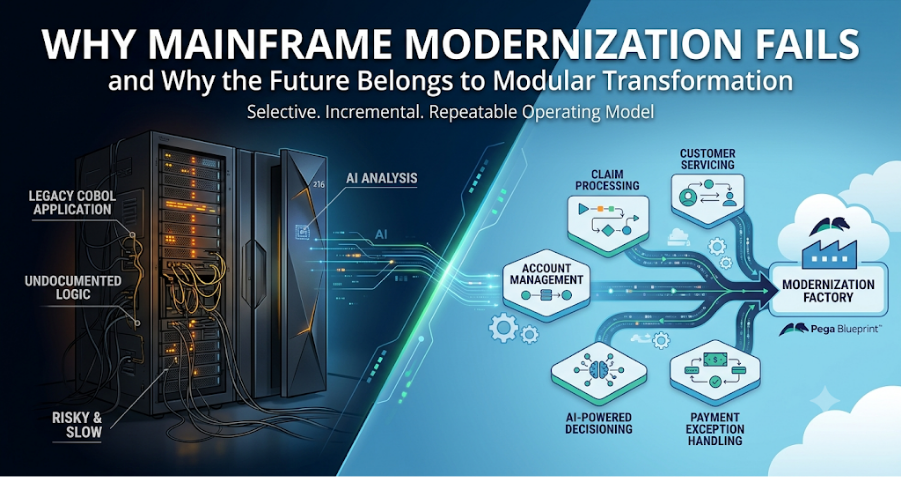
Instead, organizations should focus on modernizing the business capabilities surrounding those systems:
- Claims processing
- Customer servicing
- Account management
- Payment exception handling
- Fraud investigations
- Case management
- Regulatory workflows
These processes benefit significantly from cloud-native architectures, intelligent automation, AI-driven decisioning, and seamless integration across enterprise systems.
This targeted approach reduces risk while accelerating business value.
AI Is Changing the Economics of Modernization
One of the biggest obstacles to modernization has always been understanding decades of undocumented business logic embedded deep inside legacy COBOL applications.
Today, AI dramatically changes that equation.
Instead of spending months manually analyzing legacy code, AI can rapidly identify business rules, process flows, dependencies, and application boundaries.
But the real breakthrough isn’t translating COBOL into another programming language.
The real opportunity is transforming legacy applications into clear business documentation that enables teams to design entirely new cloud-native workflows—built around today’s business requirements rather than yesterday’s technical limitations.
This allows organizations to redesign instead of simply rewriting.
From One-Time Projects to Continuous Delivery
Successful modernization isn’t a single multi-year initiative.
It’s a repeatable operating model.
Teams can establish a modernization pipeline:
- Analyze existing applications.
- Discover business logic with AI.
- Reimagine workflows for the cloud.
- Deploy modern applications.
- Repeat with the next business capability.
Instead of waiting years for transformation, organizations begin realizing value every few weeks or months as each modernized application goes live.
The process becomes predictable, measurable, and scalable.
A Smarter Path Forward
The future of legacy transformation isn’t about replacing every mainframe workload.
It’s about preserving what already performs exceptionally well while systematically modernizing the applications that drive customer experiences, employee productivity, and business agility.
With cloud platforms, experienced transformation partners, and AI-powered workflow design tools like Pega Blueprint™, enterprises now have an opportunity to modernize incrementally, reduce delivery risk, and continuously create business value.
The most successful organizations won’t be the ones attempting the biggest transformation.
They’ll be the ones building a repeatable modernization factory—delivering cloud-native business applications one capability at a time.
#MainframeModernization #LegacyTransformation #DigitalTransformation #ArtificialIntelligence #CloudComputing #EnterpriseArchitecture #WorkflowAutomation #Pega #PegaBlueprint #CIO #Automation #EnterpriseIT
