
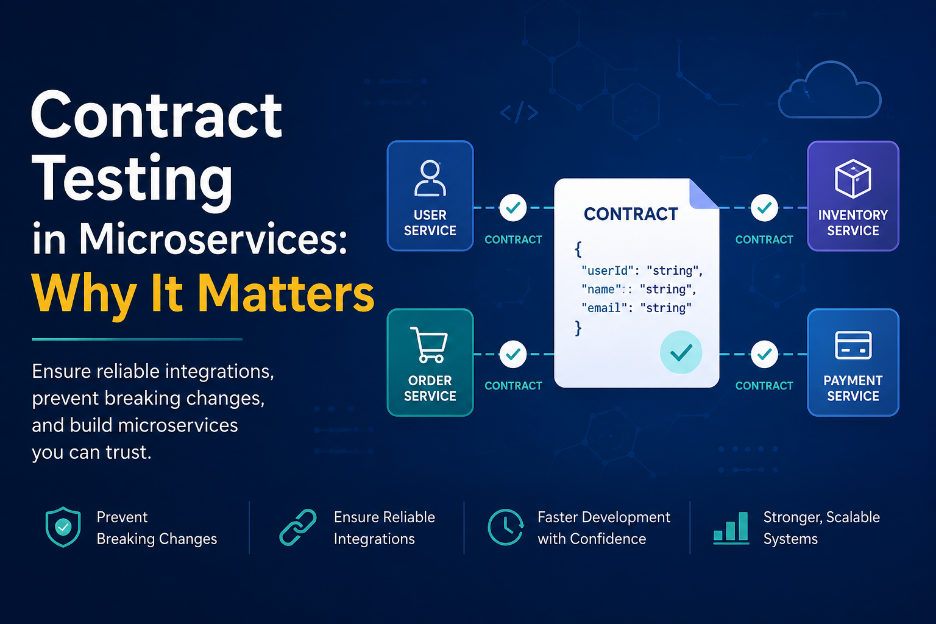
Microservices architecture has transformed how modern applications are built and scaled. As a Quality Engineer, you are likely already familiar with the benefits of microservices such as independent deployment, scalability, and team autonomy. However, along with these benefits comes a significant testing challenge ensuring that independently developed services communicate reliably.
This is where Contract Testing becomes essential.
What Is Contract Testing?
Contract testing is a testing approach where interactions between services are verified based on a defined “contract.” This contract specifies what requests a service can send and what responses it should expect.
In simple terms:
- A consumer defines what it expects from a provider
- A provider verifies that it can meet those expectations
Unlike end to end testing, contract testing focuses only on the interaction between two services, making it faster and more reliable.
Why Traditional Testing Falls Short in Microservices
In monolithic applications, testing is relatively straightforward because everything runs in a single codebase. However, in microservices:
- Services evolve independently
- Deployment cycles differ
- Dependencies are network-based
- Failures can be harder to trace
Common testing approaches often lead to issues:
1. Over Reliance on End to End Tests
- Slow execution
- Difficult to maintain
- Flaky due to multiple dependencies
2. Mocking Without Standardization
- Inconsistent mocks
- Drift between mock and real service behavior
3. Late Failure Detection
- Integration issues identified too late in the pipeline
Contract testing addresses these problems effectively.
How Contract Testing Works
Contract testing introduces a structured interaction validation model with two key components:
1. Consumer Driven Contracts
The consumer defines:
- API endpoints
- Request structure
- Expected response
2. Provider Verification
The provider:
- Validates if it conforms to the consumer’s contract
- Runs automated tests to verify compliance
Example Flow:
- Consumer writes contract tests
- Contract is stored and shared
- Provider runs tests against the contract
- Changes are validated before deployment
Types of Contract Testing
1. Consumer Driven Contract Testing
- Most common approach
- Consumer defines expectations
- Tools: Pact, Spring Cloud Contract
2. Provider Driven Contract Testing
- Provider defines API behavior
- Less flexible for consumers
3. Bi Directional Contract Testing
- Both consumer and provider contribute
- Often used in API schema based validation
Benefits of Contract Testing
1. Faster Feedback
Contract tests run quickly and provide early feedback during development.
2. Reduced Integration Failures
Issues are detected before deployment, avoiding production defects.
3. Independent Deployments
Teams can release services without breaking dependent systems.
4. Improved Collaboration
Clear contracts act as executable documentation between teams.
5. Scalable Testing Strategy
Ideal for large microservice ecosystems with multiple dependencies.
Real World Example
Consider an e-commerce platform with services such as:
- Order Service
- Payment Service
- Inventory Service
If the Order Service expects:
POST /payment
{
“amount”: 100,
“currency”: “INR”
}
And the Payment Service changes the API to:
{
“totalAmount”: 100,
“currency”: “INR”
}
Without contract testing:
- The issue is detected late
- Orders fail in production
With contract testing:
- The provider test fails immediately
- Issue is fixed before deployment
Tools for Contract Testing
Here are some widely used tools:
1. Pact
- Most popular contract testing tool
- Supports multiple languages
- Enables consumer driven contracts
2. Spring Cloud Contract
- Integrated with Spring ecosystem
- Generates server stubs automatically
3. Postman Contract Testing
- Useful for teams already using Postman
- Supports API schema validations
4. OpenAPI / Swagger
- Schema based contract validation
- Works well with bi directional contracts
Best Practices for Implementing Contract Testing
As a Quality Engineer, adopting the right practices is critical.
1. Start Small
- Begin with critical service interactions
- Expand gradually
2. Keep Contracts Simple
- Avoid unnecessary fields
- Focus on required data
3. Version Your Contracts
- Maintain backward compatibility
- Track contract changes effectively
4. Integrate into CI CD
- Run contract tests in build pipelines
- Prevent breaking changes early
5. Use Realistic Data
- Avoid overly simplified mocks
- Represent real world scenarios
6. Monitor Contract Coverage
- Ensure critical APIs are covered
- Track gaps in contract testing
Contract Testing vs Other Testing Types
| Testing Type | Scope | Speed | Reliability |
| Unit Testing | Individual components | Fast | High |
| Contract Testing | Service interactions | Fast | High |
| Integration Testing | Multiple services | Medium | Medium |
| End to End Testing | Full system | Slow | Low |
Contract testing fits perfectly between unit and integration testing, providing a balance of speed and confidence.
Challenges in Contract Testing
While contract testing is powerful, it comes with challenges:
1. Initial Setup Effort
- Requires tool setup and team adoption
2. Learning Curve
- Teams must understand contract driven development
3. Contract Maintenance
- Frequent updates may cause overhead
4. Over Contracting Risk
- Too many contracts can become difficult to manage
Despite these challenges, the long term benefits outweigh the initial effort.
Why It Matters for QA Engineers
As a Quality Engineer II, especially in environments using tools like Pega or modern cloud platforms, contract testing gives you a strong advantage:
- Enables shift left testing strategy
- Reduces dependency on unstable environments
- Improves release confidence
- Helps build robust automation frameworks
It also positions QA engineers as enablers of architecture quality, not just testers.
Key Takeaways
- Contract testing validates service communication in microservices
- It prevents integration failures early in development
- Consumer driven contracts are the most effective approach
- Tools like Pact and Spring Cloud Contract simplify implementation
- It bridges the gap between unit and end to end testing
