

Software development has evolved far beyond writing code. Today’s developers are expected to understand how applications are built, tested, deployed, and maintained in production. This shift has made DevOps an essential skill—not just for operations teams, but for every developer.
DevOps is more than a collection of tools. It is a culture that promotes collaboration between development and operations teams, enabling organizations to deliver software faster, more reliably, and with higher quality.
Understanding DevOps fundamentals helps developers write better code, deploy with confidence, and contribute more effectively throughout the software development lifecycle.
What Is DevOps?
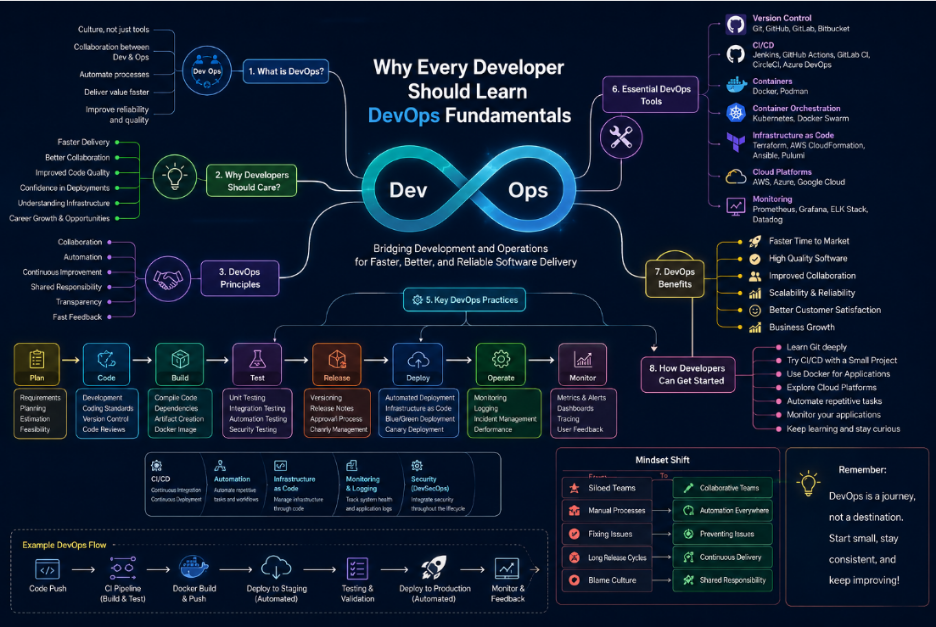
DevOps combines development (Dev) and operations (Ops) to streamline the process of building, testing, deploying, and maintaining software.
Rather than working in separate silos, developers and operations teams collaborate to automate repetitive tasks, improve deployment processes, and ensure applications remain reliable in production.
The goal is simple:
Deliver software quickly without compromising quality or stability.
Why Developers Should Care About DevOps
Modern applications don’t stop at “it works on my machine.”
Developers are increasingly responsible for ensuring that their code performs well in staging and production environments. A basic understanding of DevOps allows developers to identify deployment issues early, improve collaboration, and reduce production failures.
1. Faster Software Delivery
Automation is one of DevOps’ greatest strengths.
By using Continuous Integration (CI) and Continuous Deployment (CD), every code change can be automatically built, tested, and deployed.
This reduces manual work, minimizes human error, and allows teams to release new features more frequently.
2. Better Collaboration Across Teams
DevOps encourages shared ownership.
Instead of developers handing code to operations teams and waiting for deployment, both teams work together throughout the development process.
This collaboration leads to faster issue resolution, smoother deployments, and better communication.
3. Improved Code Quality
Automated testing is a key part of DevOps.
Before code reaches production, automated pipelines can perform:
- Unit Testing
- Integration Testing
- Security Scanning
- Code Quality Analysis
- Performance Checks
These automated validations catch issues early and improve software reliability.
4. Confidence in Production Deployments
Many developers feel nervous when deploying applications.
DevOps practices such as automated deployments, rollback strategies, health monitoring, and infrastructure automation reduce deployment risks and make releases far more predictable.
5. Understanding Cloud Infrastructure
Most modern applications run in cloud environments.
Learning DevOps fundamentals helps developers understand:
- Virtual Machines
- Containers
- Cloud Storage
- Networking
- Load Balancers
- Infrastructure as Code
This knowledge enables developers to build applications that perform efficiently in production.
Essential DevOps Tools Every Developer Should Know
You don’t need to master every tool, but understanding the basics of these technologies is extremely valuable:
- Git for version control
- Docker for containerization
- GitHub Actions, GitLab CI, or Jenkins for CI/CD
- Kubernetes for container orchestration
- Terraform for Infrastructure as Code
- Prometheus and Grafana for monitoring
- Nginx as a web server and reverse proxy
Learning these tools gradually will significantly improve your development workflow.
DevOps Is About Mindset, Not Just Tools
Many people think DevOps is simply learning Docker or Kubernetes.
In reality, DevOps is a mindset centered on:
- Collaboration
- Automation
- Continuous Improvement
- Fast Feedback
- Shared Responsibility
- Reliability
The tools support these principles, but the culture drives long-term success.
Small Steps Developers Can Take Today
You don’t need to become a DevOps engineer overnight.
Start by:
- Writing automated tests.
- Learning how CI/CD pipelines work.
- Containerizing one personal project with Docker.
- Deploying an application to a cloud platform.
- Monitoring application logs and performance.
- Understanding how your application behaves in production.
Each step builds valuable real-world experience.
The Competitive Advantage
Companies increasingly seek developers who understand the entire software delivery process.
Developers with DevOps knowledge can:
- Troubleshoot production issues more effectively.
- Build deployment-ready applications.
- Collaborate across teams.
- Reduce downtime.
- Deliver software faster.
These skills make developers more versatile and valuable in modern engineering teams.
Final Thoughts
Writing great code is only one part of building successful software.
Understanding how that code is tested, deployed, monitored, and maintained is equally important.
You don’t need to become a dedicated DevOps engineer, but every developer should understand the fundamentals. It leads to better collaboration, more reliable applications, faster releases, and continuous growth as a software professional.
In today’s technology landscape, the most effective developers don’t just build software—they understand how to deliver it, operate it, and continuously improve it.
What DevOps tool or practice has had the biggest impact on your development workflow? Share your experience in the comments!
