
Introduction
Artificial Intelligence (AI) is transforming industries by automating tasks, improving decision-making, and increasing productivity. However, the same technology that empowers businesses is also giving cybercriminals new ways to launch faster, smarter, and more convincing attacks. From AI-generated phishing emails to deepfake scams and self-evolving malware, cyber threats are becoming increasingly sophisticated.
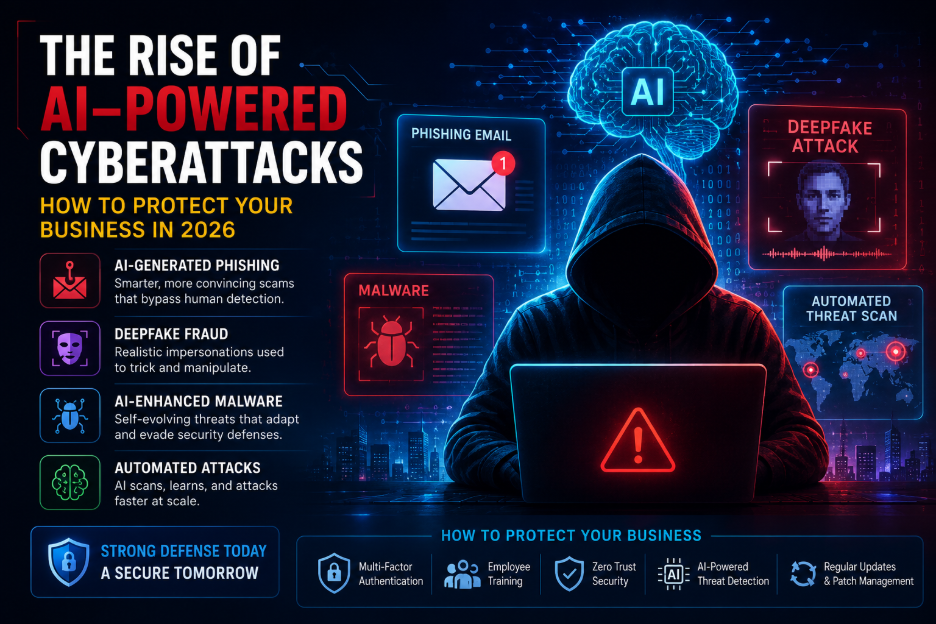
In 2026, organizations of all sizes face a new cybersecurity challenge: defending against attackers who leverage AI to automate reconnaissance, identify vulnerabilities, and evade traditional security measures. Businesses that fail to adapt their security strategies risk financial losses, operational disruptions, reputational damage, and regulatory penalties.
This article explores how AI-powered cyberattacks work, the most common threats organizations face, and the practical steps businesses can take to strengthen their cybersecurity posture.
What Are AI-Powered Cyberattacks?
AI-powered cyberattacks use machine learning algorithms, generative AI, and automation to enhance traditional hacking techniques. Instead of relying solely on manual efforts, attackers use AI to analyze massive datasets, create highly personalized scams, discover security weaknesses, and automate attacks at scale.
Unlike conventional cyberattacks, AI-driven attacks can:
- Adapt to changing environments.
- Generate convincing human-like content.
- Launch attacks much faster.
- Improve success rates through continuous learning.
- Target multiple victims simultaneously.
These capabilities make AI an attractive tool for cybercriminals seeking efficiency and greater impact.
Common Types of AI-Driven Cyber Threats
1. AI-Generated Phishing Emails
Phishing remains one of the most effective cyberattack methods. AI now enables attackers to generate grammatically correct, personalized emails that closely mimic legitimate business communications.
These emails often:
- Match a company’s writing style.
- Reference real projects or colleagues.
- Include convincing branding.
- Avoid common grammatical mistakes.
Because AI-generated phishing emails appear more authentic, they are significantly harder for employees to recognize.
2. Deepfake Scams
Deepfake technology allows attackers to create realistic audio and video impersonations of executives, employees, or trusted partners.
Common examples include:
- Fake CEO voice calls requesting urgent wire transfers.
- Video messages authorizing confidential data sharing.
- Impersonation during virtual meetings.
As deepfake technology improves, verifying identities before approving sensitive requests becomes increasingly important.
3. AI-Enhanced Malware
Traditional malware follows predefined behaviors. AI-enhanced malware can modify its tactics to avoid detection by antivirus software and endpoint security tools.
Advanced malware may:
- Change its code automatically.
- Detect virtual testing environments.
- Delay execution to bypass security scans.
- Adapt based on system defenses.
These capabilities make malware analysis and detection more challenging.
4. Automated Vulnerability Discovery
Attackers use AI to scan networks, websites, cloud environments, and applications for security weaknesses.
Instead of manually identifying vulnerabilities, AI systems can:
- Detect outdated software.
- Identify misconfigured cloud resources.
- Analyze exposed APIs.
- Prioritize high-value targets.
Automation significantly reduces the time required to prepare an attack.
5. Credential Stuffing and Password Attacks
Cybercriminals use AI to optimize password-guessing attacks using leaked credentials from previous data breaches.
AI can analyze:
- Common password patterns.
- User behavior.
- Password reuse across services.
This increases the effectiveness of credential stuffing attacks against organizations lacking multi-factor authentication (MFA).
Real-World Impact of AI-Powered Cybercrime
Organizations across finance, healthcare, retail, education, and government sectors are experiencing increasingly sophisticated attacks that combine AI with traditional hacking techniques.
Recent trends include:
- Highly targeted phishing campaigns.
- Business Email Compromise (BEC) attacks using AI-generated content.
- Deepfake fraud targeting executives.
- AI-assisted ransomware operations.
- Automated attacks against cloud infrastructure.
These incidents demonstrate that AI is becoming an integral part of modern cybercrime rather than a future possibility.
How Businesses Can Protect Themselves
Implement Multi-Factor Authentication (MFA)
Passwords alone are no longer sufficient.
MFA adds an additional verification step, making it significantly harder for attackers to gain unauthorized access—even if credentials are compromised.
Train Employees Regularly
Human error remains one of the leading causes of successful cyberattacks.
Security awareness programs should educate employees about:
- Phishing emails.
- Deepfake scams.
- Social engineering tactics.
- Safe password practices.
- Reporting suspicious activities.
Regular phishing simulations can help reinforce secure behavior.
Adopt a Zero Trust Security Model
Zero Trust follows the principle of “Never Trust, Always Verify.”
Instead of assuming users or devices inside the network are trustworthy, organizations continuously verify every access request.
Key components include:
- Identity verification.
- Least privilege access.
- Device security checks.
- Continuous monitoring.
Use AI-Powered Security Solutions
Defenders can also leverage AI to improve cybersecurity.
Modern security platforms use AI to:
- Detect unusual user behavior.
- Identify malware.
- Analyze network traffic.
- Prioritize security alerts.
- Respond to threats automatically.
AI-powered detection helps security teams respond more quickly to emerging threats.
Keep Systems Updated
Many successful attacks exploit known software vulnerabilities.
Organizations should:
- Apply security patches promptly.
- Update operating systems.
- Upgrade third-party software.
- Remove unsupported applications.
Automated patch management reduces the attack surface.
Deploy Endpoint Detection and Response (EDR)
EDR solutions continuously monitor devices for suspicious activity.
Benefits include:
- Real-time threat detection.
- Incident investigation.
- Automated containment.
- Malware analysis.
- Rapid recovery.
EDR has become a critical component of modern cybersecurity strategies.
Best Security Technologies in 2026
Businesses should consider implementing:
- AI-powered Security Information and Event Management (SIEM) platforms.
- Extended Detection and Response (XDR) solutions.
- Endpoint Detection and Response (EDR).
- Password managers.
- Identity and Access Management (IAM).
- Secure Email Gateways.
- Cloud Security Posture Management (CSPM).
- Security Awareness Training Platforms.
Combining these technologies provides layered protection against evolving cyber threats.
Future Trends in Cybersecurity
The cybersecurity landscape will continue to evolve rapidly.
Key trends include:
Defensive AI
Organizations increasingly rely on AI to detect attacks before they cause damage.
Autonomous Security Operations Centers (SOC)
AI-powered SOC platforms automate monitoring, incident response, and threat investigation.
Quantum Computing
Although still emerging, quantum computing has the potential to break traditional encryption methods, prompting organizations to explore quantum-resistant cryptography.
AI Regulation
Governments worldwide are introducing regulations to promote responsible AI development and strengthen cybersecurity requirements.
Conclusion
Artificial intelligence is reshaping both cybersecurity defense and cybercrime. While AI enables organizations to improve threat detection and automate security operations, it also equips attackers with more advanced tools to conduct phishing campaigns, deploy adaptive malware, and impersonate trusted individuals with alarming accuracy.
The key to staying secure in 2026 is adopting a proactive, layered security strategy. Businesses should combine modern technologies such as AI-powered detection, Zero Trust architecture, Multi-Factor Authentication, Endpoint Detection and Response, and continuous employee awareness training. No single solution can eliminate every threat, but a well-rounded security program significantly reduces risk.
As AI continues to evolve, cybersecurity must evolve alongside it. Organizations that invest in resilience, embrace innovation, and foster a culture of security awareness will be far better equipped to navigate the increasingly complex digital threat landscape.
