
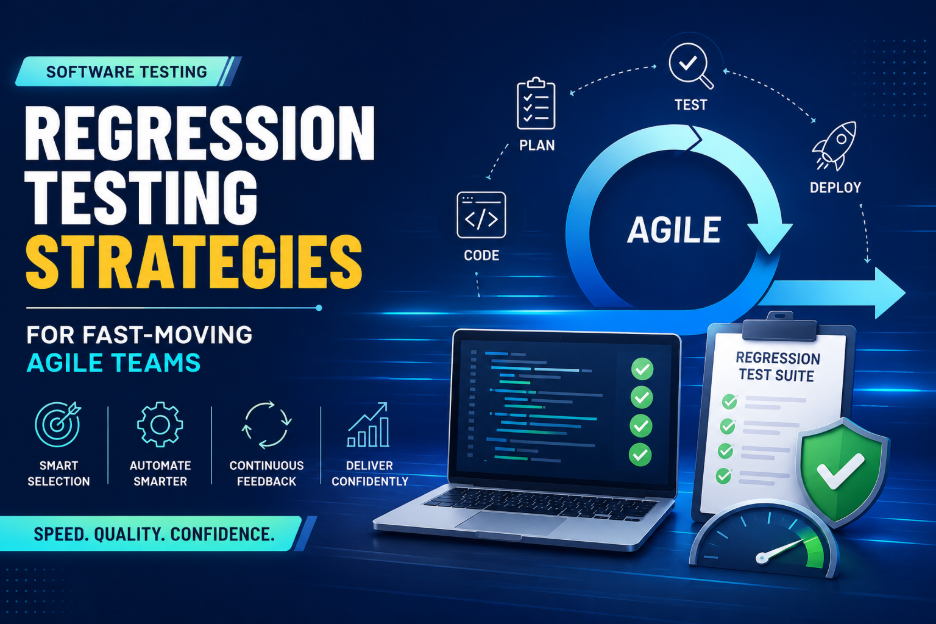
Speed is the whole game in agile development. Teams ship features every sprint, patch bugs within hours, and change direction the moment customer feedback comes in. That speed is great for business, but it comes with a hidden cost: every new change carries the risk of breaking something that already worked. This is exactly why regression testing has become one of the most important activities in modern QA, not just an item you tick off before release.
For agile teams, regression testing is not about blindly rerunning the same old test cases sprint after sprint. It is about testing smart, catching risk early, and building confidence that a release will not blow up in production. The real challenge is doing this without slowing the team down.
Here is a practical look at regression testing strategies that help agile teams stay fast and still ship quality software.
What Regression Testing Actually Means in Agile
Regression testing simply checks whether recent code changes have broken anything that used to work fine.
In older, waterfall style projects, this kind of testing happened right before release, almost as an afterthought. Agile does not have that luxury. Testing has to run continuously because:
- Features go out in short iterations, not big yearly releases
- Code changes happen almost daily
- Several teams often touch the same interconnected systems
- CI/CD pipelines push code to production far more frequently
The goal is straightforward: make sure new changes do not quietly break old functionality.
Skip this step, or do it poorly, and you end up with production defects, frustrated customers, rising support costs, delayed releases, and a team that stops trusting its own deployments.
Why Old School Regression Testing Breaks Down in Agile
A lot of teams get stuck because they try to run their entire regression suite every single sprint. That approach falls apart fast for a few reasons.
Time is limited. A regression suite with a few thousand test cases can eat up several days on its own.
Requirements move fast. By the time some test cases are written, the feature has already changed, making the tests outdated.
Manual testing does not scale. Running everything by hand burns through tester hours that could go toward more valuable work.
Environments are not always stable. Test environments go down or behave inconsistently more often than anyone would like.
Automation needs upkeep. Scripts break as the application evolves, and someone has to keep fixing them.
To actually keep up, teams need sharper regression testing strategies, not just more test cases.
1. Build Automation on Stable Ground
Automation is the backbone of any regression suite that needs to scale. Manual regression testing simply cannot keep pace once an application grows past a certain size.
Automate what rarely changes. Login, user registration, payment processing, search, and other core workflows are good starting points because they stay stable over time.
Focus on business critical paths first. Order placement, checkout, subscription management, and account handling directly affect revenue, so automating these pays off quickly.
Build reusable components. Frameworks that support shared functions and libraries cut down duplication, make maintenance easier, and speed up writing new scripts.
Stick to proven design patterns. Page Object Model, Screen Object Model, and component based design all make automation suites easier to read and maintain over time.
The real principle here: a smaller suite of tests you can trust beats a massive suite full of flaky, unreliable scripts.
2. Prioritize Tests Instead of Running Everything
Running every single test after every change is rarely realistic. Agile teams need to figure out which tests matter most and run those first.
Risk based testing means focusing on areas with high business impact, frequent changes, or a history of defects.
Change based testing means looking at what code actually changed and running the tests tied to those specific modules, which speeds up feedback and cuts wasted execution time.
Defect based prioritization means paying closer attention to components that have caused repeat issues in the past. If a module keeps generating bugs, it deserves more regression attention, not less.
Impact analysis means asking a few questions before you even start testing: which modules changed, which systems depend on them, and which user journeys could break as a result.
This kind of targeted thinking makes regression cycles far more efficient than a blanket “test everything” approach.
3. Follow the Test Automation Pyramid
Many teams pour most of their effort into UI automation and then wonder why their test runs take forever. The test automation pyramid fixes this by balancing where your tests actually live.
Unit tests sit at the base. They run fast, cost little, and catch problems early, right at the component level. Teams should have plenty of these.
API tests form the middle layer. They run faster than UI tests, validate business logic directly, and confirm that integrations behave correctly. This layer usually gives the best return on investment in a regression suite.
UI tests sit at the top. They run slower and need more upkeep, so they are best reserved for critical user journeys like login through checkout, registration, or a full purchase flow.
A healthy setup usually looks like plenty of unit tests, a solid layer of API tests, and a limited, carefully chosen set of UI tests.
4. Wire Regression Testing Into CI/CD
Regression testing should not wait until the end of a sprint. It belongs inside the CI/CD pipeline itself, running automatically with every change.
Continuous testing gives faster feedback, catches defects early, cuts down debugging time later, and builds real confidence before a release goes out.
A typical pipeline might look like this:
- Unit tests run right after every commit
- API regression checks confirm backend services are healthy
- Smoke tests validate that the core application still works
- Critical UI regression covers the major business workflows
- Full regression runs on a schedule, usually overnight or on demand
The advantage here is simple. Bugs get caught while the code is still fresh in the developer’s mind, which makes them much faster to fix.
5. Run Tests in Parallel
As an application grows, regression cycles start taking longer and longer. Parallel execution is one of the simplest ways to fix that.
Say you have 500 tests that take 10 hours to run one after another. Spread across multiple environments at once, that same suite might finish in one to two hours.
Tools like Selenium Grid, BrowserStack, LambdaTest, Playwright, and Cypress Cloud all support this kind of parallel execution, and the payoff is faster releases, broader coverage, and better use of available infrastructure.
6. Keep Your Test Suite Clean
Automation suites rot if nobody maintains them. Over time, teams end up with duplicate tests, obsolete scripts, flaky scenarios, and checks that no longer serve any real purpose.
Retire tests that no longer add value. Refactor regularly to keep scripts readable, reusable, and fast. Fix flaky tests as soon as they show up, since dynamic elements, timing issues, and unstable environments are usually the root cause. And every so often, review your coverage against actual business priorities, because priorities shift and test suites need to shift with them.
A clean regression suite runs faster, breaks less, and scales far more easily than a bloated one.
7. Learn From Production, Not Just Test Cases
Production incidents are often the best source of insight into where your testing has gaps. Agile teams that pay attention to real world usage build stronger regression coverage.
Worth reviewing regularly: customer reported defects, monitoring alerts, usage analytics, and past incident reports. Ask which features get the heaviest use, where users actually hit failures, and which workflows generate the most support tickets. Testing high traffic, high risk areas based on real data makes regression testing far more effective than testing based on guesswork alone.
8. Track the Right Metrics
You cannot improve what you do not measure. A few metrics worth watching closely:
Regression execution time, the total time a full run takes.
Defect leakage, meaning bugs that slip through to production. Lower numbers here point to stronger regression coverage.
Pass and fail rate, which reveals quality trends over time.
Automation coverage, the percentage of your regression scenarios that are actually automated.
Flaky test percentage, which tracks how much instability is creeping into the suite.
These numbers help teams spot bottlenecks, coverage gaps, and areas that need more attention, turning testing into a data driven practice instead of a guessing game.
9. Shift Testing Left
The earlier you catch a defect, the cheaper it is to fix. Shift left testing pushes quality checks earlier into the development process instead of leaving them for the end.
This includes requirement reviews, validating acceptance criteria upfront, static code analysis, solid unit testing, and early API level testing. Done well, this reduces rework, speeds up feedback, and results in stronger releases, because regression testing becomes lighter when fewer defects make it that far in the first place.
Final Thoughts
Good regression testing was never about testing everything after every single change. For agile teams, it comes down to testing the right things at the right time, backed by automation, smart prioritization, CI/CD integration, and honest risk management.
Teams that get this right see faster release cycles, fewer production incidents, stronger software quality, and far more confidence every time they hit deploy.
Regression testing works best as an ongoing quality habit, not a final gate before release. When automation, risk based testing, CI/CD, and constant refinement work together, agile teams can move fast and still ship software people can actually rely on.
Quality was never about slowing a team down. It comes from building testing systems smart enough to keep up with the business.
Frequently Asked Questions
What is regression testing in agile? Regression testing in agile is the ongoing practice of checking that new code changes have not broken existing functionality. Unlike traditional testing, it runs continuously throughout each sprint rather than only before a release.
Why is regression testing important for agile teams? It protects against unintended side effects from frequent code changes. Without it, agile teams risk production defects, unhappy customers, and lower confidence in every release.
What is the test automation pyramid? The test automation pyramid is a testing strategy with three layers: a large base of fast unit tests, a middle layer of API tests, and a smaller top layer of UI tests. It helps teams balance speed, cost, and reliability in their regression suite.
How do you decide which tests to automate first? Start with stable, business critical workflows such as login, checkout, and payment processing. These features rarely change and have a direct impact on revenue, which makes automation pay off quickly.
What causes flaky tests and how do you fix them? Flaky tests are usually caused by dynamic page elements, synchronization or timing issues, and unstable test environments. Fixing them quickly matters because flaky tests reduce trust in the entire automation suite.
How does CI/CD improve regression testing? CI/CD runs regression tests automatically with every code commit, catching defects while the code is still fresh in the developer’s mind. This shortens the time between a bug being introduced and being fixed.
