
Introduction
Building a full stack application involves much more than connecting a frontend to a backend. A successful application requires thoughtful decisions across architecture, APIs, databases, security, performance, testing, and user experience.
When developers focus only on making a feature work, they may unintentionally introduce problems that become difficult and expensive to fix later.
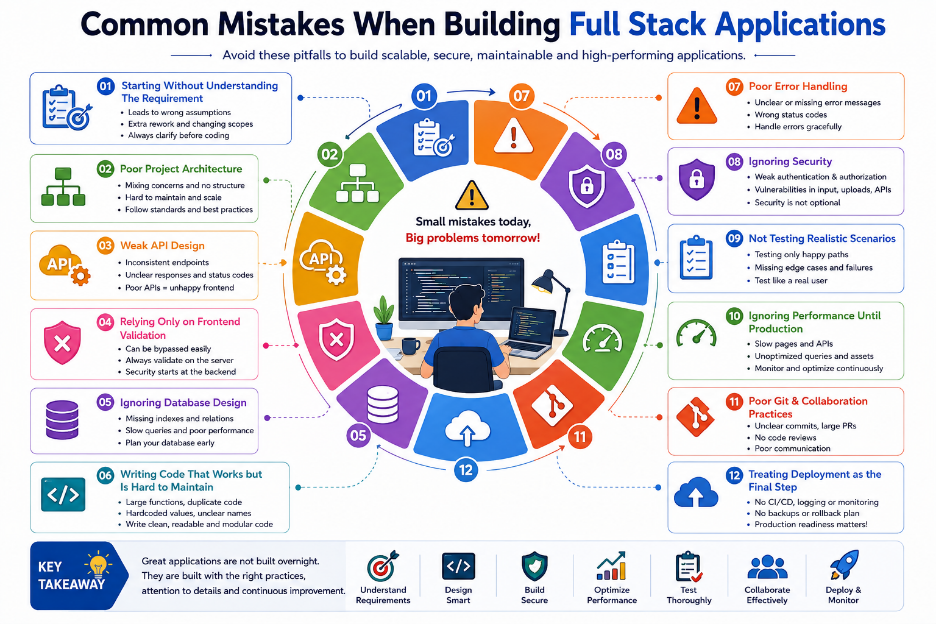
Here are some common mistakes developers should be aware of when building full stack applications.
1. Starting Development Without Understanding the Requirement
One of the most common mistakes is writing code before fully understanding the problem.
Before development begins, it is important to understand:
- Business requirements
- User expectations
- Application workflows
- Data requirements
- Possible edge cases
A clear requirement leads to a clearer implementation.
2. Poor Project Architecture
As applications grow, an unstructured codebase becomes increasingly difficult to maintain.
Common problems include:
- Mixing business logic with controllers
- Creating unnecessarily large components
- Duplicating logic
- Poor separation of responsibilities
- Inconsistent project structure
A well-organized architecture makes applications easier to understand, test, and scale.
3. Weak API Design
The API is the communication layer between the frontend and backend.
Common mistakes include:
- Inconsistent endpoint naming
- Unclear response structures
- Incorrect HTTP status codes
- Missing validation
- Poor error responses
- Lack of pagination for large datasets
Well-designed APIs make frontend integration easier and reduce future maintenance effort.
4. Relying Only on Frontend Validation
Frontend validation improves user experience, but it should never be the only layer of validation.
For example, hiding a button or validating an input in the browser does not prevent someone from directly calling the API.
The backend should independently validate:
- Request data
- User permissions
- Business rules
- File uploads
- Sensitive operations
Client-side validation improves UX. Server-side validation protects the application.
5. Ignoring Database Design
A poorly designed database can become a major performance bottleneck.
Common mistakes include:
- Missing indexes
- Unnecessary duplicate data
- Inefficient queries
- Fetching more data than required
- Ignoring relationships
- Poor transaction handling
Database design should be considered as part of application architecture, not as an afterthought.
6. Writing Code That Works but Is Difficult to Maintain
A feature may work perfectly today but become difficult to modify tomorrow.
Examples include:
- Large functions
- Hardcoded values
- Duplicate code
- Unclear variable names
- Excessive dependencies between modules
Code should not only solve today’s problem—it should also be understandable to the developer who maintains it tomorrow.
7. Poor Error Handling
Applications will encounter errors. The goal is not to eliminate every error but to handle them properly.
Good error handling should:
- Provide meaningful messages
- Return appropriate status codes
- Log useful information
- Avoid exposing sensitive details
- Give users a clear next step
A well-handled error is far better than an application that simply fails silently.
8. Ignoring Security
Security should be considered from the beginning of development.
Common areas developers need to consider include:
- Authentication
- Authorization
- Password protection
- Input validation
- Secure file handling
- SQL injection prevention
- Cross-site scripting protection
- Secure API communication
Security is not something that should be added only after the application is complete.
9. Not Testing Realistic Scenarios
Testing only the successful scenario is not enough.
Applications should also be tested for:
- Invalid input
- Missing data
- Unauthorized users
- Duplicate requests
- Large datasets
- Network failures
- Unexpected user actions
Thinking about edge cases early helps prevent production issues later.
10. Ignoring Performance Until Production
Performance should be considered throughout development.
Potential bottlenecks can occur in:
- Frontend rendering
- API response times
- Database queries
- Large file processing
- Network requests
Techniques such as caching, pagination, lazy loading, optimized queries, and efficient API design can significantly improve application performance.
11. Poor Git and Collaboration Practices
Full stack applications are usually developed by teams, which makes collaboration an important part of development.
Common mistakes include:
- Unclear commit messages
- Working directly on shared branches
- Large unreviewed changes
- Ignoring code review feedback
- Poor communication between frontend and backend teams
Good Git practices and effective communication make development more predictable and efficient.
12. Treating Deployment as the Final Step
An application is not finished when development ends.
A production-ready application also requires:
- Environment configuration
- Database migrations
- Automated testing
- CI/CD
- Logging
- Monitoring
- Backup and recovery strategies
Deployment should be considered part of the development lifecycle rather than a separate activity.
What Can We Learn From These Mistakes?
Most of these problems have something in common: they happen when developers focus only on “making the feature work.”
Professional software development requires a broader mindset:
Make it work → Make it secure → Make it testable → Make it maintainable → Make it scalable.
Final Thoughts
Building full stack applications is a continuous learning process. Every project introduces new requirements, technical challenges, and opportunities to improve.
The goal isn’t to avoid every mistake. Instead, it is to recognize potential problems early, understand their impact, and continuously improve the way we design and build software.
A strong Full Stack Developer doesn’t just ask:
“Does this feature work?”
They also ask:
“Is it secure, maintainable, testable, performant, and ready for real users?”
That mindset is what turns a working application into a production-ready application.
What is one Full Stack development mistake you’ve encountered that taught you an important lesson? Share your experience in the comments.
