
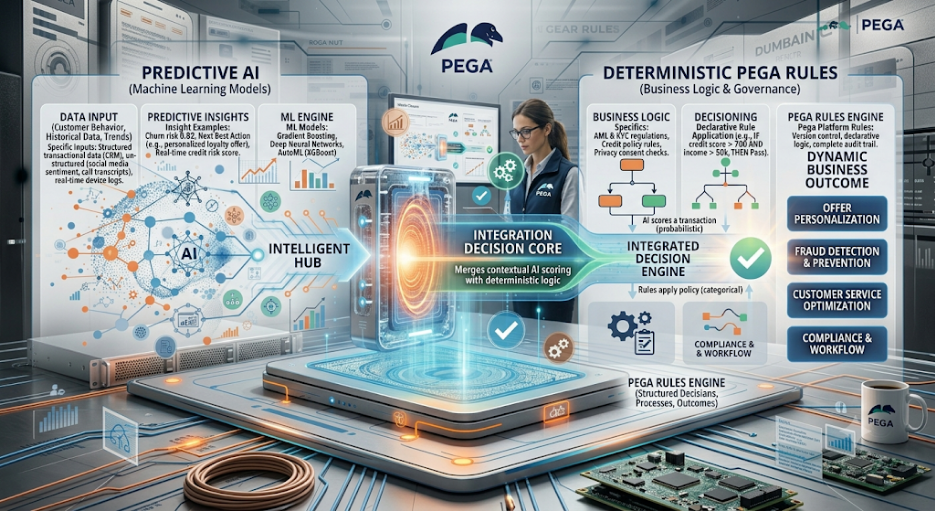
Modern enterprise applications increasingly combine artificial intelligence with traditional business rules to make decisions faster while maintaining control, consistency, and explainability. In Pega, this combination is particularly powerful because predictive AI can identify patterns and probabilities, while deterministic rules can enforce business policies and operational constraints.
Rather than replacing rules with AI, organizations can use both technologies together: AI provides an intelligent prediction, and Pega rules determine how that prediction should influence the case.
Understanding Predictive AI and Deterministic Rules
Predictive AI uses historical and behavioral data to estimate what is likely to happen. For example, a predictive model might calculate the probability that a customer will:
- Cancel a service
- Miss a payment
- Respond to an offer
- Require additional support
- Convert from a prospect to a customer
The output is generally probabilistic, such as:
Customer churn probability = 0.82
Deterministic Pega rules work differently. They apply explicitly defined conditions and actions.
For example:
IF CustomerType = “Premium”
AND AccountStatus = “Active”
THEN route the case to the Premium Support queue.
The result is predictable because the same inputs produce the same rule outcome.
The real value comes from combining these two approaches.
Why Combine AI with Pega Rules?
Predictive AI is good at answering:
“What is likely to happen?”
Deterministic rules are good at answering:
“What are we allowed or required to do?”
An enterprise application often needs both.
Consider a customer retention scenario. A predictive model determines that a customer has an 87% probability of leaving. However, the business may have additional policies:
IF ChurnProbability > 80%
AND CustomerValue = “High”
AND AccountStatus = “Active”
THEN create a retention case.
The AI identifies the risk, while the Pega rule controls the operational response.
A Hybrid Decision Architecture
A practical architecture can be divided into several layers:
Customer / Case Data
|
v
Predictive AI Model
|
v
Prediction / Probability
|
v
Pega Decision Logic
|
+—————-+
| |
v v
Business Rules Policy Constraints
| |
+——–+——-+
|
v
Final Decision
|
v
Case / Workflow Action
This separation allows each technology to perform the type of work it is best suited for.
Using AI as an Input to Pega Decision Logic
One common pattern is to treat the prediction as another decision input.
Suppose a predictive model returns:
ChurnProbability = 0.91
Pega can combine that value with customer and case information:
ChurnProbability > 0.80
CustomerSegment = “Premium”
OutstandingBalance = 0
The deterministic decision logic can then determine the appropriate treatment.
For example:
| AI Prediction | Customer Segment | Business Condition | Action |
| Low | Standard | Eligible | Standard communication |
| Medium | Standard | Eligible | Retention offer |
| High | Premium | Eligible | Specialist intervention |
| High | Any | Account restricted | Follow policy-specific process |
The AI does not directly control the business process. Instead, its prediction becomes an input into controlled decision logic.
Combining Predictive Analytics with Decision Tables
Pega Decision Tables are particularly useful for implementing this pattern.
A predictive model can produce a probability or classification, while the Decision Table translates that result into a business outcome.
For example:
Input:
ChurnProbability
CustomerSegment
AccountStatus
Decision:
Treatment
A conceptual decision table could contain conditions such as:
ChurnProbability > 0.80
CustomerSegment = Premium
AccountStatus = Active
|
v
Treatment = Specialist Retention
Business users can modify the deterministic decision logic without retraining the predictive model.
This creates a useful separation between model behavior and business policy.
Using Thresholds Carefully
One of the simplest ways to combine predictive AI with deterministic rules is through thresholds.
For example:
Probability < 0.30
→ Low risk
0.30 <= Probability < 0.70
→ Medium risk
Probability >= 0.70
→ High risk
Pega can then use these classifications to control workflow.
However, thresholds should not automatically be treated as universal values. The appropriate threshold depends on factors such as business cost, false-positive impact, false-negative impact, regulatory requirements, and operational capacity.
For example, automatically escalating every prediction above 50% could generate too many cases for a support team.
AI Should Not Automatically Override Business Policy
A key principle in hybrid decisioning is:
A prediction is not necessarily a business decision.
Suppose AI predicts that a customer is highly likely to accept an offer. A deterministic rule might still prevent the offer because:
- The customer is not eligible.
- The product is unavailable in the customer’s region.
- A mandatory waiting period has not expired.
- The account has a restriction.
- A regulatory policy applies.
The AI prediction can therefore be considered alongside mandatory rules rather than overriding them.
Separating Prediction from Action
A robust implementation separates the stages:
Stage 1: Collect Data
Retrieve the information required by the predictive model.
Customer history
Transaction behavior
Interaction history
Case information
Product information
Stage 2: Generate Prediction
The predictive service produces an output.
RiskScore = 0.86
Stage 3: Apply Deterministic Logic
Pega evaluates the prediction against business conditions.
RiskScore > 0.80
AND CustomerEligible = true
AND NoRestriction = true
Stage 4: Execute the Decision
The application performs a controlled action.
Create Retention Case
This separation makes the solution easier to test and maintain.
Handling Explainability
Predictive models can be difficult to interpret compared with traditional rules.
A deterministic rule can be explained directly:
Customer has Premium status
+
Churn score exceeds threshold
=
Route to Premium Retention
For AI-driven decisions, organizations may also need information about:
- Prediction score
- Model version
- Input data used
- Timestamp
- Decision threshold
- Final rule outcome
This information can support operational troubleshooting, auditing, and model governance.
Model Versioning and Rule Versioning
AI models and business rules evolve independently.
For example:
Predictive Model v4
+
Retention Rules v7
=
Current Decision Strategy
A new model version might produce different probability distributions even though the Pega rules have not changed.
Conversely, the business may change its retention policy while continuing to use the same predictive model.
Keeping these components logically separate makes changes easier to manage.
Using Pega Workflow to Operationalize AI
The real advantage of combining AI with Pega is not simply generating predictions. It is turning those predictions into controlled business processes.
For example:
Prediction
↓
Decision
↓
Case Creation
↓
Assignment
↓
Human Review
↓
Customer Action
↓
Outcome
Pega can coordinate the workflow after the prediction has been generated.
This enables organizations to use AI while retaining human involvement where appropriate.
Human-in-the-Loop Decisioning
Some predictions should not immediately trigger irreversible actions.
For example:
AI Risk Score = 0.94
↓
Pega Rule
↓
High-risk classification
↓
Manual Review
↓
Authorized Decision
This pattern is useful when a decision has significant customer, financial, compliance, or operational consequences.
The AI provides decision support, while a human or deterministic policy controls the final action.
Managing Conflicts Between AI and Rules
A hybrid architecture should explicitly define what happens when the prediction conflicts with a business rule.
Consider:
AI Prediction:
Customer likely to qualify
Business Rule:
Customer is not eligible
The deterministic eligibility rule should prevent the action.
A useful design principle is to distinguish between:
Predictive signals
and
Mandatory constraints
This prevents a high AI score from unintentionally bypassing policies.
Example: Loan Application
Consider a loan application process.
A predictive model calculates:
DefaultRisk = 0.18
Pega then evaluates deterministic rules:
CreditScore >= MinimumCreditScore
EmploymentVerified = true
DocumentsComplete = true
LoanAmount <= ProductLimit
The final decision could be:
AI Prediction
+
Eligibility Rules
+
Product Policy
|
v
Final Loan Treatment
The predictive model contributes risk information, while Pega enforces eligibility and product policies.
Example: Customer Service
A customer contacts a service center about a recurring issue.
The predictive model calculates:
EscalationProbability = 0.88
Pega evaluates:
EscalationProbability > 0.80
AND IssueSeverity = High
AND CustomerTier = Premium
The case can then be routed to a specialized support team.
The important point is that the predictive score does not independently determine the routing. It participates in a broader decision.
Monitoring the Combined System
Hybrid AI and rules-based systems should be monitored at multiple levels.
AI Performance
Track:
- Prediction accuracy
- Model drift
- False positives
- False negatives
- Prediction distribution
Rule Performance
Track:
- Rule execution
- Decision outcomes
- Exception rates
- Policy changes
- Override frequency
Business Performance
Track:
- Case resolution
- Customer outcomes
- Operational workload
- Conversion rates
- Escalation rates
Monitoring both layers helps determine whether a problem originates from the predictive model, deterministic logic, data, or workflow.
Designing for Failure
External AI services can become unavailable or return unexpected results.
A production implementation should define a fallback strategy.
For example:
AI Available?
|
+– Yes → Generate prediction → Apply Pega rules
|
+– No → Apply deterministic fallback rules
This prevents the entire business process from becoming dependent on an external prediction service.
The fallback behavior should be explicitly designed rather than relying on accidental system behavior.
Common Anti-Patterns
Treating AI as the Final Decision Maker
A prediction should not automatically become a business action when mandatory policies still need to be evaluated.
Hard-Coding Business Policies into the Model
Embedding changing business policies directly into a predictive model can make governance and maintenance difficult.
Ignoring Model Drift
A model that performed well during training may behave differently when customer behavior or source data changes.
Using Too Many Thresholds
Adding numerous arbitrary thresholds can make decision logic difficult to understand and maintain.
Skipping Auditability
For important decisions, retaining the prediction, model version, relevant inputs, and final rule outcome can be important for investigation and governance.
Best Practices
A strong Pega implementation should consider the following principles:
- Use predictive AI for probability and pattern recognition.
- Use deterministic rules for mandatory business policies.
- Keep AI models and business rules independently maintainable.
- Treat predictions as decision inputs rather than automatic commands.
- Define clear thresholds and document their purpose.
- Provide deterministic fallback behavior when AI services are unavailable.
- Capture sufficient decision information for auditing and troubleshooting.
- Use human review for decisions that require additional judgment or authorization.
- Monitor both model performance and business-rule outcomes.
- Continuously review whether predictions are improving the intended business outcome.
Conclusion
Combining predictive AI with deterministic Pega rules creates a hybrid decision architecture that brings together probabilistic intelligence and controlled business logic.
Predictive AI can recognize patterns, estimate risk, and provide forward-looking signals. Pega rules can apply eligibility requirements, policies, thresholds, routing conditions, and operational constraints.
The strongest architecture does not treat AI and deterministic rules as competing approaches. Instead, it gives each technology a clearly defined responsibility:
Predictive AI
“What is likely to happen?”
↓
Pega Decision Logic
“What should happen under our policies?”
↓
Pega Workflow
“How should the organization execute it?”
This approach allows organizations to introduce AI into enterprise decisioning while preserving the consistency, governance, maintainability, and operational control expected from business applications.
