
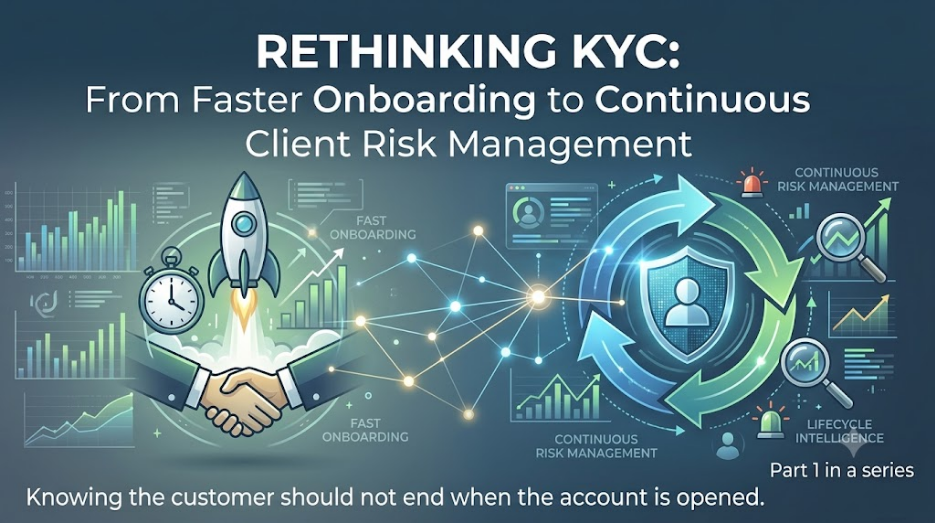
For more than a decade, Client Lifecycle Management (CLM) and Know Your Customer (KYC) have largely been approached as a speed and efficiency challenge.
The objectives were clear: reduce onboarding cycle times, eliminate manual work, simplify account opening, and prevent clients from abandoning a lengthy process in favor of a competitor with a smoother digital experience.
That focus was understandable. Onboarding is where a client relationship begins, and faster onboarding can accelerate time-to-revenue while improving the overall client experience.
But there is a limitation to this model: onboarding is only the beginning of the client lifecycle.
From onboarding optimization to lifecycle intelligence
As AI adoption has expanded, many organizations have applied AI to the existing onboarding and periodic-review model. Models can help analysts process information faster, identify relevant data, and clear cases more efficiently.
However, accelerating an existing workflow does not necessarily change the underlying operating model.
The same organizational silos, manual handoffs, fragmented systems, and periodic review cycles can remain in place. The process simply executes faster.
This raises a more fundamental question:
What does it really mean to know a customer throughout the entire relationship?
The answer becomes clearer when looking beyond onboarding.
A customer’s risk profile does not remain static after an account is opened. Ownership structures can change. Transaction patterns can evolve. Previously dormant entities can become active. Business relationships can change. New information can emerge that materially affects the original risk assessment.
Onboarding captures a point in time.
Client risk evolves continuously.
The real challenge: making decisions continuously
The regulatory and business challenge therefore extends beyond collecting information at onboarding.
The more important question becomes:
How can organizations make, govern, and evidence client-risk decisions consistently throughout a lifecycle that continuously changes?
This shifts CLM and KYC from being processes that simply need optimization into becoming an enterprise control framework for continuous client-risk decisioning.
Such a framework needs to connect several capabilities:
- Client onboarding and identification
- Customer and beneficial-owner data
- Risk assessment
- Ongoing monitoring
- Periodic and event-driven reviews
- Changes in ownership and organizational structure
- Transaction and behavioral signals
- Case management and investigations
- Decision governance
- Auditability and evidence
The objective is not simply to collect more data.
The objective is to ensure that relevant information can trigger the right decision, at the right time, with an explainable and auditable rationale.
Knowing the customer is business fundamentals
KYC is often positioned primarily as a regulatory requirement. But the underlying business question is broader:
Should an organization do business with this client, and under what conditions?
That decision influences onboarding, pricing, products, services, exposure, risk appetite, and the ongoing relationship.
From this perspective, compliance-grade KYC is not an isolated activity running alongside the business. It is one component of a broader mechanism for understanding and managing client relationships.
This distinction changes what organizations should optimize.
If KYC is treated primarily as a cost center, the natural objective is to reduce processing costs and shorten queues.
If KYC is treated as a continuous business decision capability, the objective becomes different:
- Make risk decisions more accurate.
- Make them faster when appropriate.
- Keep client information current.
- Detect meaningful changes earlier.
- Apply policies consistently.
- Maintain an evidence trail for decisions.
- Reassess risk when circumstances change.
The first approach makes the existing process faster.
The second approach redefines the process around continuous client knowledge and decision-making.
The next evolution of CLM and KYC
The future of CLM is therefore not simply about building a faster onboarding experience.
It is about creating an architecture in which client intelligence, risk signals, policies, decisions, workflows, and evidence operate continuously throughout the relationship.
AI can play an important role in that architecture, but the goal should not be AI for faster case processing alone.
The larger opportunity is to use technology to create a more continuous, contextual, governed, and explainable approach to client-risk management.
Because knowing the customer should not end when the account is opened.
It should continue for as long as the relationship exists.
