
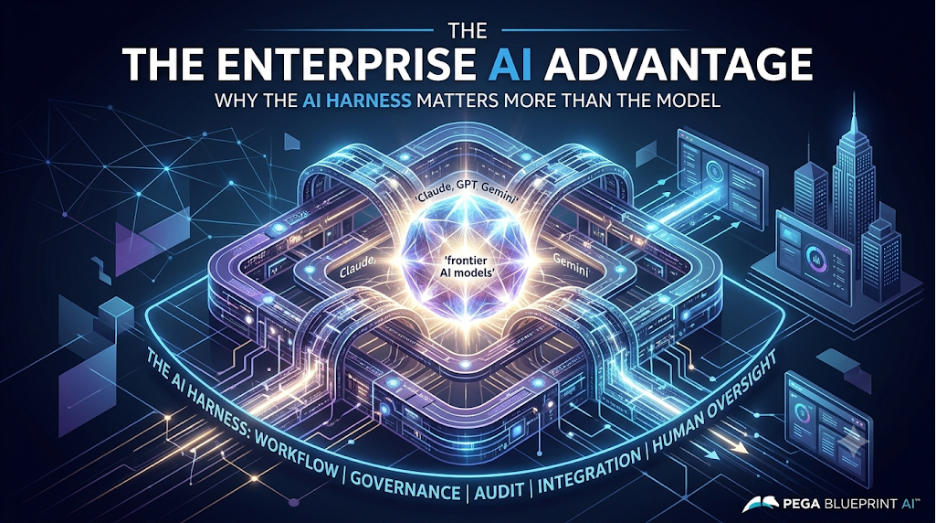
Every enterprise can now access powerful AI models such as Claude, GPT, and Gemini. These models continue to improve. However, they are also becoming widely available.
As more companies use the same models, the model itself may no longer provide a lasting competitive advantage.
The real advantage comes from what businesses build around the model.
This includes the architecture that decides when AI should run. It also controls what information AI can access and which decisions it can influence. In addition, it checks AI output before that output affects the business.
This structure is often called an AI harness.
Pega Blueprint AI™ uses this idea to help organizations add AI to business workflows in a structured and controlled way.
The Two Common Ways Enterprises Get AI Wrong
As companies adopt generative AI and AI agents, two common approaches can create problems.
1. Relying on AI-Generated Code for Everything
Generative AI can speed up software development. However, more code does not always mean a better system.
AI can generate large amounts of code in a short time. Yet, this code can make business logic harder to understand and manage.
Over time, teams may need to maintain large amounts of AI-generated logic. This can make testing, updates, and governance more difficult.
The core problem remains the same. Businesses still need to understand how their systems work.
Therefore, the goal should not be to generate as much code as possible.
Instead, companies should build processes that keep business logic clear, visible, and easy to manage.
2. Giving AI Agents Complete Runtime Control
Another approach gives AI agents control over large parts of a business process.
AI agents can perform complex tasks. However, unrestricted control can create unpredictable results.
Different inputs may lead an agent down different paths. As a result, teams may find it harder to reproduce or explain a decision.
Organizations may then depend on monitoring tools to detect problems after they happen.
This approach can also increase AI usage. A model may spend time reasoning through tasks that simple business rules could handle.
Therefore, businesses need to decide where AI adds real value before giving it control.
Why Governance Cannot Be an Afterthought
Many AI governance strategies focus on monitoring systems after deployment.
For example, a kill switch can stop an AI system after unexpected behavior occurs. A control tower can also help teams monitor activity during runtime.
These tools remain useful. However, they mainly react to problems.
A stronger approach places governance inside the workflow from the start.
Pega Blueprint AI follows this approach. It allows teams to design workflows that define where AI should operate and where traditional business rules should take control.
The workflow can also define when a person must review a decision.
This approach makes governance part of the process itself.
It can also improve auditability and traceability. Teams can see how a process works and understand where each decision takes place.
When AI cannot safely handle a decision, the workflow can route the case to a human.
As a result, business teams, technical teams, and regulators can gain a clearer view of how decisions happen.
What an AI Harness Actually Does
An AI harness does not replace an entire business process with an autonomous AI agent.
Instead, it creates a structure around AI.
Pega Blueprint AI can use large language models such as Claude, GPT, and Gemini for specific reasoning tasks. At the same time, the workflow keeps those models within defined boundaries.
This distinction matters.
AI works well when a task requires interpretation, reasoning, research, summarization, or document creation.
On the other hand, deterministic rules work well when a task must produce the same result every time.
For example, consider a customer service process.
The workflow could use AI to understand an unstructured customer request. Next, deterministic rules could validate the information.
The process could then use AI to summarize supporting details. Finally, the workflow could send the case to a human when the situation requires judgment.
This design uses AI where it provides value. It does not give AI control over the entire process.
Deterministic Workflows and Selective AI
Many enterprise tasks follow clear and repeatable rules.
Examples include:
- Data validation
- Calculations
- Routing decisions
- Compliance checks
- Approvals
- System updates
These tasks often need consistent results.
Replacing them with AI could introduce unnecessary variation.
A better approach is to keep deterministic steps where they make sense. Then, organizations can add AI to tasks that need reasoning or interpretation.
For example, an AI agent can receive and interpret unstructured information. It can also research information, summarize a case, or create a document.
The workflow can then control the next steps.
Business rules can manage validation, approvals, and system updates. This creates a clear separation between AI-driven reasoning and deterministic business execution.
It also limits each AI interaction to a specific task.
This limited scope can reduce context drift and unnecessary reasoning. More importantly, it gives organizations greater control over how AI affects the overall process.
Design-Time Intelligence and Runtime Discipline
Another important distinction exists between design-time intelligence and runtime discipline.
At design time, AI can help teams rethink how work should happen.
Teams can identify where AI adds value. They can also decide where business rules work better and where people need to remain involved.
The resulting workflow becomes the structure that controls execution.
At runtime, that workflow sets clear boundaries for AI.
The system calls AI only when a specific task needs it. AI does not need to improvise the entire business process.
This approach can make outcomes more predictable.
Most of the process can continue to follow clear business rules. At the same time, AI can handle tasks that require interpretation or judgment.
The Cost Dimension of Enterprise AI
Cost has become another important part of the enterprise AI discussion.
As AI adoption grows, companies are paying closer attention to token use and reasoning costs.
A model can consume significant resources while processing a request. These costs can grow when organizations use AI for tasks that do not require it.
This raises an important question:
Should businesses use AI for every decision simply because they can?
The answer is no.
If deterministic business logic can complete a task reliably and efficiently, there may be little reason to send that task to an AI model.
Instead, organizations should use AI where it creates meaningful business value.
Workflow design plays an important role here.
By controlling when AI runs, companies can make AI usage more predictable. They can also avoid unnecessary model calls.
The principle is simple:
AI cost should connect to business value, not simply to the amount of model reasoning.
Why the AI Harness Matters Now
Frontier models such as Claude, GPT, and Gemini will continue to improve.
Their reasoning abilities will become more advanced. New models will also continue to enter the market.
However, the core enterprise challenge will remain.
Businesses still need workflows that are:
- Transparent
- Auditable
- Governed
- Understandable
- Flexible
- Easy to change
Therefore, the key question is no longer just:
Which AI model should the enterprise use?
A more important question is:
What architecture should stand between the AI model and the business decision?
A powerful model provides intelligence. However, it does not automatically provide governance, accountability, process structure, or predictable execution.
An AI harness provides that structure.
It determines where AI belongs and what information it can access. It also defines which tasks AI should perform and when deterministic rules should take over.
Most importantly, it can define when a human should make the final decision.
Conclusion
Enterprise AI is moving beyond the question of which model is the most capable.
As frontier models become easier to access, businesses will need to focus more on how they use those models.
The goal is not to make every workflow autonomous.
Instead, businesses should create workflows where AI, deterministic automation, governance, and human judgment work together within a controlled architecture.
Pega Blueprint AI represents this approach. It helps organizations design workflows visually and add AI where it provides real value.
It also supports governance within the workflow itself.
This structure can remain clear and adaptable as business needs, technology, and AI models change.
The future of enterprise AI is not only about building more powerful models.
It is about building better systems around those models.
Those systems can turn AI capabilities into reliable, governed, and actionable business outcomes.
